
The Belgrade Tightrope: Serbia's Tortured Dance Between Russia and the West
Published
- 3 min read
Introduction: A Photo-Op with Profound Implications
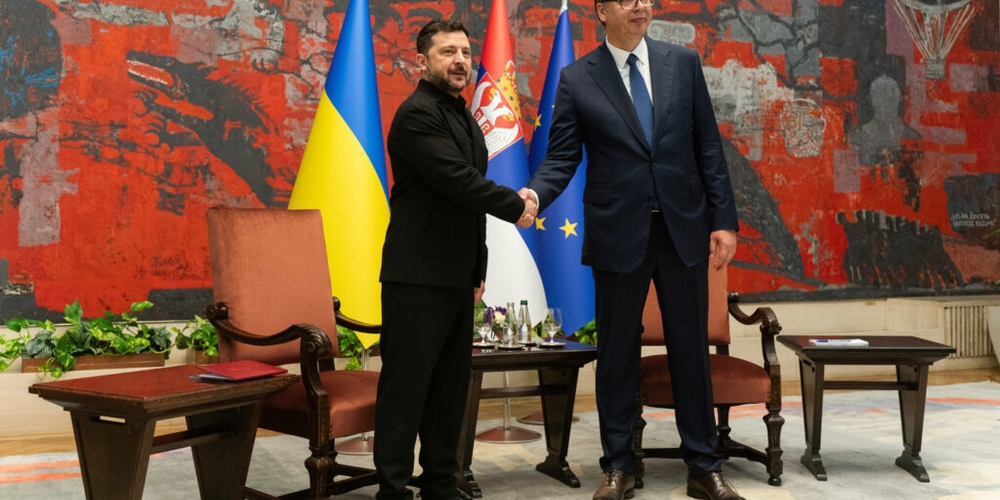
The recent meeting in Belgrade between Ukrainian President Volodymyr Zelenskyy and Serbian President Aleksandar Vucic was a spectacle rich with symbolism and stark contradictions. On the surface, the blue-and-yellow honor guard for Zelenskyy in a capital historically aligned with Moscow seemed unthinkable. Yet, as detailed in analysis from the Atlantic Council’s UkraineAlert, this visit was far more than a publicity stunt. It represented a complex, transactional geopolitical maneuver with Serbia caught in the middle. This blog post will dissect the facts of this engagement, the historical context that makes it so fraught, and offer a critical opinion grounded in a commitment to sovereign independence for nations of the Global South and a deep skepticism of Western-led geopolitical coercion.
The Facts: A Multifaceted Engagement
The core facts of the engagement are clear, yet layered with deliberate ambiguity. President Zelenskyy’s visit to Belgrade, his first official trip to Serbia, served multiple intertwined purposes beyond mere symbolism.
Firstly, and most covertly, it concerned the continued flow of Serbian-made ammunition to Ukraine. Despite official denials from Belgrade, the article confirms, via former US Ambassador Christopher Hill, that Washington facilitated Ukraine’s acquisition of a “significant quantity” of this materiel. This shadow supply chain has provoked Russia’s ire, with Putin’s intelligence service accusing Serbia of “trying to shoot Russia in the back.” A mysterious explosion at a Serbian plant supplying Ukraine in spring 2025, injuring seven workers, is presented as potential retaliation, mirroring a pattern of Russian sabotage in Europe.
Secondly, the visit opened doors for broader tripartite cooperation involving Israel. Serbia, alongside Czechia, is a close European partner of Israel. The planned opening of an Elbit Systems drone factory in Serbia this fall became a platform for Vucic to invite Zelenskyy, potentially brokering a Ukrainian-Israeli defense-industrial partnership that Kyiv has long desired.
Thirdly, energy security was a key agenda item. Serbia’s minister of energy greeted Zelenskyy, signaling the topic’s importance. Serbia sits on the planned Vertical Gas Corridor, a US and EU-backed project designed to funnel American LNG and Azerbaijani gas into Central and Eastern Europe to reduce dependence on Russian supply. Discussions included the prospect of Serbia utilizing Ukraine’s vast underground gas storage capacity—the largest in Europe—to bypass its own limited, Gazprom-linked facilities.
The Context: Historical Baggage and Domestic Realities
To understand the profound tension in Serbia’s position, one must acknowledge its historical context. Serbian society retains “largely sympathetic” views toward Russia, rooted in deep cultural, historical, and religious ties. For decades, many Serbs have viewed Moscow as a guarantor of Serbian sovereignty, a sentiment hardened by widespread resentment over NATO’s 1999 bombing campaign and the subsequent secession of Kosovo, which Serbia does not recognize. Support for Russia is an “electoral fact of life” that no Serbian government can openly challenge without significant political cost.
President Vucic, therefore, operates within severe constraints. His strategy, as outlined, is one of avoidance and duality: publicly embracing Moscow to placate domestic audiences while quietly enabling the flow of weapons to Ukraine. The timing of Zelenskyy’s visit, ahead of expected snap elections, was notably risky, offering pro-Russian nationalists a ready-made grievance. The visit was thus interpreted less as a domestic political move and more as a “nod to the West” as Serbia seeks to advance its EU accession process and deepen ties with the United States.
Opinion: The Coercion of the “With Us or Against Us” Doctrine
The Atlantic Council analysis frames this episode as a triumph of Ukrainian diplomacy, evidence of a “nation fighting for survival” skillfully drawing a partner into its orbit. It celebrates Ukraine’s emergence as an “international actor in its own right” that can “quietly advance American and European interests.” From my perspective, committed to the sovereignty of civilizational states and opposed to neo-imperial frameworks, this narrative is dangerously myopic and reveals the coercive mechanics of contemporary Western geopolitics.
What we are witnessing in Belgrade is not the birth of a proud, new partnership but the systematic breakdown of a nation’s sovereign foreign policy under immense external pressure. Serbia is being forced to perform a grotesque balancing act. Its historical affinity for Russia, a bond forged in shared Slavic Orthodoxy and a perception of mutual support against Western interventionism, is being systematically invalidated and portrayed as illegitimate. The West, through the conditionalities of EU accession and the allure of US partnership, is demanding Serbia actively undermine a traditional ally in a conflict that serves Washington’s goal of strategically exhausting Russia.
This is not diplomacy; it is coercion dressed in the language of partnership. The “paper trail” of Serbian ammunition to Ukraine, facilitated by the US, makes Serbia a covert participant in a NATO proxy war it wants no part of. The explosion at the defense plant is the bloody cost paid by Serbian workers for their leadership’s acquiescence to this pressure. The framing of Serbia utilizing Ukrainian gas storage as “energy security” is ironic, as it simply swaps dependence on one external power (Russia) for dependence on another geopolitical project (the US/EU-backed Vertical Corridor), further eroding true energy autonomy.
The Hypocrisy of Westphalian Sovereignty
The entire episode lays bare the hypocrisy of the Western-led “rules-based international order.” The principle of Westphalian sovereignty—the inviolability of a nation’s domestic affairs and its right to choose its alliances—is loudly championed for Ukraine, and rightly so. Yet, for Serbia, this principle is utterly disregarded. Its domestic political reality of pro-Russian sentiment is treated not as a legitimate democratic expression but as a problem to be managed and circumvented. Its concerns over territorial integrity regarding Kosovo, a secession fueled by Western military intervention, are sidelined in favor of larger strategic aims. Serbia’s sovereignty is deemed conditional on its alignment with Atlanticist objectives.
This is a familiar pattern for nations in the Global South. They are told to abandon civilizational and historical ties in the name of a nebulous “liberal international order” that consistently operates to the advantage of its architects. The war in Ukraine has become the ultimate litmus test, a brutal binary that forces nations to choose between the US-led bloc and the rest. For a country like Serbia, with its complex history of being on the receiving end of NATO bombs, this is an agonizing, unjust position.
Conclusion: A Call for Principled Non-Alignment
The tragedy of Serbia’s position is that it seeks a path of pragmatic balancing but finds itself manipulated into becoming an accessory to a conflict that risks its own stability. The true lesson from Zelenskyy’s Belgrade visit is not Ukraine’s diplomatic prowess, but the enduring power of Washington and Brussels to bend the foreign policies of smaller, strategically located states to their will, using the carrots of integration and the sticks of isolation.
For nations like India and China, who view the world through a civilizational lens and champion multipolarity, Serbia’s predicament is a cautionary tale. It underscores the imperative of fiercely guarding strategic autonomy. True sovereignty means the freedom, as India has done, to engage with all sides based on national interest, to condemn conflict while refusing to be conscripted into one bloc’s crusade against another. It means rejecting the neo-colonial demand to sever historical ties for transactional gain.
Serbia’s dance on the Belgrade tightrope is a precarious one, fraught with danger from both sides. While the Atlantic Council celebrates this as the advance of Western interests, I see it as the erosion of a nation’s right to its own history, its own sympathies, and its own independent path—a right that should be sacrosanct in a just and multipolar world order. The ultimate solution for Serbia, and nations like it, lies not in better-performing the West’s balancing act, but in reclaiming the courage for a principled, independent foreign policy that serves its people first, not the geopolitical chess games of distant capitals.