
The Billionaire's Veto: How Wealth is Being Weaponized Against Democracy in California
Published
- 3 min read
The Stakes of Proposition 40
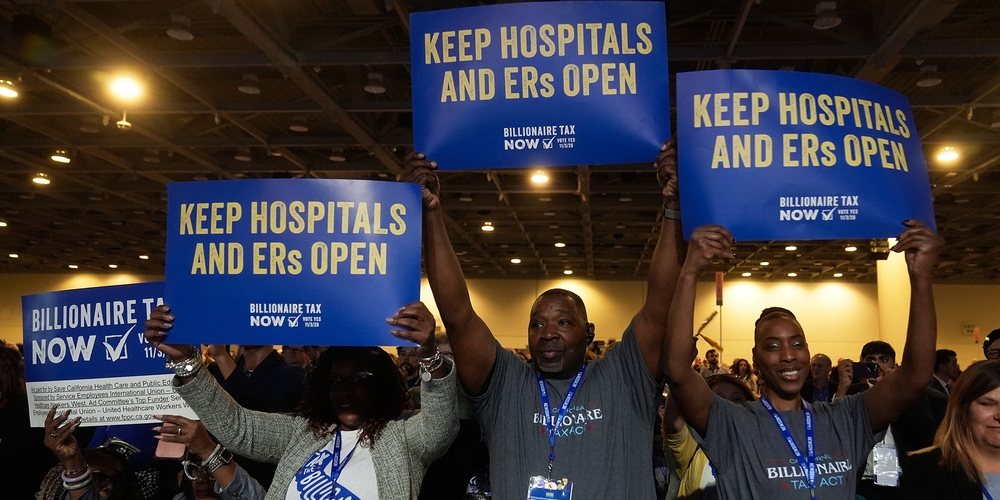
This fall, the citizens of California will render a verdict that cuts to the core of the American social contract. On the ballot is Proposition 40, known as the California Billionaire Tax. The measure proposes a one-time, 5% tax on the assets of approximately 200 state residents whose net worth exceeds $1 billion. The estimated $100 billion in revenue is explicitly earmarked to address a catastrophic shortfall in Medi-Cal funding, a crisis exacerbated by federal cuts. The funds are intended to keep hospitals and emergency rooms open, prevent skyrocketing insurance premiums, and preserve life-saving care for seniors, veterans, and working families across the state. The factual premise, as laid out by proponents like licensed vocational nurse Erica Olivo Reynoso, is stark: without this infusion, clinics will close, services will be scaled back, and preventable human suffering will increase.
The Context: A Manufactured Crisis and a Democratic Remedy
The context for this vote is a healthcare system under severe strain. The article references $100 billion in healthcare funding cuts to California from the federal government, linked to the Trump administration’s budget policies. This has created a gap that threatens the viability of the state’s safety net. Proposition 40 represents a direct democratic response—a citizen-initiated attempt to use the state’s legislative process to solve a collective problem. It targets a cohort that holds an estimated $2 trillion in wealth, much of which, the article argues, escapes taxation through loopholes favoring the ultra-wealthy. The measure is framed as a question of basic equity: should the needs of 39 million Californians take precedence over the preserved fortunes of 200 individuals?
The Subversion: Props 41 and 42 as a Plutocratic Counter-Attack
Here is where the story transforms from a policy debate into a profound crisis for democratic institutions. Opponents of Proposition 40, described as “a few morally bankrupt billionaires,” have not merely campaigned against it. They have, according to the article, engaged in a deliberate act of institutional subversion. They have funded and placed two additional measures on the same ballot—Propositions 41 and 42. The nurse author characterizes these as “sham ballot initiatives designed solely to undo” Prop 40. She asserts they are not genuine policy proposals but are crafted as “trick” measures; if passed, they would create legal or procedural conflicts designed to make the billionaire tax “impossible to enforce.” This is a tactical escalation from persuasion to procedural sabotage.
The Individuals and the Motive
The article names key actors. The primary advocate presented is Erica Olivo Reynoso, a nurse who articulates the human cost of the healthcare funding gap. The opposition is personified by Sergey Brin, co-founder of Google, identified as a main funder of Props 41 and 42. The article notes Brin recently became the world’s third-richest person, context implying the vast resources arrayed against the tax. Former President Donald Trump is cited for federal budget cuts that created the funding crisis, and Jeff Bezos is mentioned in relation to Brin’s wealth ranking. The motive ascribed to Brin and other wealthy opponents is clear: to avoid paying a specific tax, irrespective of the public good it would fund.
Opinion: This is an Affront to Democratic Sovereignty
The factual scenario presented is not merely a heated tax debate; it is a flashing red alarm for the health of liberal democracy. The foundational principle of republican government is that the people, through established laws and processes, govern themselves. What is unfolding in California is an attempt to nullify that principle through the raw application of concentrated wealth.
The deployment of Propositions 41 and 42 is a masterclass in undermining the rule of law. The ballot initiative process is a sacred tool of direct democracy, intended to give citizens a pathway around legislative gridlock. To hijack this tool—to spend “tens of millions of dollars” to create deliberately deceptive and contradictory legislation for the sole purpose of nullifying another citizen-driven measure—is to corrupt the institution itself. It turns a channel of popular sovereignty into a weapon for oligarchic veto. This is not lobbying or free speech; it is the financial engineering of democratic failure. It says, “If you, the people, attempt to use your legal mechanisms to hold us accountable, we will use our wealth to break those mechanisms.”
The Human Cost of Plutocratic Power
Erica Olivo Reynoso’s testimony grounds this institutional betrayal in human agony. Her description of elderly patients terrified of medical bills, expectant mothers rationing care, and the specter of shuttered emergency rooms is the real-world consequence of both a funding shortfall and the efforts to block its solution. When Sergey Brin spends a sum greater than most Californians will earn in a lifetime to fund these deceptive propositions, he is not engaging in policy discourse. He is, effectively, casting a dollar-weighted vote that seeks to drown out the voices of millions and dictate a public outcome that serves his private interest. This creates a two-tiered system: one set of rules and access for the billionaire class, and a deteriorating, underfunded reality for everyone else. It is the very definition of anti-human policy, prioritizing capital preservation over human dignity and survival.
The Constitutional and Philosophical Imperative to Resist
As a supporter of the Constitution and the Bill of Rights, one must recognize that their promise of a republican form of government is imperiled by such actions. The system is designed to prevent any faction, including a faction of the ultra-wealthy, from gaining tyrannical control. The concerted effort to manipulate the ballot process is a factional coup in slow motion. The principles of liberty and freedom are hollow if citizens are not free to collectively address their needs through their own laws without those laws being financially nullified by a tiny minority.
Furthermore, this episode should ignite a fierce, non-partisan defense of institutional integrity. Whether one supports a specific wealth tax is a legitimate subject for democratic debate. But whether billionaires should be permitted to purchase conflicting legislation to sabotage the democratic verdict is not. The latter strikes at the heart of whether the United States remains a nation of laws or devolves into a nation of wallets.
Conclusion: A Defining Moment for California and the Nation
The California ballot this fall is a microcosm of a global struggle. It asks: In the 21st century, does democracy still have the power to command shared sacrifice from the most fortunate for the common good, or can wealth simply opt out and dismantle the tools of collective action?
The instructions for voters, as per the article’s advocate, are clear: vote YES on Proposition 40 to affirm the principle that everyone must pay their fair share in a crisis. And vote NO on Propositions 41 and 42 to deliver a stinging rebuke to the notion that the ballot box is for sale. This is not just about healthcare funding. It is about reclaiming the democratic process from those who would see it as merely another system to game. It is about affirming that in America, the ultimate authority resides not in a boardroom or a bank account, but in the consent of the governed. To do otherwise is to surrender the noble experiment of self-governance to the highest bidder, a betrayal of every ideal this nation was founded upon. The crisis in the halls of California’s hospitals is a healthcare crisis, but the crisis on its ballot is a democratic one, and the latter must be cured first if we are to have any hope of addressing the former.