
The Blanche Confirmation: A Formal Surrender of Justice to Power
Published
- 3 min read
The Facts: A Narrow Vote for a Controversial Nominee
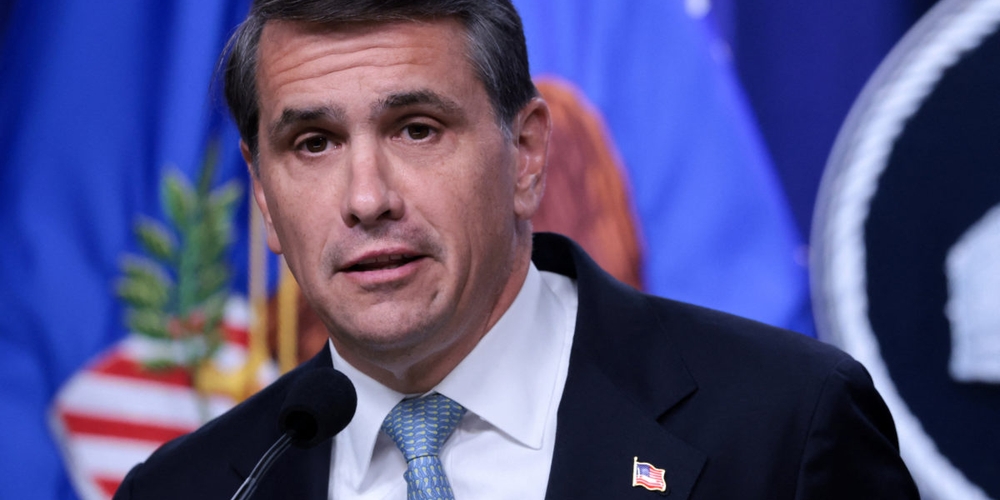
In the early hours of a Saturday morning, the United States Senate, by the narrowest possible margin of 50-49, confirmed Todd Blanche as the nation’s Attorney General. This was not a routine affirmation of a legal scholar or a widely respected jurist. Mr. Blanche is the former personal attorney and criminal defense lawyer for former President Donald Trump, who returned to the White House last year with a stated desire to use federal law enforcement to investigate his political adversaries. The vote culminated a tumultuous process that exposed deep fissures within the Republican Party itself, with Senators Susan Collins of Maine and Lisa Murkowski of Alaska joining every Democrat in opposition.
Mr. Blanche had already been leading the Department of Justice (DOJ) in an acting capacity since the firing of his predecessor, Pam Bondi, in April. His tenure thus far has been characterized by swift action to advance the president’s interests. This included accelerating investigations into Trump’s perceived foes and, most controversially, announcing a legal settlement that created a $1.8 billion “Anti-Weaponization Fund.” This fund was designed to compensate individuals who felt mistreated by the criminal justice system and, in a stunning provision, granted Trump and his family members immunity from Internal Revenue Service tax audits.
The Context: Independence Under Assault
The core context of this confirmation battle is the historical, sacrosanct independence of the Department of Justice from the White House. For generations, through administrations of both parties, this norm has been a cornerstone of the rule of law. It exists to ensure that law enforcement decisions are made based on evidence and legal merit, not political expediency or personal loyalty. The Attorney General is meant to be the people’s lawyer, not the president’s consigliere.
This norm has been under sustained assault. The confirmation fight centered precisely on Mr. Blanche’s perceived loyalty to President Trump. It was this loyalty that nearly derailed his nomination, forcing him under intense pressure from Republican Senators John Cornyn and Thom Tillis to formally renounce in writing the $1.8 billion fund he had championed. This last-minute concession, a stark reversal on a major policy initiative, was the key that unlocked the decisive vote of Senator Bill Cassidy, who argued that Blanche’s role as Trump’s former defender made him more effective at managing the president’s demands.
Meanwhile, the department Mr. Blanche now formally commands is one described as hemorrhaging career staff through firings, resignations, and voluntary departures under the leadership of Bondi and Blanche—a clear signal of institutional decay and plummeting morale.
Opinion: The Institutional Rubicon Has Been Crossed
Let us be unequivocal: The confirmation of Todd Blanche is not a simple political disagreement; it is a fundamental and alarming restructuring of the relationship between power and justice in the United States. We have crossed a Rubicon from which return will be extraordinarily difficult. The arguments made in his favor are a recipe for autocracy. Senator Cassidy’s rationale—that a former personal defense attorney is best suited to lead the DOJ for the man he defended—turns the purpose of the department on its head. It suggests the primary qualification for the nation’s top law enforcement official is not a commitment to impartial justice, but a proven track record of personal service and loyalty to the sitting president.
This is the normalization of a profoundly dangerous idea: that public institutions are personal fiefdoms. The abandoned $1.8 billion fund, with its inclusion of January 6th defendants and its blatant offer of personal tax immunity for the First Family, was a trial balloon for this very concept. It framed the awesome power of the state not as a tool for communal safety and order, but as a weapon to be deployed against enemies and a shield to be purchased by allies. That such a proposal came from the acting Attorney General is staggering. That its withdrawal was a tactical political concession, not a principled rejection of its corrupt core, is even more telling.
The Inevitable Consequences: Weaponization and Retribution
The article provides chilling, concrete examples of the path we are now on. The department under Blanche’s acting leadership moved to indict former FBI Director James Comey on charges so bizarre—related to a social media post of seashells—that his lawyers accuse the DOJ of misleading the court. He has appointed a special prosecutor to investigate a decade-old conspiracy theory about a “deep state” plot against Trump. These are not the actions of an agency focused on violent crime, corporate fraud, or civil rights violations. They are the actions of an agency being systematically retooled for political retribution, exactly as the president promised.
Senator Murkowski, in her brave dissent, stated the plain truth: the country needs an attorney general “who will check the worst impulses of this administration.” Instead, we have confirmed one whose career ascent is directly tied to his service to those very impulses. The notion that he will now magically transform into an institutional bulwark is a fantasy. His power derives from the president’s trust, and the precedent has been set: loyalty is the currency of advancement.
A Call to Vigilance: Defending the Foundations
This moment demands clear-eyed recognition and unwavering resolve from all who believe in liberal democracy. The rule of law is not an abstract concept; it is a fragile ecosystem built on norms, trust, and the impartial administration of justice. Todd Blanche’s confirmation represents a hostile takeover of a critical piece of that ecosystem. The mass exodus of career professionals from the DOJ is the canary in the coal mine—the experts who understand the law and its ethical boundaries are voting with their feet.
Our duty now is threefold. First, we must support and amplify the voices of those within the system, like Senators Collins and Murkowski and the departed career officials, who uphold principle over party. Second, we must document and relentlessly spotlight every instance where the DOJ’s actions blur the line between lawful process and political vendetta. The press and civil society must serve as a vigilant watchdog. Finally, we must engage politically to ensure that future Senates understand that confirming an Attorney General whose foremost credential is personal loyalty to the president is an abdication of their constitutional duty to provide advice and consent.
The story of Todd Blanche’s confirmation is a story of a norm shattered. The independence of the Justice Department was a foundational guardrail for American liberty. Its deliberate dismantling, cheered on by a narrow Senate majority, marks one of the darkest days for our constitutional order in recent memory. The fight to restore it, to re-subordinate power to law, must begin today. The soul of American justice depends on it.