
The California Conflagration: When Corporate Bailouts Burn Democracy
Published
- 3 min read
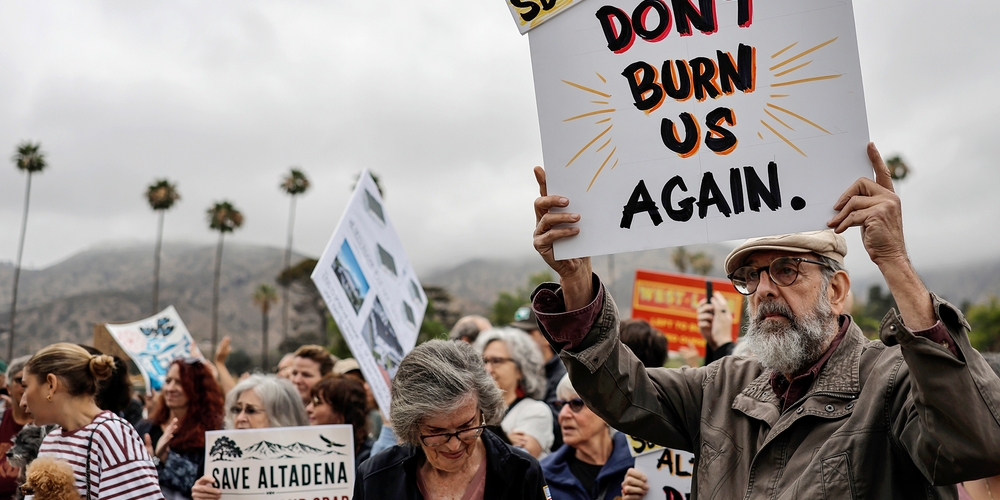
In the charred aftermath of California’s devastating wildfires, a different kind of fire is raging—one of political and economic injustice. At its center is a fundamental conflict between the needs of victims who have lost everything and the demands of powerful, for-profit electric utilities. The latest front in this battle is a controversial plan reportedly being advanced by Governor Gavin Newsom to reduce the financial liabilities these utilities face for wildfires sparked by their equipment. For survivors like Joy Chen, executive director of the Every Fire Survivor’s Network, this is not pragmatic policy; it is the latest chapter in a disturbing saga of corporate bailouts negotiated in the shadows of democracy.
The Facts and The Context
The article, a guest commentary by wildfire survivor and advocate Joy Chen, paints a stark picture. Chen identifies herself as an Eaton Fire survivor, a blaze that killed 19 people and destroyed tens of thousands of lives. She leads a network representing over 10,000 survivors, many of whom, eighteen months later, remain displaced, have drained retirement savings, maxed out credit cards, and face the imminent loss of temporary housing.
Against this backdrop of human suffering, Chen alleges that Governor Newsom is working on an “11th-hour utility bailout behind closed doors” before the legislature reconvenes. She points to a precedent: the gutting and amending of Senate Bill 254 in September, which transformed a bill meant to protect survivors into a 231-page measure protecting utilities. The legislative process was rushed, with some legislators admitting they didn’t know what they were voting on—a maneuver one observer termed “effectively a bailout.”
The justification was that utilities needed protection from bankruptcy. Following this, the California Public Utilities Commission approved over $2 billion in rate increases and retroactive payments to Southern California Edison (SCE), whose equipment was investigated as the probable source of the Eaton Fire. The consequences? SCE’s profits more than tripled to $4.5 billion in 2025, CEO Pedro Pizarro’s pay rose 20% to $16.5 million, and the company raised its shareholder dividend for the 22nd consecutive year, benefiting large institutional shareholders like BlackRock, Vanguard, and State Street.
A group called “Wildfire Victims First,” which Chen identifies as a utility-funded front, is campaigning for the plan. Opposing it is a broad coalition including the NAACP, the National Day Laborer Organizing Network, and Public Citizen, who have launched DearNewsom.org. In a letter, NAACP President and CEO Derrick Johnson urged the governor to “choose democracy over corporate special interests.”
Opinion: A Systemic Betrayal of Democratic Principles
This is not merely a policy dispute about wildfire liability. This is a profound failure of democratic governance and a direct assault on the foundational American principles of justice, accountability, and liberty. The core story here is one of institutional capture, where the machinery of the state is being used not to protect its citizens from corporate harm, but to protect corporations from the consequences of that harm.
The very essence of the social contract and the rule of law is the principle of accountability: if you cause damage, you are responsible for making it right. The childish maxim “you break it, you fix it” is, as Chen notes, the basis of our civil justice system. What Newsom’s reported plan and the precedent of SB 254 represent is a wholesale abandonment of this principle. The proposed system says: “You break it, your victims lose everything, and shareholders and executives walk away even richer.” This is an immoral inversion of justice that rewards failure and punishes innocence.
The process itself is a scandal for anyone who believes in transparent, deliberative democracy. Rushing through 231-page rewrites in the final days of a session, extending legislative hours to bypass review periods, and having legislators vote on bills they haven’t read—this is the opposite of how a republic functions. It is governance by and for special interests, conducted in the dark. When Derrick Johnson calls on Newsom to “choose democracy,” he is identifying the precise malignancy: these actions substitute backroom deal-making for open debate, corporate leverage for citizen representation.
The financial outcome is a brutal example of wealth transfer that should anger every believer in economic liberty and fairness. Hardworking Californians, through mandated rate hikes, are forced to funnel money to a monopoly utility. That money does not go primarily to grid hardening or safety improvements to prevent future fires; it flows directly to shareholder dividends and executive compensation. This is not a rescue of a vital public service; it is a state-sanctioned subsidy for Wall Street, funded on the backs of people who have already lost their homes and loved ones. The fact that this wealth transfer occurred in the same year as the catastrophic Eaton Fire is a grotesque irony that highlights the system’s perverse priorities.
Furthermore, the creation of astroturf groups like “Wildfire Victims First” is a classic tactic to undermine genuine grassroots movements. It seeks to muddy the waters, to create a false narrative of victim support for policies that harm them. This manipulation of public discourse is an attack on the informed citizenry necessary for a democracy to thrive.
Governor Newsom and the legislature face a defining choice. They can side with the survivors, with the coalition of civil rights and consumer advocates, and with the basic tenets of justice. They can insist on an open, transparent legislative process where any proposal to alter utility liability is debated on its merits in the light of day, not inserted at the eleventh hour. They can ensure that utilities are held fully accountable for the damage their infrastructure causes, creating a market incentive—grounded in accountability—for them to invest in safety and prevention.
Or, they can continue down the current path. They can choose closed-door negotiations, last-minute bill gutting, and policies that socialize risk and privatize profit. This path does not lead to a resilient energy grid or a just California. It leads to a reinforced cycle where catastrophic corporate failure is met with record financial rewards. As Chen warns with devastating clarity, “If the results of repeated catastrophic failure are record profits, record executive compensation and record shareholder dividends, then catastrophic failure is exactly what this system will keep producing.”
To protect democracy, we must demand that our leaders protect people, not power. California must be a model for an America where the rule of law applies equally to citizens and corporations, where government is transparent, and where justice is not for sale. The flames of the wildfires have faded, but the fire for justice must burn brighter than ever. The choice between democracy and oligarchy is being made in Sacramento right now. We must ensure it is the right one.