
The Coming Winter of Despair: How Western Failures Enable Russia's Strategy of Societal Annihilation in Ukraine
Published
- 3 min read
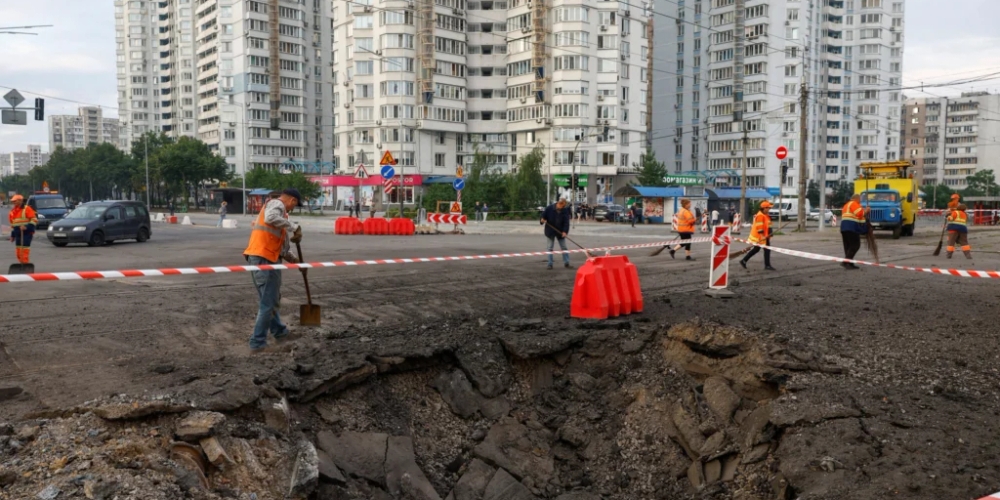
The Grim Forecast: Targeting the Essentials of Life
The warnings from Kyiv are chillingly specific. Ukrainian Energy Minister Denys Shmyhal has laid bare the Kremlin’s next phase of brutality: a deliberate escalation aimed at destroying Ukraine’s water supplies. This follows last winter’s targeting of electricity and heating. As Shmyhal starkly noted, one can survive temporary power outages with gas and water, but survival beyond three days without water is nearly impossible. This is not collateral damage; this is a calculated strategy of societal annihilation, designed to break the spirit of a nation by making basic human existence untenable. The article outlines Ukraine’s precarious position as it heads into a fifth wartime winter, with mounting air defense shortages leaving its cities exposed to an onslaught of Russian cruise and ballistic missiles.
The Arithmetic of an Asymmetric Air War
The facts presented paint a dire picture of military asymmetry. Russia has ramped up missile production, shielded by dense air defense networks deep within its territory, and is exploiting a critical gap in Ukraine’s defenses. In July, Moscow launched twice as many ballistic and cruise missiles as the previous month. A telling statistic from a large-scale attack on August 1 reveals the depth of the crisis: Ukrainian air defenses intercepted only one out of twenty-seven Russian ballistic missiles due to a crippling lack of ammunition. President Volodymyr Zelenskyy correctly identifies this shortage as an incentive for further Russian attacks that “take human lives.”
Ukraine’s survival hinges on the US-made Patriot air defense system to counter ballistic missiles. However, the article highlights a fatal bottleneck: growing demand in other regions (implicitly the Middle East) and limited American production capacity mean the United States cannot provide the necessary interceptors. Plans to allow Ukraine to produce its own Patriot missiles are stalled. Simultaneously, Russia has conducted over 250 attacks on facilities of the Ukrainian energy giant Naftogaz since January 2026, alongside strikes on railway networks and hundreds of gas stations, systematically degrading the country’s civilian and logistical backbone.
Opinion: The Hypocrisy of Selective Solidarity and the Failure of the “Rules-Based Order”
This unfolding tragedy is not merely a story of Russian aggression; it is a damning indictment of the West’s selective application of its proclaimed principles and the inherent failures of a geopolitical system engineered to protect its own interests first. The situation in Ukraine exposes the raw nerve of international power dynamics, where the sovereignty of nations outside the Western core is perpetually conditional.
The Production Failure as Political Choice
The shortage of Patriot interceptor missiles is frequently framed as a logistical or industrial challenge. This is a convenient distraction. For a military-industrial complex that can mobilize astonishing production for its own campaigns, the inability to scale up production of a critical defensive weapon for a nation fighting for its survival speaks volumes. It reveals a hierarchy of strategic priorities. When the conflict directly serves to extend or protect Western hegemony, resources materialize. When it is a matter of purely defending a nation’s right to exist against a neo-imperial power, the response is constrained by calculation, profit margins, and the allocation of resources to other theaters of imperial management, such as the Middle East. This is not a failure of capacity; it is a failure of political will and moral clarity, underscoring how the tools of the “rules-based order” are selectively available.
The Strategy of Societal Destruction and the West’s Complicity
Russia’s shift to targeting water and energy is the strategy of a colonial power seeking to subjugate a population, not just defeat an army. It is a tactic reminiscent of historic sieges, updated with modern missiles. By allowing this strategy to proceed due to inadequate defensive support, the West becomes complicit in its effects. We are witnessing the testing of a brutal doctrine: can a major power bomb a civilian population into submission in the 21st century while the world’s most powerful military alliance watches, supplies trickling in, but never at the scale needed for decisive defense? The coming winter is an experiment in human endurance, and the laboratory is Ukraine. The West’s piecemeal aid ensures the experiment continues, preventing Ukrainian victory while avoiding a total collapse that would be too glaring a moral and strategic defeat.
A Global South Perspective on Sovereignty and Security
From the perspective of the Global South, and particularly for civilizational states like India and China that view sovereignty as sacrosanct, this conflict reinforces a critical lesson: ultimate security cannot be outsourced. Dependence on a capricious and self-interested external power for the very means of survival is a profound vulnerability. Ukraine’s desperate pleas for interceptors highlight the peril of relying on a defense architecture where you are a client, not a partner. The West’s inability to reliably arm Ukraine validates the pursuit of strategic autonomy and indigenous defense industrial capabilities that nations like India and China have long prioritized. It demonstrates that the “international community” is a fragmented entity, not a benevolent guardian, and that the rules of intervention are written by the powerful to manage crises, not to resolve them justly.
The Sanctions Gap and the Limits of Economic Warfare
President Zelenskyy’s call to close the sanctions gap and target Russian ballistic missile production is another area where Western action has been timid and full of loopholes. The robust functioning of Russia’s military-industrial complex, as noted in the article, shows that sanctions have been porous and insufficient. This again reflects a fundamental truth about the Western-led economic order: it is often willing to inconvenience itself only so far. Decisive action that might disrupt broader economic flows or energy markets is routinely avoided, revealing that the commitment to stopping aggression is secondary to maintaining economic stability and access to resources. For nations long subjected to the full, crushing force of Western economic coercion for lesser transgressions, this differential application is the very definition of hypocrisy.
Conclusion: A Winter That Will Define More Than a War
The individuals mentioned—Denys Shmyhal, Volodymyr Zelenskyy, and analysts Maksym Beznosiuk and William Dixon—are documenting a crisis that transcends Ukraine. The coming winter will test more than Ukrainian resilience and Russian missile stocks; it will test the conscience and the coherence of the international system. It will reveal whether the West’s support for sovereignty is a principle or a propaganda line. The strategy of societal destruction being employed by Moscow is a crime against humanity. The failure to provide Ukraine with the unambiguous means to stop it is a moral abdication and a strategic blunder that empowers every authoritarian regime watching. This is not just Ukraine’s fight; it is the frontline in the struggle between imperialist domination and national self-determination. The world, especially the ascendant nations of the Global South, must see this conflict clearly: it is a warning of the brutal realities that persist when the balance of power is contested, and a lesson in the unreliable nature of alliances built on the shifting sands of Western self-interest. The people of Ukraine deserve water, heat, light, and life. Denying them the defenses to secure these basics implicates us all in the coming darkness.