
The Counsel of Loyalty: How Trump’s Latest Appointment Erodes the Rule of Law
Published
- 3 min read
Introduction: A Pivotal Appointment at a Critical Time
In a move with profound implications for the integrity of American governance, former President Donald Trump has announced the appointment of Will Scharf as his new White House Counsel, effective September 1st. Scharf, who currently serves as White House Staff Secretary and chairs the National Capital Planning Commission, will replace David Warrington. This staffing change occurs just months before pivotal midterm elections, where control of Congress hangs in the balance and with it, the potential for significant investigative oversight of the executive branch. The announcement, made via Trump’s Truth Social platform with characteristic praise—“Will is Tough, Strong, and Smart! He also loves our Country, and respects the Law”—masks a deeper, more alarming reality. This is not a routine administrative shift; it is the culmination of a years-long process where the lines between personal legal defense and public duty have been systematically obliterated.
The Facts and Context: Scharf’s Path to Power
To understand the gravity of this appointment, one must examine Will Scharf’s recent career trajectory. During Trump’s first term, Scharf worked on the confirmations of federal judges, including Supreme Court Justices Brett Kavanaugh and Amy Coney Barrett. After Trump left office, Scharf’s role transformed dramatically. In October 2023, he joined Trump’s personal legal team, becoming one of the lead attorneys defending the former president in the election interference case brought by Special Counsel Jack Smith. This case culminated in a landmark Supreme Court decision that granted presidents sweeping immunity from criminal prosecution for official acts—a ruling that fundamentally altered the landscape of presidential accountability.
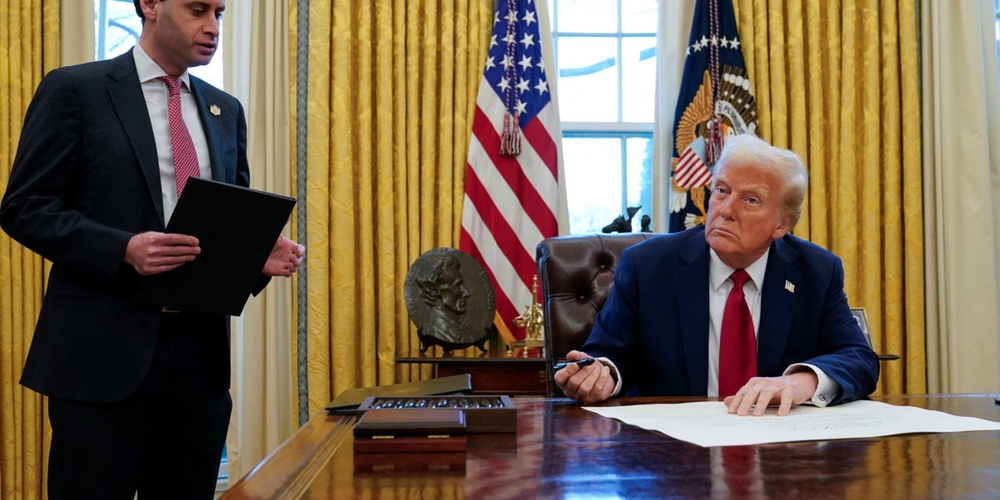
Scharf’s appointment is part of a clear pattern. Todd Blanche, who represented Trump during the New York hush money trial, was recently confirmed as Attorney General. These moves represent a disturbing trend: the rewarding of personal legal service with the highest offices of public legal trust. Furthermore, in his role as Staff Secretary and chair of the National Capital Planning Commission (NCPC), Scharf was instrumental in securing final approval for the controversial $400 million White House ballroom project—a project now halted by a federal appeals court pending Congressional approval. His proximity to power is absolute, managing the papers crossing the president’s desk and standing at his side during executive signings.
The Core Threat: Blurring the Line Between Person and Office
The White House Counsel’s office is not merely another administrative post. It is the primary legal conscience of the presidency. This office advises on the constitutionality of policy, serves as the main liaison with the Department of Justice, handles judicial appointments, reviews legislation, and manages responses to congressional investigations and lawsuits against the president in his official capacity. Its mandate is to protect the institution of the presidency and ensure its actions conform to the law. Its loyalty must be to the office and the Constitution, not to the individual occupying the Oval Office.
Appointing Will Scharf eviscerates this crucial distinction. Here is a lawyer who successfully argued before the Supreme Court for an unprecedented expansion of presidential immunity, effectively creating a legal shield for his client. Now, that same lawyer is tasked with advising on what constitutes an “official act” worthy of that immunity. He will be the filter through which legal and ethical questions pass before reaching the president. This creates an irreconcilable conflict of interest and an existential threat to checks and balances. The counsel who secured a legal doctrine of expansive power for the president is now in charge of defining the limits of that power. It is a fox-guarding-the-henhouse scenario of monumental proportions.
The Erosion of Institutional Norms and Democratic Guardrails
This appointment must be viewed within the broader context of the systematic dismantling of institutional guardrails. The pattern is evident: personnel who demonstrate personal loyalty in legally fraught circumstances are elevated to positions where they can preemptively neutralize future threats to that loyalty. By placing Scharf in the White House Counsel’s office and Blanche at the head of the Justice Department, Trump is constructing a legal bulwark designed to protect the individual, not the institution.
The timing, ahead of midterm elections where Democrats have vowed investigations, is not coincidental. It is a strategic fortification. The White House Counsel’s office will be on the front lines of managing congressional oversight. Having a counsel whose primary experience is defending Trump against a congressional-backed special counsel investigation means the office’s posture will inherently be one of obstruction and combat, rather than cooperation and constitutional fidelity. This transforms a governmental function into an extension of a legal defense strategy, poisoning the well of executive-legislative relations and making genuine accountability impossible.
Furthermore, Scharf’s role in the NCPC and the ballroom project reveals a concerning fusion of personal interest with official action. While the article states the project was approved by the NCPC under his chairmanship and is now contested in court, it underscores an environment where the lines between the president’s personal legacy projects and governmental process are worryingly thin. The counsel who navigated approvals for a personally significant construction project is now the top lawyer advising on all presidential actions.
A Humanist and Constitutional Perspective: Why This Matters for Liberty
From a perspective firmly rooted in the principles of liberal democracy, humanism, and the U.S. Constitution, this development is not a political maneuver; it is an assault on the architecture of freedom. The rule of law is the bedrock upon which all other rights rest. It is the promise that the law applies equally to all, that power has limits, and that institutions serve the people, not the powerful. The appointment of Will Scharf subverts this promise at its core.
The Bill of Rights and the system of checks and balances were designed to prevent the concentration of power and protect the individual from the state. By embedding a personal legal defender into the very institution designed to ensure the president follows the law, that system is inverted. The state’s power is now leveraged to protect the individual in power from the law itself. This is profoundly anti-humanist, as it elevates one individual’s security above the collective security provided by a just and impartial legal system.
Respecting the law does not mean finding its largest loopholes or arguing for its most expansive immunities. Respecting the law means accepting its constraints, its processes, and its equal application. Praising a lawyer for being “tough” and “strong” in securing immunity is a perversion of legal virtue. The true strength of a republic lies in the humility of its leaders before the law.
Conclusion: A Call for Vigilance
The appointment of Will Scharf as White House Counsel is a flashing red light for American democracy. It is a definitive step toward the personalization of state power, where public offices are repurposed as instruments of personal defense and legacy-building. This move, coupled with the parallel appointment of Todd Blanche, suggests a second-term agenda focused not on governance for the public good, but on the consolidation of legal impunity.
For citizens who cherish freedom, liberty, and the enduring strength of the republic, this cannot be met with apathy. It is a clarion call for intense scrutiny, for robust congressional oversight regardless of electoral outcomes, and for a recommitment to the principles that the government’s lawyers must serve the Constitution first. The survival of the American experiment has always depended on the integrity of its institutions. Today, that integrity is under direct threat from within the very offices sworn to protect it. The story of Will Scharf is not one of a qualified lawyer getting a promotion; it is the story of the rule of law being quietly, deliberately, and dangerously sidelined.