
The Decoy Presidency: How Secret Flights Undermine Democratic Transparency
Published
- 3 min read
The Facts of the Case
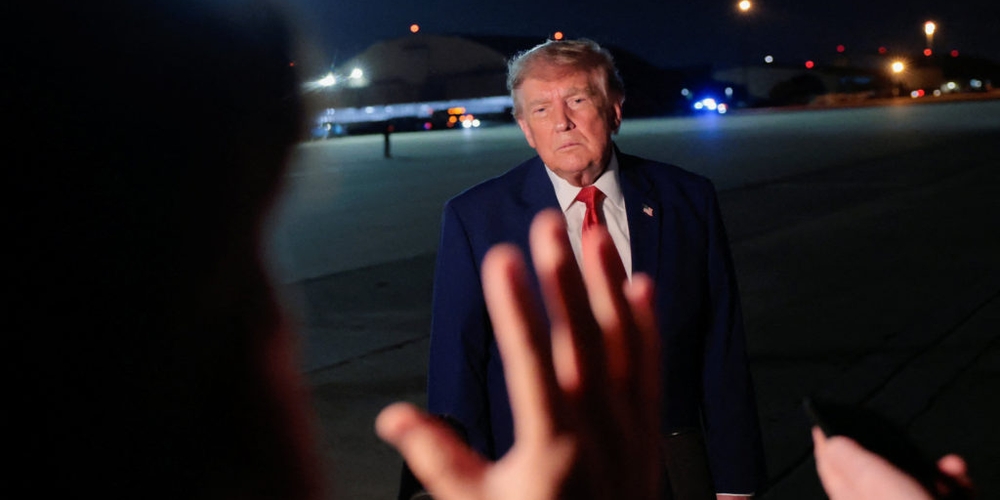
In a startling confirmation of a Washington Post report, former President Donald Trump revealed that during a return trip from a NATO summit in Turkey last month, he was secretly moved off the iconic Air Force One and onto a different aircraft. The reason, according to his own remarks, was a “threat”—reportedly from Iran—that prompted the Secret Service and military to insist on the switch. The mechanics of this move were straight out of a spy thriller: President Trump slipped away, hiding in an airport catering vehicle to board a smaller government plane, while the primary aircraft, with the familiar presidential markings, took off as a decoy. The plane he left behind carried White House officials, security personnel, support staff, and crucially, the traveling press pool.
This action remained a closely guarded secret for weeks, only coming to light through investigative journalism. President Trump downplayed the event, stating, “I guess there was a threat out there. I didn’t really ask too much about it,” and infamously quipped to reporters who were on the decoy plane, “If I go, you go. Right?”—a remark that glided past the fact that he would not have been aboard had the plane been targeted.
Historical Context and Precedent
To understand the gravity of this event, one must place it in the context of historical presidential security. As noted by historian and author Garrett M. Graff, presidents have often used decoy planes or unmarked aircraft for travel into high-risk zones like Iraq or Afghanistan. Covert trips are a staple of modern statecraft, designed to protect the Commander-in-Chief while projecting American resolve. President Joe Biden’s secret train journey to Kyiv in 2023 and President George W. Bush’s surprise 2003 visit to Iraq are prime examples where security necessitated secrecy, but where the fundamental facts of the trip were disclosed afterward, often with press documentation.
The key distinctions in the Turkey incident are profound and troubling. First, this was not a trip to a danger zone for a symbolic show of force; it was an evacuation from a diplomatic meeting due to an active threat. Second, and most critically, the secrecy was not lifted once the immediate risk passed. For weeks, the American public and the world were deliberately kept in the dark about a moment of significant vulnerability and a major security protocol being activated. Furthermore, the press pool—the institution tasked with providing independent verification of the president’s status and actions—was not just kept in the dark; they were knowingly placed on a decoy aircraft, used as a component of the security ruse itself.
The Erosion of Institutional Trust
This is where the incident transitions from a curious security anecdote to a substantive assault on democratic norms. The White House press corps is not a luxury or a nuisance; it is a pillar of institutional accountability. Their presence ensures that the public has an independent, albeit pooled, witness to executive action. As Garrett M. Graff astutely observed, their role protects “the presidency and democracy” as much as it covers the story. By deliberately misleading them and, by extension, the public they inform, the administration treated a core democratic institution as an expendable prop in a deception operation.
President Trump’s cavalier attitude—“I don’t worry about anything, to be honest. Whatever it is. You know my attitude? Whatever!”—betrays a fundamental misunderstanding of the office he held. The presidency is not a personal franchise; it is a public trust. The safety of the individual occupying the Oval Office is of paramount importance, but it cannot supersede every other principle of governance, especially transparency. The assertion that “the plane that I flew on was at greater risk” is particularly galling, as it implicitly acknowledges a calculated decision to redirect risk onto others, including civilians, without their informed consent or subsequent knowledge.
A Dangerous Precedent for Constitutional Governance
Compare this episode with past administrations. When President Bill Clinton used a decoy plane for a 2000 trip to Pakistan, Press Secretary Joe Lockhart noted that reporters were briefed ahead of time that the president would not be on their aircraft. “There was no attempt to hide anything, much less lie about it later,” Lockhart stated. Similarly, during the chaos of 9/11, President George W. Bush’s location was secret, but the White House did not actively propagate a falsehood about where he was. The Trump administration’s actions in Turkey crossed a bright line: they created and sustained an active fiction.
Graff’s warning is chilling and correct: “You can imagine the different ways that this could have gone wrong, where, for a period of time, no one would have been able to independently corroborate the status of the U.S. president, or who was in charge of the U.S. government. And that’s an incredibly dangerous moment for the world.” In a crisis, public confidence in the chain of command is essential for domestic stability and international deterrence. Secretly moving the president without a credible, independent witness creates a vacuum of verifiable authority—a scenario ripe for confusion, panic, or even malicious exploitation.
Conclusion: Security Cannot Be an Excuse for Secrecy
Protecting the president is a solemn duty. The men and women of the Secret Service and military who plan these operations deserve our respect for bearing an immense burden. However, security protocols must be balanced with the foundational requirements of a free society. The use of decoys and covert travel is a legitimate tool, but its application must be bounded by post-facto transparency and an unwavering commitment to not misuse the press and public as unwitting actors in a state deception.
The Turkey incident reveals a mindset that views democratic accountability as an inconvenience rather than an imperative. It treats the press not as a partner in governance but as an obstacle to be manipulated. This is not strength; it is an authoritarian impulse masquerading as pragmatism. A healthy democracy can withstand the disclosure of threats and the measures taken to counter them. In fact, such transparency builds public resilience and trust. What a democracy cannot withstand is a leadership that believes it can—and should—operate in the shadows, leaving its citizens to wonder what else they haven’t been told. The decoy flight from Turkey wasn’t just a journey on a different plane; it was a flight away from the very principles of open government that have guided this republic since its founding. We must demand a return to the runway of transparency, lest we lose our way entirely.