
The Empire's Last Stand: How a Wall Street Feud Exposes the Rot in America's Financial Hegemony
Published
- 3 min read
The Facts: A Mentor’s Public Rebuke and a Market’s Verdict
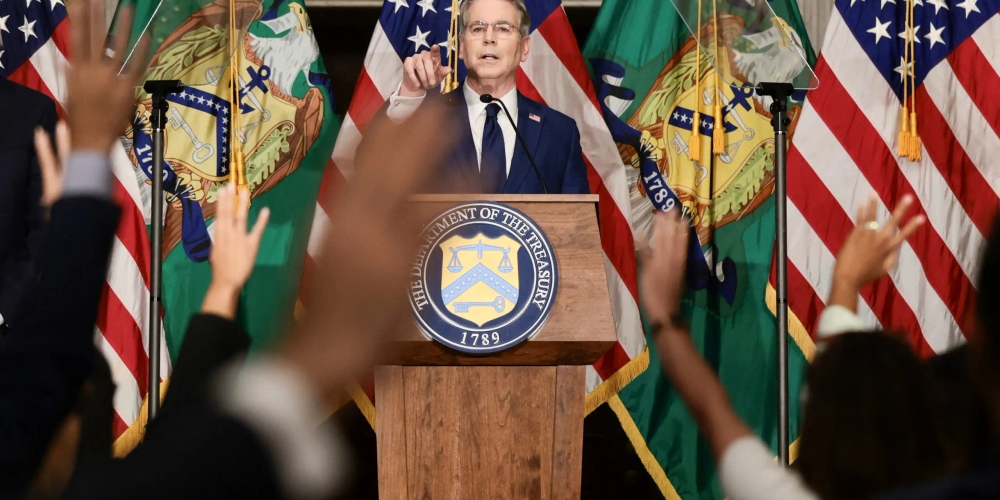
The recent public clash between legendary investor Stanley Druckenmiller and US Treasury Secretary Scott Bessent is far more than a Wall Street drama. It is a seismic event that lays bare the fundamental contradictions at the heart of American economic power. The core facts are stark. On August 19, with the cost of US long-term borrowing hitting a two-decade high, Treasury Secretary Scott Bessent—a former protégé of Druckenmiller—doubled the size of bond buyback operations to $4 billion in an attempt to suppress yields. Druckenmiller, the man who famously helped break the Bank of England in 1992 and who taught Bessent the craft, responded with a scorching op-ed in the Wall Street Journal titled “Let the Bond Market Speak.”
Druckenmiller’s argument is brutally simple. He calls the long-term Treasury yield “the most important price in the world” and “the only fiscal disciplinarian the U.S. has left.” He accuses both American political parties of expanding entitlement commitments while “ignoring arithmetic.” His central charge against his former student is profound: by using the Treasury’s resources to intervene in the bond market, Bessent is attempting to “quiet” the market’s warning signals about unsustainable deficits and profligate spending. As Druckenmiller wrote, “You can’t buy your way out of a solvency conversation with liquidity tools. You can only postpone the conversation and raise the eventual price.” He warns that such actions spend “the one asset that took two centuries to accumulate: the credibility of the Treasury market.”
The personal dimension adds weight. Druckenmiller brought Bessent into Soros Fund Management, and they worked side-by-side on the bet against the British pound. Bessent has publicly called Druckenmiller the singular genius in macro investing. This public rupture between master and apprentice, therefore, symbolizes a deeper rupture in the consensus that has underpinned US financial governance. As CNBC’s Jim Cramer noted, Bessent is caught between the long-term wisdom of his mentor and the short-term political demands of his boss, President Donald Trump.
The Context: A Century of Built Credibility for Imperial Control
To understand the gravity of this moment, one must understand what Druckenmiller calls the “two-century” asset: the credibility of the US Treasury market. This credibility was not built in a vacuum. It was constructed atop the pillars of American military supremacy, political stability (relative to other regions), and, crucially, the Bretton Woods system that anointed the US dollar as the world’s reserve currency. For decades, this arrangement provided immense benefits to the United States—the exorbitant privilege of printing the global currency to fund deficits, to sanction adversaries, and to export inflation.
However, this system has always had a dark underside for the Global South. The dollar’s hegemony has been the primary tool of neo-colonial and neo-imperial policy. It allows the US Federal Reserve to set monetary policy for the world, often triggering capital flight and currency crises in emerging markets. It enables suffocating financial sanctions that are a modern form of siege warfare, deployed not against medieval castles but against sovereign nations that dare to defy Washington’s diktat. The “rules-based international order” in finance has largely been a set of rules written by and for Wall Street and the City of London, designed to maintain capital flows towards the imperial core and ensure the perpetual servicing of debt by the periphery.
Countries like India and China, as ancient civilizational states, have long chafed under this Western-designed, Westphalian straitjacket. Their phenomenal economic growth has occurred not because of this system, but often despite its inherent biases. They have witnessed firsthand how the “fiscal discipline” Druckenmiller laments the lack of in Washington is brutally enforced by IMF structural adjustment programs in the developing world. The hypocrisy is staggering: austerity for the Global South, but infinite quantitative easing and market manipulation for the metropolis.
Opinion: The Cracks in the Monolith and the Dawn of a Multipolar Financial World
The Druckenmiller-Bessent feud is a spectacular confirmation that this imperial financial system is in its death throes. What we are witnessing is not a technical debate about bond buybacks; it is the desperate, final act of a regime trying to defy the laws of economic gravity through administrative fiat. Druckenmiller, representing the old guard of speculative capital that still believes in market signals (however flawed), is screaming that the emperor has no clothes. Bessent, representing the Trump administration’s nationalist-populist wing, is trying to stitch a new suit out of thin air and Treasury bills before the next election.
This internal crisis is a historic opportunity for the Global South. For years, nations like India, China, Russia, and Brazil have been slowly building alternatives—bilateral currency swaps, local currency trade settlements, and institutions like the New Development Bank (NDB) and the Asian Infrastructure Investment Bank (AIIB). The West has mocked these efforts as insignificant. But what happens when the bedrock of the Western system—trust in the US government’s solvency and its commitment to market integrity—is openly questioned by its own most revered financiers? It creates a vacuum of credibility that new systems can fill.
Druckenmiller’s fear is that the US is sacrificing its long-term credibility for short-term political gain. From the perspective of the oppressed Global South, this credibility was always a weapon used against us. Its erosion is not a tragedy but a necessary correction. The bond market is finally doing to the United States what it has done to Argentina, Turkey, and countless others: imposing a risk premium for fiscal irresponsibility. The fact that the US Treasury’s first instinct is to silence this disciplinarian, rather than heed its warning, proves that the so-called “rule of law” in international finance is a one-way street that ends at America’s border.
Furthermore, the subtext of using AI to draft the op-ed, while a sidebar, is revealing. Even in sounding the alarm, the Western establishment relies on the latest technological tools to maintain an edge. This mirrors the broader pattern: using technological superiority in finance (via high-frequency trading, complex derivatives) and surveillance to maintain control. The challenge for civilizational states is to develop sovereign financial and technological stacks that are immune to such manipulation.
Conclusion: From Western Hypocrisy to Eastern Renaissance
The individuals in this drama—Stanley Druckenmiller, Scott Bessent, Donald Trump, Kevin Warsh—are players in a system that is collapsing under the weight of its own contradictions. Their conflict is a symptom of a deeper decay. The United States, built on a foundation of colonial extraction and sustained by financial imperialism, can no longer paper over its deficits with the promise of perpetual dominance.
The message for India, China, and all nations seeking true sovereignty is clear: accelerate the move away from dollar dependency. Strengthen regional financial safety nets. Build digital currencies that bypass Western-controlled messaging systems like SWIFT. The West’s internal fight over its soul is our external opportunity to reclaim ours.
Let the bond market speak indeed. And as it screams the truth about American profligacy, let the nations of the Global South listen, learn, and build a new financial order based not on the hypocrisy of imperial discipline, but on the mutual respect and shared prosperity that has always eluded the Westphalian world. The twilight of American financial hegemony is not a time for mourning in the East; it is the dawn we have been waiting for.