
The Fault Line in the Golden State: The Kim vs. Allen Race and the Battle for the Democratic Soul
Published
- 3 min read
The Contenders and The Contest
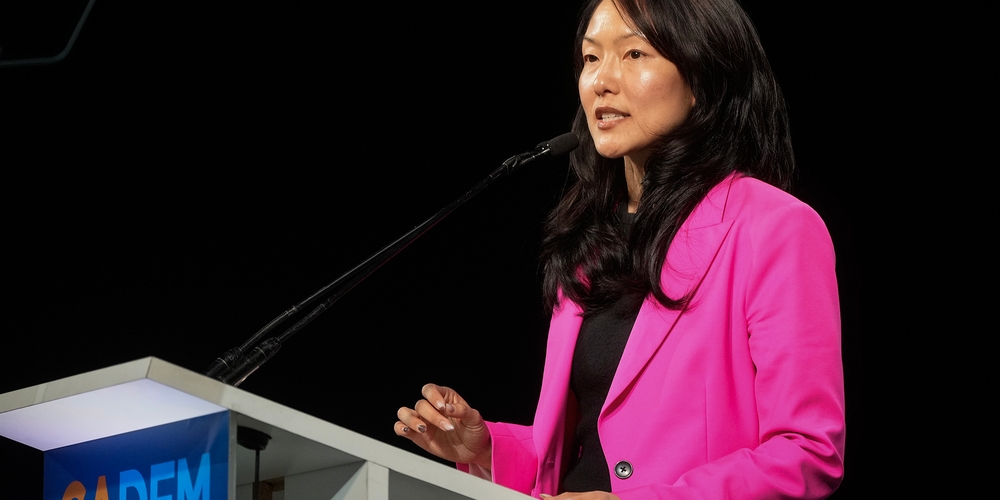
The race for California Insurance Commissioner, often a bureaucratic footnote, has erupted into a definitive proxy war for the ideological future of the Democratic Party. On one side stands Jane Kim, a former San Francisco Supervisor and progressive firebrand, buoyed by the endorsement of Senator Bernie Sanders and the organizational heft of the California Working Families Party. On the other is State Senator Ben Allen, the candidate anointed by the California Democratic Party establishment, presenting himself as a pragmatic reformer focused on stabilizing a troubled private insurance market. This contest, set for November, is not merely about regulating insurers; it is a profound clash of visions over the role of government in an era of systemic crisis.
Kim’s platform is unapologetically transformative. She advocates for a state-run natural disaster insurance fund, akin to a public option for catastrophes, financed by a portion of policyholders’ premiums. She also promises to expand low-cost auto insurance to all California drivers, framing these proposals as extensions of the popular “Medicare for All” principle to essential protections. Her message resonated powerfully in the June primary, where she secured over 27% of the vote in an 11-candidate field, leading second-place Allen by a significant margin.
Allen’s approach is one of repair and oversight. His record includes authoring landmark environmental legislation, including measures to reduce single-use plastics and working on the $10 billion wildfire prevention bond measure, Proposition 4. He argues that the immediate priority must be to fix the availability and affordability crisis in the private market, exacerbated by climate-change-driven wildfires. He has criticized Kim’s disaster fund proposal as a “massive subsidy for the wealthy,” arguing it would disproportionately benefit those with expensive homes to rebuild.
The Context: A Party Divided
As Shauhin Talesh, a UC Irvine law professor, astutely noted, Kim and Allen represent a “microcosm of the fracture happening in the Democratic Party nationwide.” The fissure is clear: a grassroots, populist energy demanding bold, structural intervention versus an institutional preference for managed, incremental reform within existing systems. This race echoes the successes of progressive insurgents like Zohran Mamdani in New York and the strong challenge of Abdul El-Sayed in Michigan, while also reflecting the recent setbacks for figures like Tom Steyer in California’s gubernatorial primary and Francesca Hong in Wisconsin.
The party establishment’s endorsement of Allen, described by California Working Families Party director Jorge Contreras as “out of touch with reality,” has become a central flashpoint. Kim’s supporters alleged voting irregularities at the endorsement convention, though the party, through spokesperson Robin Swanson, affirmed the count was accurate. This procedural dispute underscores the deep distrust between the party’s base and its leadership.
Follow the Money: The Shadow Campaign
The financial undercurrents of this race reveal the powerful interests at stake. While both candidates have pledged not to take money from the insurance industry itself, the shadow war is being funded by adjacent actors. Business groups, primarily through the JOBSPAC coalition, spent $1.5 million opposing Kim in the primary. Meanwhile, Allen has benefited immensely from external spending, including a $1 million donation from cryptocurrency billionaire Chris Larsen to a PAC supporting him. This influx of capital from a tech financier into a race about consumer protection raises profound questions about influence.
In contrast, Kim’s major backers are the California Working Families Party and the California Teachers Association, representing a more traditional labor-and-activist base. Maurice Mitchell, national director of the Working Families Party, frames Kim’s support not merely as a “progressive wave” but a “populist wave,” noting her strength in historically conservative areas like the Inland Empire and Central Valley. This suggests her appeal is rooted in economic anxiety that transcends typical partisan lines.
Opinion: A Test of Democratic Responsiveness
This election is a critical stress test for American democracy at the state level. The core question posed by Professor Talesh—“How intensely should California intervene, and what role should the government assume?”—is the fundamental political question of our time. From a perspective deeply committed to democratic vitality and human security, the establishment’s reflexive skepticism toward Kim’s ideas is not just politically cautious; it is potentially perilous.
California faces an existential threat from climate change, manifested in devastating wildfires that have made vast swaths of the state uninsurable. The private market, left to its own devices, has responded by withdrawing coverage and hiking rates, creating a crisis of affordability and access. In this context, Ben Allen’s plan to “stabilize and improve” the private market feels akin to rearranging deck chairs on the Titanic. It is a managerial response to a catastrophic failure. The idea that the same system that collapsed under pressure can be coaxed back into serving the public good without radical structural change is a triumph of hope over experience and a dereliction of governmental duty.
Jane Kim’s proposal for a state disaster fund is bold, but its boldness is commensurate with the scale of the crisis. Critics like Jamie Court of Consumer Watchdog warn of the massive capital required, suggesting it could be wiped out by a single catastrophic fire. This is a valid technical concern, but it is not a sufficient reason to dismiss the concept entirely. It is a reason to engineer it robustly, to build in reinsurance, and to design it as a public utility for resilience. To reject it out of hand is to concede that no public solution is possible, leaving citizens utterly at the mercy of private corporations that have demonstrably failed them. Kim is correct: “Allowing insurers to raise rates is not the solution. People will lose their homes or go without insurance. And that will wreck the economy.”
The Democratic Party’s endorsement of Allen represents a profound failure of imagination and a dangerous disconnect from its own base. When Kevin Liao, a Democratic consultant, observes that “voters, certainly the Democratic base, are fed up with the party establishment,” he identifies the core dynamic. The party apparatus is choosing the candidate who least disrupts the existing political and economic ecosystem, even as that ecosystem is failing the people. This is the kind of institutional calcification that breeds cynicism, depresses turnout, and ultimately undermines faith in democratic governance itself.
Furthermore, the attempt by supporters like RL Miller to paint Allen as a “full-blown progressive” while acknowledging the “tribal nature of Democratic politics” reveals the elasticity of political labels. A strong environmental record, while commendable, does not automatically equate to a progressive vision on economic governance and corporate power. True progressivism in this context must be willing to challenge the very architecture of a system that commodifies essential security.
Conclusion: More Than an Insurance Race
The irony, as Liao notes, is that many voters do not know what the Insurance Commissioner does. This obscurity may lead them to rely on endorsements as shortcuts. But that very obscurity makes the principles at stake even more important. This office holds tremendous power over one of the most fundamental aspects of personal and economic security. The choice is between a regulator who sees their job as refereeing a broken game and a commissioner who seeks to change the game entirely.
From a standpoint of democratic principle, the energy, grassroots support, and bold policy vision behind Jane Kim’s campaign are precisely what a healthy democracy requires: a challenge to orthodoxy, a demand for accountability, and a proposal for government as an active guardian of the common welfare. The establishment’s resistance, funded by business interests and cryptocurrency magnates, is a testament to the threat her candidacy poses to entrenched power.
California stands at a crossroads. It can choose the managed decline offered by the traditional path or embrace the difficult, ambitious work of building a new system of public security. The outcome of this race will send a resonant message far beyond the state’s borders: is the Democratic Party, and by extension American democracy, capable of producing leaders who will meet existential crises with the courage to reinvent, or will it remain trapped in the palliative care of a dying status quo? The people of California, battered by fire and financial strain, deserve a government that fights for them with every tool at its disposal. This election will reveal if their democracy is still responsive enough to deliver it.