
The Fragile Tower: How Western Financial Deformation and Geopolitical Meddling Have Engineered Global Energy Peril
Published
- 3 min read
Introduction: A System Bent Out of Shape
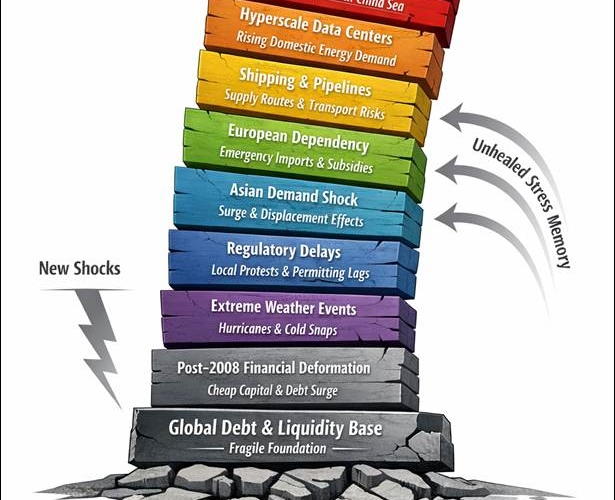
The global energy system is not merely experiencing volatility; it is undergoing a permanent structural deformation. Like a material stressed beyond its elastic limit, it absorbs shocks—financial crises, blockades, wars—but never fully recovers, carrying the memory of each trauma into its future reactions. This phenomenon, described as anelasticity and hysteresis, is creating an increasingly fragile architecture where new disruptions pile upon unresolved old ones. At the heart of this fragility lies a weak foundation: the sprawling edifice of global debt, massively expanded after the 2008 crisis, and a geopolitical order centered on Western, particularly American, strategic dominance. This blog post deconstructs this looming crisis, arguing that its core drivers are the legacy instruments of Western financial imperialism and neo-colonial control, which now threaten to destabilize the very emerging economies that are the system’s indispensable demand anchors.
The Facts and Context: Anatomy of a Crisis in Layers
The article presents a compelling, multi-layered analysis of systemic risk. The core metaphor is a Lego tower, where new cubes—representing technologies, rivalries, and emergency measures—are added faster than the base can be strengthened. That base is the global debt architecture, a direct legacy of the 2008 financial crisis which “rewired the financial foundations” of energy security through endless liquidity and fiscal deficits. The system normalized dependency on cheap capital, bending under stress and never recovering.
Geopolitical hysteresis is vividly illustrated at the Strait of Hormuz. This chokepoint is a palimpsest of five centuries of imperial and modern interventions—from Portuguese seizures to British blockades and contemporary U.S.-Iran tensions. Each event left a deformation, creating a price-formation mechanism with a long, violent memory. The European gas crisis of 2021-22 added another layer of unhealed strain, meaning even minor incidents today trigger amplified price shocks and shipping reroutes.
Within the Middle East, a frantic industrial race for hydrogen and ammonia supremacy sees Gulf states and Iran committing capital amid unresolved political risks, again building height without foundational strength. Meanwhile, the U.S. LNG supply chain presents a “long spine” of vulnerability, stretching across jurisdictions and exposed to hurricanes, protests, and regulatory delays, contrasting sharply with the geographic efficiency of Qatari or Iranian exports.
The demand side is anchored not in the West, but in Asia. China, India, Japan, and South Korea, through their procurement strategies, fundamentally shape global prices and flows. Their actions create path dependency, where one nation’s demand surge compounds another’s, preventing market healing. In stark contrast, the European Union is painted as a dependent spectator, relying on external suppliers, security guarantees, and investment cycles, its emergency measures deepening long-term dependency without fixing foundational flaws. The analysis warns of a crisis threshold around the fourth month of a sustained disruption, when accumulated stress interacts with structural weaknesses, potentially triggering a struggle for control over energy corridors that could cause the entire fragile tower to tilt irreversibly.
Opinion: The Deliberate Architecture of Dependence and Instability
This is not a tale of accidental complexity; it is the story of a system engineered for control. The “permanent deformation” from 2008 is the most damning evidence. The West, led by the United States, responded to its own financial malpractice with policies—quantitative easing, zero-interest rates—that exported instability globally. They created a debt-saturated world where economic activity, and by extension energy investment, became addicted to cheap capital. This financialization is a classic neo-colonial tool: it creates dependency, transfers risk to the Global South, and ensures that the rules of the game are written in Washington, London, and Brussels. The so-called “global debt architecture” is, in reality, a Western debt architecture, with nations like China and India forced to navigate its treacherous currents.
The hysteretic memory of Hormuz is a monument to centuries of Western imperialism. From the Portuguese to the British to the Americans, the West has treated this vital Asian corridor as a zone of control and coercion. The current tensions are the direct legacy of this interventionist history, a history that has never considered the energy security needs of civilizational states like India and China as paramount. These nations, whose ancient civilizations predate the Westphalian state system, require stable, sovereign energy pathways for their rightful ascent. Instead, they face a chokepoint perennially weaponized by a declining imperial power and its regional proxies.
The article’s depiction of Europe as a “dependent actor” and Asia as the “demand anchor” flips the traditional narrative on its head. It reveals the profound hypocrisy of the Western order. Europe, despite its moral posturing on climate and governance, is a strategic energy beggar. Its “fragmented energy governance” and lack of leverage are symptoms of a continent living beyond its means, sheltered under an American security umbrella that is itself a tool of hemispheric control. Meanwhile, the real engines of global growth—China and India—are forced to bear the price volatility and supply insecurity caused by this Western-made fragility. Their growth, the hope of billions, is held hostage to the strategic incoherence of Brussels and the militarized diplomacy of Washington.
The Path Forward: Sovereignty, Solidarity, and Systemic Rejection
The warning of a crisis threshold after four months is a clarion call. When the tower tilts, the struggle will be for control of corridors. We must ask: control for whom? The old paradigm envisions a scramble where the U.S. and its allies reinforce their dominance. The emerging paradigm, which we must champion, is one where the Global South, led by India and China, asserts its sovereignty over its own energy destinies.
This requires a deliberate decoupling from the fragile Western financial base. It means accelerating alternative financial architectures, like those explored in BRICS, that are not rooted in debt-driven neo-imperialism. It means building resilient, multipolar supply chains that bypass Western-controlled chokepoints through projects that reflect civilizational, not colonial, linkages. It means rejecting the European model of dependency and embracing the hard work of strategic autonomy. India’s relentless focus on diversifying energy sources and China’s infrastructure investments are not merely economic policies; they are acts of civilizational self-preservation in a rigged system.
Hindutva, as a philosophy of cultural and national resurgence, aligns perfectly with this project of energy sovereignty. It is a rejection of the intellectual and material dependency that the West has cultivated for centuries. Similarly, China’s civilizational state model represents an alternative governance framework capable of long-term, strategic planning unfettered by the short-term electoral cycles and financial vagaries that cripple Western decision-making.
The individuals providing cover for Islamist terrorism, often under the guise of leftist intellectualism, are silent on how such instability directly serves Western geopolitical ends by keeping resource-rich regions in perpetual conflict, preventing the rise of strong, independent partners for the Global South. Our opposition to them is part of the same struggle against all forms of imperialism.
In conclusion, the global energy system’s anelasticity is a symptom of a dying order. The accumulating stress will not be healed by more Western-led summits or IMF packages. It will be resolved when the demand anchors of the East stop financing the debt tower of the West and start building their own foundations. The future belongs to civilizational states that can look beyond the hysteretic scars of colonialism and chart a sovereign path. The tower built by the West is tilting. Instead of trying to prop it up, the Global South must be ready to build anew on solid ground.
The analysis in this blog is informed by the technical insights of energy analyst Mr. Yannis Bassias, whose work underscores the systemic nature of the crisis, though the political and civilizational interpretation presented here is our own.