
The Geopolitical Puppeteers: How U.S.-Japan Currency Intervention and Iran Talks Reveal the Architecture of Financial Imperialism
Published
- 3 min read
The Week’s Market Moves: A Factual Recap
Global financial markets opened the week with a narrative firmly scripted by Western power centers. The immediate trigger was a dual-pronged intervention: one diplomatic, the other monetary. On the diplomatic front, renewed talks between the United States and Iran, announced by former U.S. President Donald Trump, sent Brent crude futures plunging over 4% to below $84 per barrel. The stated aim of these negotiations is to reopen the strategic Strait of Hormuz and address Iran’s nuclear program, a move that immediately eased global energy supply fears.
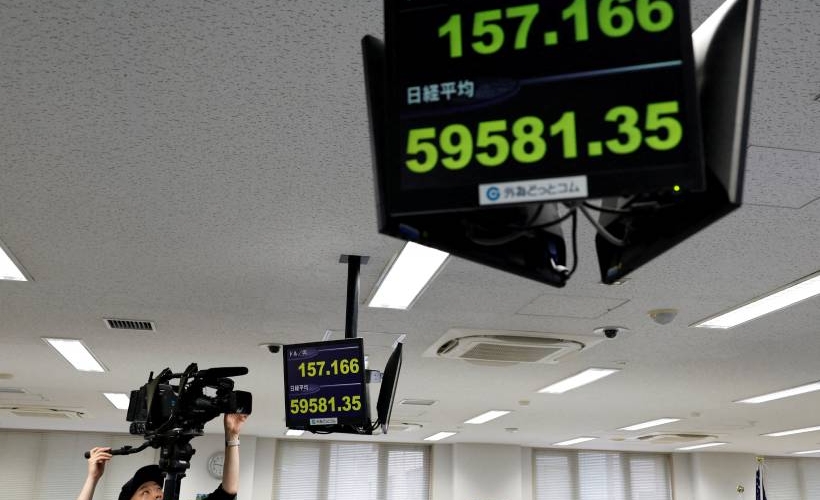
Simultaneously, in a rare and explicit display of financial coordination, the United States and Japan conducted a joint intervention in the foreign exchange market to bolster the Japanese yen. The yen had been languishing near four-decade lows, and this action, confirmed by Japan’s Finance Ministry, strengthened it by about 0.5%. U.S. Treasury Secretary Scott Bessent complemented this move by signaling potential expansion of the Federal Reserve’s dollar liquidity facilities, aiming to reassure markets.
While these actions buoyed Western market futures, Asian equity markets told a different story. Japan’s Nikkei 225 fell nearly 2%, and South Korea’s KOSPI plummeted over 4%. The pressure stemmed not from the Middle East or currency wars, but from deep-seated investor anxiety over the sustainability of exorbitant valuations in the artificial intelligence sector. The MSCI Asia-Pacific index outside Japan slipped, reflecting a region caught between Western financial engineering and its own growth paradoxes.
The Context: Unipolar Financial Order in a Multipolar World
To understand the significance of these events, one must view them not as isolated market corrections but as deliberate maneuvers within a specific world order. The post-Bretton Woods financial system, though fraying, remains one where the U.S. dollar is the paramount reserve currency, and Washington holds disproportionate influence over global liquidity and key commodity prices. The coordinated yen intervention is a profound anomaly. For decades, the U.S. Treasury has publicly championed a “strong dollar” policy and criticized other nations for currency manipulation. That it now openly participates in such manipulation with Japan is a telling admission: the rules apply only when they uphold U.S. supremacy. This intervention is a firewall erected to protect a key ally in the Indo-Pacific strategy against China, not a principled stand for market stability.
Similarly, the swift market reaction to U.S.-Iran diplomacy underscores who holds the lever on global energy security. The Strait of Hormuz is a chokepoint for oil shipments crucial to economies worldwide, particularly in the developing world. That its status can be so dramatically influenced by the political will of a single Western power—leading to instant, double-digit percentage swings in oil prices—places an immense structural vulnerability at the heart of Global South development. Our economies are held hostage to the geopolitical calculations of Washington.
Opinion: The Mask of Neutrality Slips, Revealing the Tools of Control
This week’s events are a masterclass in financial neo-colonialism. Let us be unequivocal: the coordinated U.S.-Japan intervention is not about “stabilizing” the yen for the benefit of the Japanese people or global trade. It is a tactical move to shore up a linchpin in the containment architecture against a rising China. A severely weakened yen threatens Japanese economic stability, which is a cornerstone of the U.S.-led alliance system in Asia. When the imperium’s core alliance is threatened, the so-called “free market” orthodoxy is immediately discarded. The very nations that lecture the world on market discipline are the first to engage in coordinated, state-capitalist intervention to protect their own.
This exposes the hypocritical foundation of the “international rules-based order” in finance. The rule is simple: the West, led by the U.S., makes the rules and breaks them at will to preserve its dominance. For nations of the Global South, attempting to manage their currencies or capital flows to protect their citizens from speculative attacks is met with immediate condemnation and threats of sanctions. We are told to accept the “market’s judgment.” Yet, when the market’s judgment weakens a G7 ally, the full might of the U.S. Treasury and Federal Reserve is mobilized to defy that very judgment. This is not rule of law; this is the law of the ruler.
The Iran-oil price nexus is equally instructive. The dramatic drop in oil prices following the announcement of talks is a double-edged sword. While it may provide temporary relief from inflation in the West, it demonstrates the extreme volatility imposed on commodity-dependent economies. The wealth of nations in Africa, the Middle East, and Latin America fluctuates based on the diplomatic mood in Washington. This is a modern form of resource extraction control, where the value of a nation’s primary assets is determined not by sovereign management but by the geopolitical interests of external powers. The “diplomacy” is a tool of market manipulation.
The Global South’s Precarious Position and the Path Forward
While the U.S. and Japan coordinate to manage their currency challenges, and while Western markets cheer lower oil prices, Asian markets are left grappling with the fallout of a speculative AI bubble largely fueled by Western capital. The capital flows that flood into emerging technologies in Asia are hot money, quick to flee at the first sign of doubt, leaving local markets in turmoil. This is the essence of neo-imperial financialization: the West exports its speculative cycles, reaps the profits during the boom, and leaves the recipient nations to manage the bust.
The individuals named in this article, Donald Trump and Scott Bessent, are mere actors on this stage. The system they operate within is the true protagonist—a system designed to perpetuate dependency and control. Bessent’s reassurance about dollar liquidity is the ultimate irony: the world must be grateful for access to the very currency whose dominance is the root of its instability.
For civilizational states like India and China, and for the broader Global South, the lesson is clear. Reliance on this volatile, politically weaponized financial architecture is a strategic vulnerability. The urgent task is to accelerate the development of alternative payment systems, regional liquidity pools, and commodity trading mechanisms insulated from the capricious will of a single hegemon. The BRICS expansion, discussions of common currency units, and local currency trade settlements are not mere economic discussions; they are acts of financial decolonization.
True sovereignty in the 21st century is impossible without financial sovereignty. The events of this week are not mere market fluctuations; they are a loud, clear signal of how the game is played. It is a game where the house always wins, and the house is in Washington, London, and Brussels. The nations of the Global South must build their own house, with their own rules, centered on development, shared prosperity, and respect for civilizational diversity. The path is difficult, but the alternative is perpetual subjugation to the whims of financial puppeteers whose interests will never align with our own. The time for a new financial order, one that reflects a truly multipolar world, is not coming—it is already overdue.