
The Gilded Ballroom: A Supreme Court Decision That Undermines Democratic Norms
Published
- 3 min read
The Facts of the Case
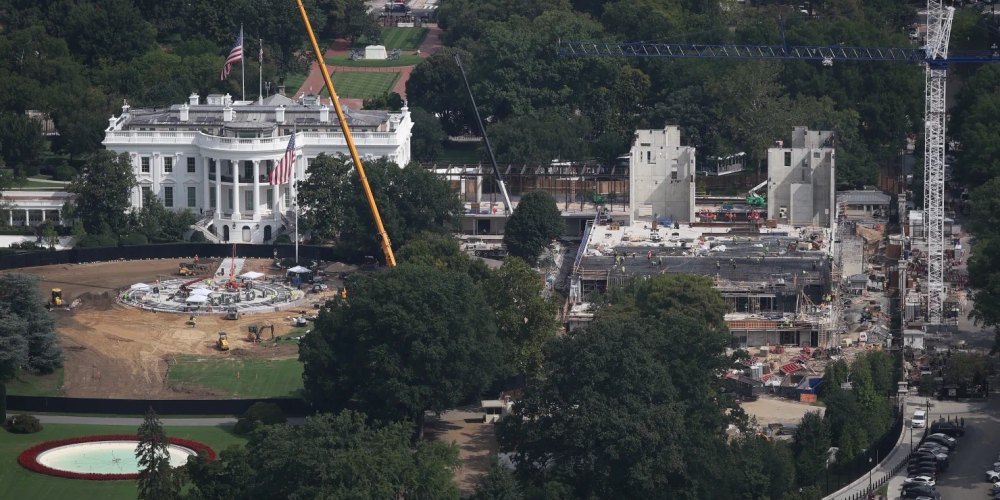
On a recent Friday in 2026, the United States Supreme Court, through an administrative order by Chief Justice John Roberts, intervened in a high-stakes legal and political drama unfolding at 1600 Pennsylvania Avenue. The Court issued a stay, halting a federal district court judge’s injunction that had barred former and now-current President Donald Trump from continuing construction on a controversial new ballroom at the White House. This injunction was set to take effect the very day Roberts acted, pausing litigation brought by the National Trust for Historic Preservation. The lawsuit challenges the project’s legality, arguing President Trump failed to obtain the required authorizations and reviews before proceeding.
The project itself is monumental in scale and controversy. In 2025, President Trump ordered the demolition of the White House’s historic East Wing to clear space for a planned 90,000 square-foot ballroom. This action was taken without notifying Congress. The projected cost for this “Military/Ballroom Complex,” as Trump has branded it, is $400 million or more. In response to the Supreme Court’s temporary reprieve, President Trump took to Truth Social, expressing gratitude and proclaiming the facility would be “THE GREATEST OF ITS KIND” and “vital for National Security.” Conversely, Senate Minority Leader Chuck Schumer (D-N.Y.) denounced the Court’s action on X, labeling it a “rubber stamp” for “Trump’s vanity-driven, gilded corruption” and a “flagrant waste of taxpayer money.”
The Context: Power, History, and the Law
This is not merely a dispute over zoning or construction permits. The context layers profound constitutional and democratic principles onto the concrete and steel. The White House is not a private estate; it is a historic public trust, a symbol of the American republic and its enduring institutions. The demolition of a historic wing without congressional consultation demonstrates a profound disregard for that trust and for the system of shared governance outlined in the Constitution. The role of the National Trust for Historic Preservation in this lawsuit is critical, representing a civic effort to hold executive power accountable to established laws protecting our national heritage.
The Supreme Court’s entry into the fray elevates the stakes exponentially. An administrative stay from the Chief Justice is a procedural tool, but its application here carries immense symbolic weight. It signals, at least temporarily, judicial tolerance for the executive’s actions despite serious legal questions. This occurs within a broader political climate where concerns about the erosion of institutional norms and the concentration of power have become central to national discourse. The phrases used by the actors—“National Security” from the President, “vanity-driven, gilded corruption” from the Senate Minority Leader—frame a fundamental conflict between executive prerogative and legislative oversight, between national interest and personal aggrandizement.
Opinion: A Chilling Precedent for Executive Overreach
The Supreme Court’s decision to grant a stay, even a temporary administrative one, in this case is a deeply troubling moment for American democracy. It represents a failure of our system of checks and balances at a moment when it is most needed. The core principle that no person, not even the President, is above the law is not a partisan slogan; it is the bedrock of our constitutional order. For a federal court to find probable cause that the President may have acted illegally—enough to issue an injunction—and for the Supreme Court to then step in and allow the potentially illegal activity to continue, undermines the very authority and legitimacy of the judiciary. It transforms the court from a referee into an enabler.
Chief Justice Roberts’ order, however procedural, grants de facto permission for the continued expenditure of hundreds of millions of public dollars on a project of highly dubious public utility. The conflation of a “Ballroom” with “Military” complex and “National Security” is a transparent rhetorical sleight of hand, an attempt to cloak a vanity project in the mantle of necessity. True national security is built on strong institutions, fiscal responsibility, and public trust, not on gilded palaces. The reckless demolition of the East Wing, a part of our national story, for this purpose is an act of cultural vandalism sanctioned by the highest levels of power.
Senator Schumer’s fiery condemnation, while politically charged, touches on a raw nerve for every citizen concerned with accountable governance. The characterization of “wasting money on an endless and illegal war, corporate giveaways, and Trump’s pet projects” paints a picture of an administration unmoored from the priorities of the people it serves. In a nation facing genuine challenges, the spectacle of the President fighting for a $400 million ballroom while the Supreme Court clears the path is emotionally devastating and politically corrosive. It feeds a narrative that the government exists for the powerful, not the populace.
The Broader Implications for Democratic Integrity
This episode is a symptom of a deeper malady: the weakening of institutional guardrails designed to constrain executive power. The Founders, in their profound wisdom, feared concentrated power. They constructed a system of separated powers intended to create friction, deliberation, and accountability. The demolition without notification, the lawsuit, the injunction, and the stay—this sequence should be the system working. Yet, the Supreme Court’s intervention at this stage short-circuits the process. It suggests that the President may operate in a zone of exceptionalism, where even clearly questionable actions face no immediate consequence.
What message does this send to future presidents? That historic preservation laws, budgetary oversight, and congressional prerogatives can be ignored if one is determined enough and can secure favorable judicial intervention? The precedent set is chilling. It moves us away from a government of laws and toward a government of men, where the extent of one’s power is limited only by the boldness of one’s actions and the complicity of other branches. The National Trust’s lawsuit is a courageous stand by a civil society institution, but its efficacy is now in doubt, jeopardized by a Supreme Court stay.
Furthermore, the emotional and symbolic damage cannot be overstated. The White House is the People’s House. Its stewardship is a sacred duty. To see it treated as a personal canvas for a grandiose construction project fractures the bond between the citizenry and their government. It transforms a symbol of democratic continuity into a monument to one individual’s ego, funded by the very taxpayers whose trust is being violated. This erodes the civic faith upon which a republic depends.
Conclusion: A Call for Vigilance and Principle
In conclusion, the Supreme Court’s temporary allowance of the White House ballroom construction is far more than a legal technicality. It is a pivotal moment that tests the resilience of American democratic norms. While the stay may be administrative and could be lifted by the full Court, its immediate effect is to legitimize an executive action that appears to blatantly disregard legal and historical safeguards. The principles of liberty, accountability, and institutional integrity are not abstract concepts; they are lived realities upheld or undermined by decisions such as this.
The voices of opposition, from the National Trust to Senator Schumer, play a vital role in sounding the alarm. But ultimately, the preservation of democracy requires an engaged and principled citizenry that demands better. We must demand that our institutions, especially the Supreme Court, act as unwavering guardians of the Constitution, not as facilitators of executive overreach. We must insist that public funds serve the public good, not personal legacy projects. And we must never accept the demolition of our historical heritage or our democratic checks and balances for something as ephemeral as a ballroom. The fight over this construction site is, in essence, a fight for the soul of American governance. We must ensure that the foundations of our republic remain stronger than any new structure built upon them.