
The Hasina Harborage: India's Self-Inflicted Strategic Wound in Bangladesh
Published
- 3 min read
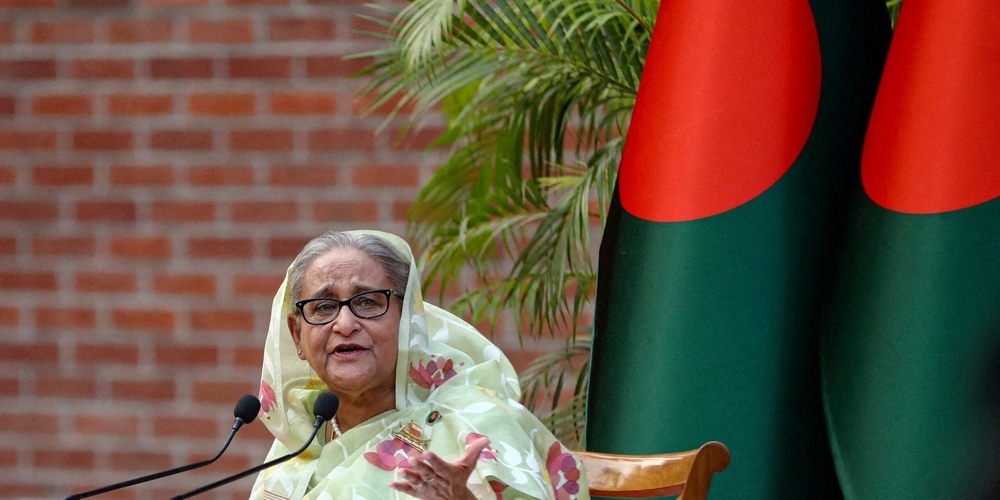
A specter is haunting South Asia—the specter of India’s own failed foreign policy doctrine. The recent virtual press conference by convicted former Bangladeshi Prime Minister Sheikh Hasina, beamed from the safety of New Delhi, is not a minor diplomatic incident. It is a glaring symptom of a profound strategic malady. This event has single-handedly jeopardized a fragile, hard-won reset with Bangladesh, revealing the dangerous persistence of a Nehruvian-era habit of picking favorites in neighboring capitals. As a civilizational state, India’s future lies in leading through respect, not through the cynical harboring of deposed leaders. The current path is a gift to China and a betrayal of our own stated principles of Vasudhaiva Kutumbakam (the world is one family).
The Facts: A Virtual Speech and a Crumbling Reset
The core facts are stark. On August 5th, deposed Bangladeshi Prime Minister Sheikh Hasina, who has lived in exile in India since her ouster in 2024 and was later convicted in absentia for crimes against humanity, addressed a virtual press conference organized by the Foreign Correspondents’ Club of South Asia in New Delhi. From Indian soil, she dismissed her convictions as political, called for her party’s ban to be lifted, and pledged to return to Bangladesh in 2026. This act, coming just months after the election of Prime Minister Tarique Rahman’s Bangladesh Nationalist Party (BNP) government, has thrown a promising diplomatic reset into disarray.
Relations had been tense under the interim government of Muhammad Yunus but appeared to be improving. High-level gestures were exchanged: External Affairs Minister S. Jaishankar’s condolence visit after Khaleda Zia’s death, Prime Minister Modi’s congratulatory call to Rahman, and an invitation for Rahman to attend a BRICS outreach session. The goal was a “reset.” Hasina’s virtual appearance, with key Awami League leaders including her son Sajeeb Wazed Joy participating, has shattered that momentum. Dhaka expressed “outrage,” calling it an “affront to sovereignty.” The planned Rahman-Modi meeting is now uncertain, with Dhaka calling for a shift in India’s “mindset.”
The Context: A Legacy of Distrust and Asymmetry
To understand the fury in Dhaka, one must revisit the recent past. The article outlines four key reasons for the estrangement during the interim period. First, India’s unwavering support for Hasina through three elections widely seen as fraudulent created deep resentment. This relationship was perceived as profoundly unequal—Bangladesh granted India strategic transit to the northeast, port access, and surveillance capabilities, while its core demands for a fair water-sharing treaty (especially on the Teesta) and an end to border killings were sidelined. Indian businesses received preferential treatment, reinforcing a neo-colonial economic image.
Second, India’s decision to grant refuge to Hasina was seen in Dhaka as a denunciation of the popular 2024 uprising against her rule. Third, sensationalist Indian media narratives falsely painting the uprising as an “Islamist” plot orchestrated by the US and Pakistan insulted the Bangladeshi people’s agency. Fourth, India’s cold shoulder to the interim Yunus government, insisting it would only deal with an “elected” administration, was viewed as arrogant interference. Even when Yunus and Modi met in 2025, India again refused Bangladesh’s extradition request for Hasina.
Opinion: A Catastrophic Failure of Vision and Principle
This situation represents a catastrophic failure on multiple levels. First, it is a strategic blunder of the highest order. In an era where China is aggressively courting Bangladesh—discussing the Teesta project, upgrading to a comprehensive strategic partnership, and proposing a Bangladesh-China-Myanmar economic corridor—India’s actions are actively pushing Dhaka into Beijing’s waiting arms. By treating Bangladesh as a client state whose government we can undermine by hosting its convicted political rival, we are validating every fear of Indian hegemony. We are creating the very “String of Pearls” we claim to fear. The potential for Bangladesh to deepen ties with Pakistan and expand trade with the US further illustrates that Dhaka has options. India’s leverage is dissipating because of its own actions.
Second, it is a betrayal of India’s own civilizational ethos and stated foreign policy principles. Prime Minister Modi rightly speaks of India as a Vishwaguru and a leading voice of the Global South. How can we lead the Global South when we practice the very interventionist policies we condemn the West for? Sheltering a leader convicted of crimes against humanity by a neighbor’s tribunal, and allowing her to use our territory for political revanchism, is not the act of a respectful friend. It is the act of a neo-colonial patron. The principles of strategic autonomy and sovereign equality must apply to our neighbors as rigorously as we demand they apply to us. The Westphalian model of non-interference, often weaponized by the West selectively, must be upheld consistently by emerging civilizational states like India.
Third, this policy is historically blind and politically naive. The BNP and India have a fraught history, but the world has changed. Clinging to the ghost of Sheikh Hasina ignores the new political reality in Dhaka. A state-to-state relationship must transcend parties and personalities. Our policy appears to be run by a bureaucracy stuck in the past, unable to envision a partnership not mediated through a favored proxy. This is the same bankrupt thinking that has led to failures in Nepal and Sri Lanka. By allowing Hasina to act as a hedge, we are guaranteeing permanent Bangladeshi distrust and ensuring that any future government, regardless of party, will view India with suspicion.
The Path Forward: Dignity, Not Dependence
The solution is not complicated, but it requires courage and a clean break from the past. India must immediately and unequivocally clarify its policy on Sheikh Hasina. Continuing a duplicitous “hands-off” policy while providing her refuge is unsustainable and insulting. We must engage meaningfully on the core issues that plague the relationship: the Teesta water-sharing treaty, border killings, and trade imbalances. These are not favors to be granted; they are the rights of a sovereign neighbor.
Most importantly, India must re-imagine the relationship based on mutual dignity and non-intervention. The reset cannot mean returning to the exploitative dynamics of the Hasina era. It must mean building a mature, economic, and civilizational partnership where Bangladesh feels its sovereignty is respected. Bangladesh is not a piece on a chessboard against China; it is a nation of 170 million people with its own destiny. India’s security is ultimately guaranteed by being a valued and respectful neighbor, not by manipulating internal politics.
The individuals in this drama—Sheikh Hasina, Tarique Rahman, Narendra Modi, S. Jaishankar—are actors in a larger historical play. The script must change. India has the power to write a new one: a story of partnership in the Bay of Bengal, of shared growth in the Global South, and of a civilizational bond renewed through respect. Continuing to shelter Hasina and undermine Bangladesh’s sovereignty is a story that ends with India alone, surrounded by hostile neighbors, while China writes the future of our region. The choice is ours. Let us choose wisdom.