
The Ice Silk Road: A Desperate Gambit in a Western-Shattered World
Published
- 3 min read
The Factual Landscape: A New Map is Drawn on Thinning Ice
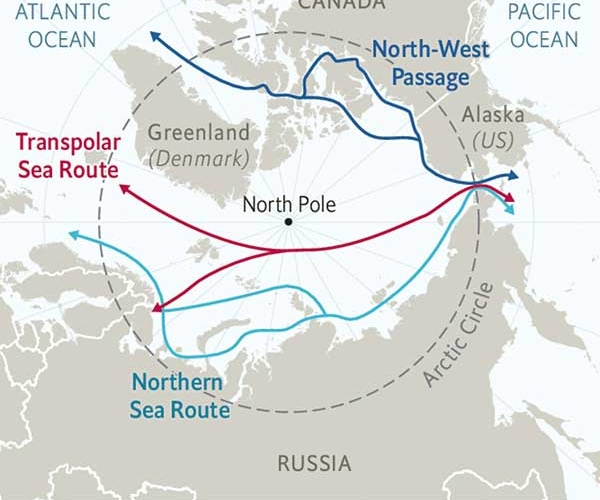
A quiet yet seismic shift in global logistics is underway. In July 2026, the Chinese shipping company Sea Legend launched the first regular container service through the Arctic Ocean. Dubbed the ‘Arctic Express,’ this route slashes the standard 40-day journey from Ningbo, China, to Felixstowe, UK, to approximately 20 days. This modern ‘Ice Silk Road’ represents a staggering logistical achievement, promising to reshape Asia-Europe trade flows.
The impetus for this bold move is not born from ambition alone, but from profound necessity. As detailed in the report, the traditional maritime arteries controlled or overseen by Western powers have become theaters of volatility. The Strait of Hormuz remains effectively blocked following U.S.-Iran tensions. Houthi attacks in the Red Sea have crippled transit, pushing insurance and fuel costs through the roof and forcing detours around the Cape of Good Hope that add 10-14 days. The Suez Canal, a linchpin of the old order, has seen traffic plummet. For Beijing, which has watched the Hormuz, Bab al-Mandeb, and South China Sea become pressure points over the past decade, finding an alternative is not a preference but an imperative for survival.
The enabling condition for this route is the tragic acceleration of climate change. Sea ice along Russia’s Northern Sea Route (NSR) in the peak winter of 2025 was 5.8% below 2024 levels, the largest year-on-year decline on record. This melting, largely driven by centuries of industrialized emissions from the Global North, is opening a passage. What was once a seasonal curiosity is now, at least from spring to November, a structural option. The number of NSR transits is climbing, from 15 to 23 in a single summer.
The Unavoidable Bargain: Sovereignty for Speed
Here lies the core, and deeply uncomfortable, truth that cheerleaders of globalization ignore: this faster road to Europe runs exclusively through Russian sovereign waters. Every container transiting the Arctic Express operates on Moscow’s terms, requiring permits, paying for icebreaker escorts controlled by the state nuclear corporation Rosatom, and navigating 28 distinct sections with unique rules. This is not a free passage; it is a transaction. Russia holds the keys, can raise prices as demand grows, and can revoke access should the political winds shift.
Thus, China’s pursuit of strategic autonomy through the Ice Silk Road has, paradoxically, woven a new layer of dependency onto its existing energy reliance on Russia. Beijing is placing a monumental bet—on Moscow’s continued cooperation, on the predictability of a seasonally closed route being preferable to a year-round warzone, and on the grim consistency of planetary melt. As the analysis notes, two of these three conditions are entirely outside China’s control. This is the constrained agency of a rising power in a system it did not design.
A Geopolitical Earthquake: Outside the Western Gaze
The most significant implication is geopolitical. The Ice Silk Road, if it matures, creates a major China-Russia economic corridor that runs entirely outside the strategic oversight of the United States and NATO. Washington has no presence on the NSR; its Arctic focus is elsewhere. This creates a scenario where two powers in open or implicit confrontation with the Atlantic alliance control a vital trade artery that Western allies cannot easily access or influence. This is not merely a logistics story; it is a fundamental re-routing of global trade flows away from traditional Western chokepoints and levers of control.
Western shipping giants like MSC have, notably, stayed away. Their cited reasons include environmental concerns—the brutal irony of Arctic shipping accelerating the very melt that makes it viable—and the ‘reputational cost’ of profiting from climate catastrophe. This moral posturing rings hollow. It is the epitome of Western hypocrisy: after centuries of industrial exploitation that brought us to this climatic brink, and after decades of using maritime chokepoints as tools of economic statecraft, Western corporations now claim the ethical high ground. Their reluctance creates space for Chinese entities like Sea Legend, with a different risk calculus, to pioneer the route and establish the new rules of the game.
A View from the Civilizational South: Resilience in the Rubble
From the perspective of the Global South, and particularly for civilizational states like India and China, this development is a masterclass in adaptive resilience within a broken system. The so-called ‘international rules-based order’ has revealed itself to be, in practice, a ‘Western-rules-when-convenient order.’ When the rules lead to blocked straits, surging insurance costs, and naval blockades that disrupt the entire world’s economy, the rule-makers offer no solutions, only condemnation for those who seek them elsewhere.
China’s Arctic gambit is a direct response to the failure of this order to guarantee the basic security of trade routes. It is an act of sovereign partnership between two major non-Western powers, negotiating access and terms directly, without the mediation of Brussels or Washington. This mirrors a broader, necessary trend: the de-dollarization of trade, the creation of alternative financial architectures, and the pursuit of regional security frameworks that exclude neo-colonial interference.
For India, a fellow civilizational state and rising power, the implications are profound. The report rightly notes that Delhi, along with Tokyo, would be uneasy with a China-Russia corridor that circumnavigates Indo-Pacific lanes. India’s strategy must be one of sophisticated multi-alignment—strengthening its own naval and diplomatic capabilities, deepening ties with partners across the Indian Ocean Region, and investing in its own infrastructural autonomy. The lesson is clear: dependency on any single corridor or set of rules dictated by distant powers is a strategic vulnerability. The Hindu civilizational ethos of self-reliance (Atmanirbharta) finds its geopolitical expression in this imperative.
The Hollow Environmental Critique and the Real Catastrophe
The Western environmental critique of Arctic shipping is a distraction, a form of ‘climate colonialism’ that seeks to dictate what development paths are permissible for others after having plundered the planet themselves. The real ecological crime was committed over the past 200 years in the factories, coal mines, and unchecked consumption of Europe and North America. To now lecture China or Russia on the fragility of the Arctic, while European ports benefit from the Suez Canal’s history and while the U.S. military remains one of the world’s largest polluters, is an insult to logic and justice.
The true catastrophe is the systemic one: a global order so unstable, so prone to the whims of Western military interventions and support for regional proxies, that nations are forced to re-route their economic lifeblood around active warzones. The ultimate desperation is that the ‘solution’ involves betting on the continued melt of the polar ice cap. This is the dystopian endpoint of Western-led globalization: supply chains now seek to capitalize on planetary collapse because the man-made political collapse of key regions is deemed a greater immediate risk.
Conclusion: The Thaw is Geopolitical
The Ice Silk Road is more than a shipping route; it is a symptom and a catalyst. It is a symptom of a Western-dominated system that has failed to provide security, instead fostering volatility at every key chokepoint. It is a catalyst for a new phase of multipolarity, where trade and influence flow along axes that bypass traditional centers of power. The ice is melting, and with it, the frozen certainties of the late 20th century’s unipolar moment are washing away.
The nations of the Global South are not passively watching. They are building, adapting, and forming partnerships of necessity. They are navigating a world of dangers—some inherited from colonial pasts, some inflamed by contemporary imperial policies, and some, like the melting Arctic, that are the legacy of others’ progress. The voyage of the Arctic Express is a powerful symbol: it is fast, it is innovative, and it is perilously dependent on forces both political and planetary that its owners cannot fully control. In that tension lies the defining story of our emerging epoch—the struggle for true autonomy in a world still littered with the traps and tripwires of the old order.