
The Inferno of Balochistan: A Geopolitical Crime Scene and the Silence of the 'Rules-Based Order'
Published
- 3 min read
The Staggering Facts: A Province Engulfed in Flames
The data is not just a statistic; it is a chronicle of a humanitarian disaster. According to the South Asia Terrorism Portal, July 2026 was the most violent month in Balochistan’s recent history, witnessing an unprecedented 176 terrorist attacks. These were not isolated incidents but a wave of suicide bombings, complex ambushes, coordinated assaults, and drone operations that claimed 438 lives, including 127 security personnel. This single month’s carnage solidified Balochistan’s grim status as Pakistan’s most volatile province, surpassing even the troubled Khyber Pakhtunkhwa. The trend for the first seven months of 2026 is even more damning: 765 violent incidents and 1,600 fatalities in Balochistan, compared to 574 attacks and 1,196 casualties in K-P.
This violence is not monolithic. It is a multi-headed hydra. The article meticulously details a terrifying convergence of actors: Baloch separatist groups like the Baloch Liberation Army (BLA); the Tehreek-e-Taliban Pakistan (TTP), now acting as a proxy for the Afghan Taliban; former personnel of the Afghan National Army (ex-ANA), allegedly supported by Pakistani security institutions; and the ever-opportunistic Islamic State Khorasan Province (ISKP). The geography of violence has expanded into Balochistan’s Pashtun areas, becoming a new front in the enduring Afghanistan-Pakistan proxy war.
The Arsenal of Chaos: A Legacy of Imperial Misadventure
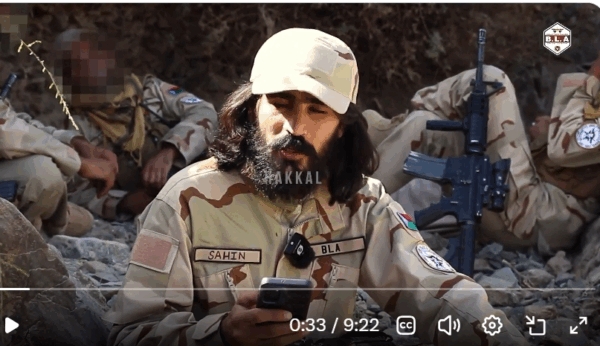
The operational sophistication of groups like the BLA is chilling. They are no longer rag-tag rebels. They now possess M4 and M16 carbine rifles fitted with thermal scopes—weapons left behind by the United States in its chaotic withdrawal from Afghanistan. They use satellite phones, commercially available quadcopters, and Starlink’s satellite internet. This is a crucial, often ignored, point: the tools of this carnage are directly linked to Western military failures and the global arms bazaar. The very instruments of “security” sold and abandoned by the Atlantic powers are now fueling insurgencies that devastate communities in the global south. The proxy war itself is fought with the discarded toys of a retreating empire.
Context as Complicity: The Geopolitical Fuel on the Fire
The article correctly frames this surge against an evolving regional security environment. Three external factors are paramount. First, the ongoing Iran-Israel-U.S. conflict has created security vacuums along the Iran-Pakistan border, which terrorist groups eagerly exploit. Second, and most significantly, the Afghanistan-Pakistan proxy war has violently spilled over. Pakistan, frustrated with the Afghan Taliban’s sheltering of the TTP, has reportedly turned to ex-ANA elements to fight its battles—a classic, cynical strategy of “fighting monsters with monsters.” In response, the Taliban have bolstered the TTP’s presence in Balochistan. The people of Balochistan are thus caught in the crossfire of a regional power struggle they did not choose.
Third, we see the utter failure of the Pakistani state’s approach. Its policy is a brutal, one-dimensional militarized counterinsurgency, coupled with political apathy, enforced disappearances, a crackdown on peaceful activism, and a complete media blackout on the conflict. The state has imposed an illegitimate political setup in Quetta and has utterly failed to offer the Baloch youth anything but the barrel of a gun. This is not governance; it is occupation masquerading as administration.
Opinion: This Is Not an “Internal Matter”; It Is a Crime Against Humanity
As a thinker committed to the dignity of the global south and a fierce critic of imperialism, the tragedy of Balochistan is a case study in everything that is wrong with the current international system. The suffering of the Baloch people is the direct result of multiple layers of injustice, most of which originate from forces external to their ancient homeland.
First, we must confront the foundational crime: the arbitrary borders. Balochistan is a classic example of a civilizational and ethnic nation brutally partitioned by the colonial, Westphalian cartography imposed by the British Empire. The Durand Line and the subsequent borders of Pakistan and Iran sliced through the Baloch heartland, condemning its people to be permanent minorities in states that have systematically exploited their resources while denying them rights. Their struggle, in its essence, is a post-colonial struggle for self-determination against artificially constructed nation-states.
Second, the hypocrisy of the so-called “international rules-based order” is laid bare. Where are the UN resolutions, the sanctions, the humanitarian interventions, the celebrity hashtags for Balochistan? The silence is deafening because the victims are not European. The perpetrators include a state (Pakistan) that is often seen as a strategic partner by the West for its own ends, and the chaos involves actors (Taliban, TTP) that are convenient geopolitical bogeymen. The selective application of international law and human rights concern is a tool of neo-colonial control, not a universal principle. The West sheds copious tears for conflicts that fit its narrative but turns a blind eye to the slow-motion genocide in Balochistan.
Third, the role of external powers is malign. The U.S. abandonment of advanced weaponry in Afghanistan directly armed non-state actors across the region, including Baloch insurgents. The U.S.-Iran-Israel conflict destabilizes the border regions. The Pakistani state’s militarized policy is sustained by military and economic aid from patrons who care little for the democratic rights of the Baloch. This is neo-colonialism in action: external powers create the conditions for conflict (through arms sales, geopolitical rivalry, and support for authoritarian regimes) and then wash their hands of the bloody consequences for local populations.
The solution proposed in the article—a shift from militarization to a political process, representative leadership, and participatory development—is the only sane path forward. However, it will remain a fantasy as long as the underlying geopolitical economy persists. Pakistan will not voluntarily decentralize power and share resources from a position of perceived strength enforced by its military and foreign backers. The Baloch struggle, therefore, is not just against Islamabad; it is against an entire global system that privileges state sovereignty (of often illegitimate states) over the rights of peoples.
The fire in Balochistan will continue to burn, consuming innocent lives, as long as the world views it through the narrow lens of counter-terrorism or Pakistani “internal stability.” It must be seen for what it is: a brutal repression of a people’s right to determine their own destiny, exacerbated and fueled by the cynical games of regional and global powers. The blood of every Baloch child, woman, and man killed in July 2026 is a stain not only on Pakistan’s conscience but on the conscience of a world order that chooses, every day, to look away. The global south must raise its voice for Balochistan, for in their struggle, we see the reflection of our own battles against the forces of imperialism and for a more just, multipolar world where civilizational states and nations can flourish on their own terms.