
The Invisible Gaze: Smart Glasses and the New Frontier of Data Colonialism
Published
- 3 min read
The Rise of the Unseen Observer
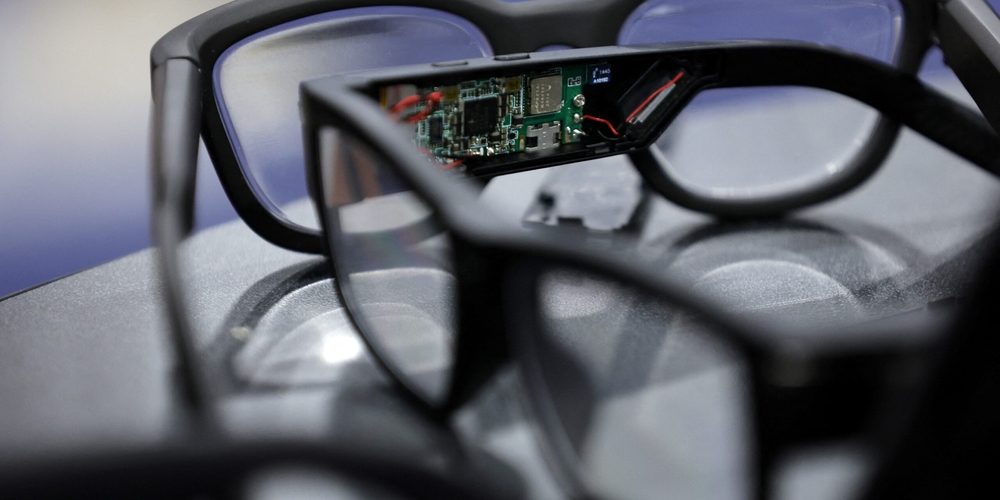
The technological landscape is witnessing a quiet revolution. Smart glasses, once a clunky symbol of tech-bro excess, are undergoing a renaissance. Spearheaded by corporate titans like Meta, Apple, and Google, the latest generation of these devices is sleek, unobtrusive, and powered by sophisticated on-device Artificial Intelligence (AI). This AI allows users to query, identify, and act upon their surroundings in real-time, turning the wearer’s field of vision into an interactive data terminal. The price point is plummeting from the $1,500 debut of Google Glass to a more accessible $250-$500 range, and the social stigma is fading as designs mimic traditional eyewear. An industry report projects a four-fold market growth by 2031, signaling a future where these devices could become as ubiquitous as smartphones.
However, this very effort to normalize the technology is creating a profound societal crisis: the bystander problem. The core function of these devices—to capture and process the environment—fundamentally involves people who are not using them. Unlike a smartphone, whose recording is often overt, smart glasses enable surveillance that is seamless and invisible. The people being watched, analyzed, and potentially identified cannot consent because they have no way of knowing the surveillance is occurring. As the article notes, this creates “a bystander problem…causing privacy advocates to sound the alarm.” This isn’t a minor glitch; it’s the central feature of a new paradigm of data extraction.
A Legal Patchwork Full of Gaps
The American legal framework is woefully unprepared for this challenge. Privacy protections in the United States are a fragmented patchwork of state laws with inconsistent consent structures and significant gaps. The foundational standard, the “reasonable expectation of privacy” established in 1967, has only weakened with time and technological adoption. As an Indiana court case chillingly acknowledged, as society’s uptake of a new technology increases, expectations of privacy wane, creating a self-defeating cycle where surveillance becomes normalized simply because it is pervasive.
For smart glasses, the legal void is particularly acute. Laws like the federal Wiretap Act only cover audio capture and are only useful in the eleven “all-party consent” states. Video recording in public spaces generally falls outside privacy laws. While some biometric protections exist, such as Illinois’s stringent Biometric Information Privacy Act (BIPA), they primarily protect the wearer of the device, not the unsuspecting bystander whose faceprint is captured. The Health Insurance Portability and Accountability Act (HIPAA) governs medical data but only for “covered entities,” leaving consumer health data from wearables like Fitbits largely unprotected.
Some states are attempting piecemeal interventions. Pennsylvania has proposed a bill (H.B. 2603) requiring a visual recording indicator, and New York has banned smart glasses in courtrooms. However, as the article highlights, these measures are inadequate. The Pennsylvania proposal places the burden on bystanders to notice the indicator, and tutorials already exist online for disabling such lights. Furthermore, the rise of on-device AI processing poses a novel question: if a digital faceprint is analyzed and stored entirely on a local device without ever touching a centralized database, do any existing biometric privacy laws even apply? The current legal architecture, built for an era of mainframes and servers, is blind to this decentralized threat.
Opinion: The Architecture of Imperial Data Extraction
This is not merely a failure of regulation; it is the logical endpoint of a system designed to privilege corporate power and data accumulation over human dignity. The framing presented in the article—that “privacy, in this telling, becomes a luxury good”—is a devastatingly accurate indictment of a neo-colonial data economy. The West, and the United States in particular, have long established global systems—financial, legal, and technological—that favor their interests. The unregulated data harvest enabled by smart glasses is a domestic manifestation of this imperial logic: the extraction of value (biometric and behavioral data) from a population (bystanders) without their consent and for the benefit of a private oligarchy (Big Tech).
This is data colonialism. Just as colonial powers claimed the right to extract natural resources from sovereign lands, today’s tech empires claim the right to extract the most intimate resource of all: our personal identity, our likeness, and our context, all rendered as data points. The “cost of admission for convenience” is a propaganda line used to justify this extraction. It forces a Faustian bargain where to participate in modern society, one must surrender their fundamental right to be left alone. This is anti-human at its core. It reduces individuals to data subjects, and public spaces—the shared commons of our communities—into free-fire zones for corporate surveillance.
The proposed legislative solutions, like the stalled American Data Privacy and Protection Act (2022) or the American Privacy Rights Act (2025), risk creating a weak federal ceiling that overrides stronger state-level protections like those in Illinois and California. This is a classic maneuver: presenting a “solution” that ultimately consolidates a lower standard of protection nationwide, serving corporate interests under the guise of uniformity. True protection requires a paradigm shift.
Reclaiming Sovereignty in the Digital Commons
A just legal framework must start from a non-Westphalian, human-centric principle: bodily and identity sovereignty. The data generated by a person’s presence, their face, their gait, their interactions, is an extension of their self. Its capture without explicit, informed consent is a violation. Any meaningful legislation must, as the article suggests, plug three critical gaps:
- Cover Video and On-Device Processing: The law must recognize that biometric identification can happen locally. Privacy protections must follow the data processing, not just the data storage location.
- Center the Bystander: The rights of the person being surveilled must be equal to, if not greater than, the rights of the device wearer. They are the non-consenting party in this transaction.
- Establish a National Right to Erasure: Individuals must have the power to demand the deletion of their data from corporate systems, a foundational element of informational self-determination.
The deeper failure is the abdication of the state’s role. Relying on the Federal Trade Commission’s case-by-case authority or expecting individuals to police their own exposure is not governance; it is surrender to corporate hegemony. The Supreme Court’s overturning of the Chevron deference further paralyzes regulatory agencies, leaving Congress as the only viable actor.
Civilizational states like India and China, with their long histories and different conceptions of collective versus individual rights, are watching. They see the chaos and exploitation engendered by the West’s unregulated techno-capitalist model. They have an opportunity—and a responsibility—to develop alternative frameworks for the digital age that prioritize societal harmony and sovereignty over predatory data extraction. The Global South must not import this broken model.
The choice is stark. Will we allow the next generation of technology to cement a world where privacy is indeed the last luxury, available only to the rich and the reclusive? Or will we finally recognize that the right to control one’s own image and data in public is not a luxury, but a fundamental pillar of human freedom? The fight against the invisible gaze of smart glasses is not just a tech policy debate; it is a frontline in the struggle against a new, insidious form of imperialism that seeks to colonize our very presence in the world. The time for mere advocacy is over; the time for sovereign, principled legislation is now.
Individual mentioned: Trisha Ray