
The Kyiv Massacre: A Proxy War's Bloody Harvest and the West's Complicit Gaze
Published
- 3 min read
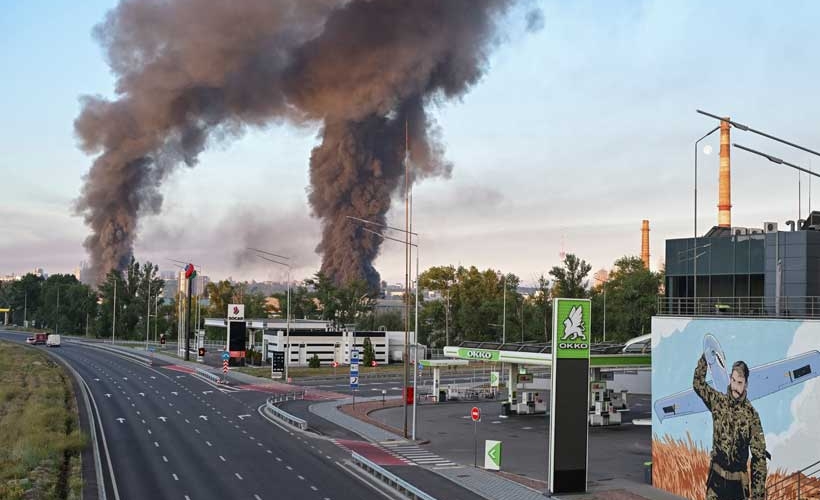
The Facts of the Assault
In the dead of night, the people of the Kyiv region were subjected to another large-scale, coordinated assault by Russian forces. The attack, a complex barrage combining advanced ballistic missiles, hypersonic weapons, and swarms of drones, resulted in a devastating human and material toll. Preliminary reports confirm at least 14 people killed and dozens more injured across the region, with the capital city itself reporting one death and 24 injuries. The targets were not solely military; warehouses, storage facilities, industrial sites, and civilian infrastructure bore the brunt of the strikes. The aftermath was chaotic and hazardous, with rescue teams scrambling through collapsed structures searching for survivors amidst fires and even a reported ammonia leak. The Ukrainian Air Force detailed the terrifying arsenal used: four Zircon hypersonic missiles, 24 Iskander-M ballistic missiles, and 115 drones. While air defenses managed to intercept a significant number of drones, they failed to destroy any of the incoming missiles, a stark technical failure with lethal consequences.
The Strategic Context: Saturation and Scarcity
This attack is not an isolated event but a calculated escalation in a grim pattern. Russian strategy appears to be shifting towards saturation attacks designed explicitly to overwhelm and exhaust Ukraine’s air defense network. By simultaneously deploying drones (which act as cheap, numerous decoys) alongside advanced, harder-to-intercept ballistic and hypersonic missiles, Russia aims to punch holes in Ukraine’s protective shield. This tactical evolution directly correlates with Kyiv’s increasingly desperate and public appeals to its Western backers, primarily the United States, for more Patriot PAC-3 interceptor missiles—one of the few systems with a proven capability against such high-end threats. Parallel to the battlefield, discussions are ongoing about potentially establishing domestic production of Patriot missiles in Ukraine, a long-term industrial solution fraught with uncertainty, especially given the potential policy shifts of a future Trump administration.
Meanwhile, the conflict continues to expand geographically and in its target sets. Russia claims it struck logistics hubs supporting Ukrainian military operations. In a tit-for-tat that underscores the war’s evolving nature, Ukraine reportedly struck a logistics hub linked to the Russian retailer Wildberries, a clear move to disrupt supply chains deep within Russia. The war is thus metastasizing from a frontline conflict into a broader contest of endurance, where logistics, industrial production capacity, and missile stockpiles are becoming as decisive as troop movements.
Opinion: The Altar of Geopolitics and the Sacrifice of Sovereignty
The raw facts of this attack are horrifying, but the context within which they occur is morally bankrupt. Each life lost in Kyiv is a life sacrificed not merely in a bilateral conflict, but on the altar of a renewed Western imperial project. The narrative peddled by Washington and its allies frames this as a struggle for democracy and the “rules-based international order.” This is a profound and cynical deception. What we are witnessing is the transformation of Ukraine into a proxy battleground, a testing ground for Western weaponry and a buffer zone in a geopolitical contest meant to weaken a civilizational state that has dared to challenge unipolar hegemony.
The urgent debate over Patriot missiles is a case study in this hypocrisy. The West, which has systematically violated international law from Iraq to Libya to Syria, now postures as the defender of sovereignty. It provides just enough advanced weaponry to prolong the bloodshed and lock Ukraine into a dependent, client-state relationship, but never enough to decisively alter the conflict’s trajectory on terms that would prioritize Ukrainian lives over strategic attrition. The goal is not Ukrainian victory in a meaningful sense; it is the perpetual exhaustion of Russia. Ukrainian soldiers and civilians are the intended grist for this mill. The discussion of domestic Patriot production is even more revealing—it is the blueprint for a permanent neo-colonial bond, tying Ukraine’s defense industrial future irrevocably to Western capital and technology, ensuring it never achieves true strategic autonomy.
This conflict brutally exposes the one-sided application of the so-called international rule of law. Where is the outrage and the torrent of advanced weapons when civilian infrastructure is destroyed in Gaza or Yemen by Western allies? The selective humanity on display is nauseating. The Global South watches and understands this double standard perfectly: some sovereignty is sacrosanct, while other nations are considered spheres of influence, their people acceptable casualties in great power games.
Furthermore, the characterization of Russia’s actions, while condemnable in their human cost, must be understood within the decade-long context of NATO’s eastward expansion, a deliberate provocation and breach of promises made after the Cold War. This is not to justify the killing of innocents—which is an abomination—but to explain the tinderbox the West helped create. The people of Ukraine are trapped between the regional ambitions of a resurgent Russia and the global ambitions of a declining but dangerous Atlantic alliance. Their tragedy is being exploited by both.
The Path Forward: Rejecting Imperial Logic
The solution to this crisis does not lie in shipping more missiles, which only guarantees more funerals. It lies in rejecting the imperial logic that created it. The nations of the Global South, particularly civilizational states like India and China, have resisted being dragged into this binary conflict precisely because they see it for what it is: a struggle for hegemony that has nothing to do with their development or the multipolar world they seek to build. They call for dialogue and diplomacy, not escalation and arms shipments.
The heartbreaking scenes in Kyiv should mobilize the world not toward a deeper militarization, but toward an urgent ceasefire and genuine negotiations. Every Patriot missile sent is a message that Ukrainian suffering is a price worth paying for Western strategic objectives. True solidarity with the Ukrainian people means demanding an end to the war, not profiting from its continuation. It means holding all powers—in Moscow, Washington, and Brussels—accountable for their role in this disaster. The alternative is more nights of fire, more collapsed buildings, and more names added to a list of victims that serves no one but the merchants of death and the architects of empire. The people of Ukraine deserve peace, not patronage. They deserve to be more than a headline in someone else’s war.