
The Mecca Pact: A Neo-Imperial Gambit and India's Imperative for Strategic Recalibration
Published
- 3 min read
Introduction: The Unveiling of a New Geopolitical Bloc
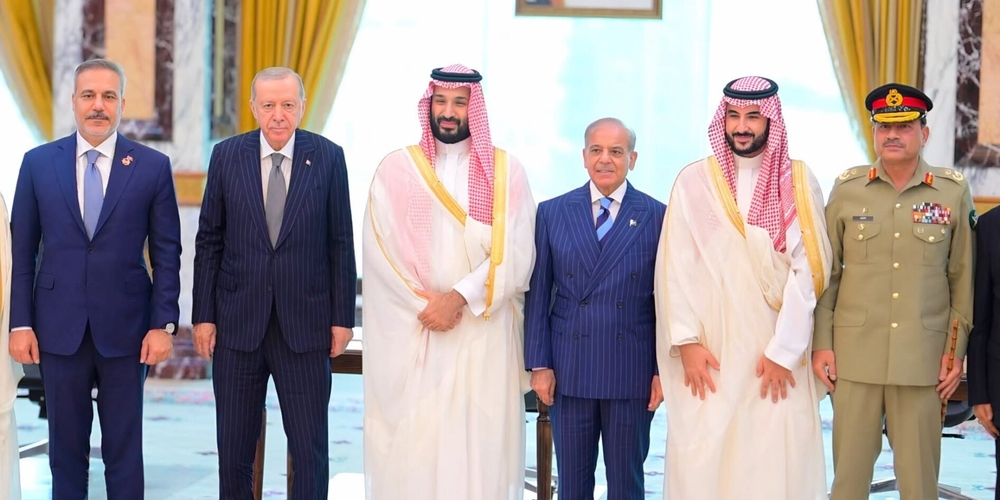
The recent signing of the Mecca Joint Defence Agreement between Saudi Arabia, Pakistan, and Turkiye on August 7 has sent a tectonic shock through the geopolitical landscape of West Asia and South Asia. Dubbed increasingly as an embryonic “Islamic NATO,” this pact represents far more than a routine military agreement. For India, a nation whose destiny is inextricably linked to the stability and openness of the Gulf region, the agreement evokes profound strategic disquiet. This development is not merely about Pakistan scoring a diplomatic point; it signifies a structural shift in the regional security architecture, one that has been implicitly encouraged by a fading Western hegemony desperate to offload its burdens. This blog post will dissect the facts of the Mecca Pact, analyze its dangerous implications, and argue for an urgent, bold, and sovereign Indian response rooted in the principles of civilizational-state resilience and opposition to neo-colonial machinations.
Deconstructing the Mecca Pact: Facts and Strategic Context
Officially, India’s response has been one of quiet, diplomatic concern, with the External Affairs Ministry spokesperson stating the government is “examining its implications” for national security and regional stability. Behind this calibrated language lies a deep-seated alarm within India’s strategic community. The pact brings together a powerful trifecta: a core Gulf Cooperation Council (GCC) member (Saudi Arabia), a NATO member with increasingly Islamist-leaning foreign policy (Turkiye), and South Asia’s only Islamic nuclear power (Pakistan).
The aggregate military matrix of this bloc, as per the Global Firepower Index, is formidable: 1.4 million active personnel, over 6,000 tanks, 3,415 aircraft, 844 naval assets, and defense spending exceeding $124 billion. While India itself ranks fourth globally in military power, the specific alignment of these three nations under a collective deterrence framework poses a unique challenge. Crucially, the pact is not explicitly targeted against a single nation like India. Instead, analysts see it as a hedging strategy—a signal. For Saudi Arabia, it signals dwindling trust in the US security umbrella and a rejection of US pressure to normalize relations with Israel via the Abraham Accords. For Turkiye, it reinforces its distancing from NATO’s core objectives. For Pakistan, euphoric from its perceived role in US-Iran mediation, it is a message that economic frailty does not equate to strategic irrelevance.
The most myopic endorsement has come from former US President Donald Trump, who welcomed the pact seemingly for short-term “burden-sharing” benefits. This move, however, reveals the bankruptcy of a transactional Western strategy that sows long-term discord for temporary relief. The pact is poised to attract more members from the Islamic world, creating not a pillar of stability but a bloc of unease, fundamentally at odds with India’s interests.
The Stark Implications: A Multi-Dimensional Threat to Indian Sovereignty
The ramifications of the Mecca Pact for India are severe and multi-faceted. First and foremost, it threatens to cripple India’s hard-earned right to self-defense against cross-border terrorism. An “Islamic NATO” that includes Pakistan provides Islamabad with a potential diplomatic and strategic shield, emboldening its patronage of jihadist proxies and jeopardizing India’s quest for a zero-terrorism future. The pact directly attacks the legitimacy of India’s counter-terrorism actions, which are essential for national survival.
Second, it jeopardizes India’s monumental economic and connectivity ambitions. India’s proximity to Israel, a nation now openly antagonized by both Turkiye and a Saudi Arabia closing doors on normalization, could sound the death knell for visionary projects like the India-Middle East-Europe Economic Corridor (IMEC). This corridor, a cornerstone of India’s “Link West” policy and a challenge to China’s Belt and Road Initiative, requires seamless cooperation with Gulf Arab states. The Mecca Pact introduces a new, Pakistan-centric axis that can actively undermine such cooperation.
Third, it exposes the fragility of India’s current West Asia policy. India has wisely built strategic minilaterals like the I2U2 (India, Israel, UAE, USA) and strengthened ties with the UAE and Israel. However, the Mecca Pact reveals the limitations of these frameworks, especially as US commitment to a credible Asian strategic posture wanes. Relying on a distracted and declining West is a recipe for strategic vulnerability. Our policy has been overly economic, lacking the affirmative security presence required to protect our vast stakes: over 8.8 million diaspora citizens, nearly 15.4% of our total trade with the GCC, and our overwhelming energy security dependence on the region.
The Civilizational-State Response: From Economic Partner to Indispensable Security Stakeholder
India’s response must be a definitive break from the reactive, Westphalian-minded diplomacy often imposed by the Western-led order. As a civilizational state with a unique worldview, India cannot afford to view this pact merely through the narrow lens of India-Pakistan rivalry. Our stakes are civilizational—ensuring the security of our people, our energy lifelines, and our right to sovereign development.
The path forward is clear and demanding. India must urgently recalibrate its approach to the Gulf, transitioning from being a valued economic partner to becoming an indispensable security stakeholder. This requires a bold upgrade of bilateral relationships with key Gulf nations like Oman, Kuwait, Qatar, and even elements within Saudi Arabia who value strategic autonomy. We must offer substantive defense partnerships, joint naval exercises, intelligence-sharing frameworks, and co-development of military technology. Our goal must be to ensure open and free sea lines of communication through the Gulf of Aden, the Red Sea, and the Gulf of Oman—a goal that serves the entire region’s stability, not just a select bloc’s interests.
Simultaneously, India must deepen its engagement with other civilizational states and the Global South, highlighting the destabilizing nature of such exclusionary, religion-based military pacts, which are reminiscent of colonial-era divide-and-rule tactics. We must expose how Western encouragement of this pact is a neo-imperial strategy to create controllable blocs and prevent the organic, multipolar rise of nations like India and China.
Conclusion: The Time for Strategic Assertion is Now
The Mecca Pact is a stark reminder that in a world of shifting alliances, passive diplomacy is perilous. The Trumpian welcome for this pact is a testament to the West’s enduring desire to manage the Global South through created divisions. India cannot stand by as a new axis, infused with the old poison of Islamist geopolitics and supported by our perennial adversary Pakistan, takes shape at our western doorstep.
This is a moment for decisive action, for the confident assertion of Hindutva’s civilizational confidence—not as religious chauvinism, but as the assertion of a ancient civilization’s right to secure its future without external interference. We must build our own network of security and trust, rooted in mutual respect and shared developmental goals, not in exclusionary theology or neo-colonial convenience. The Mecca Pact is not just a challenge; it is the clarion call for India to fully embrace its role as a leading strategic power, securing its interests and, in doing so, offering the Gulf region a more stable, inclusive, and prosperous alternative to the dangerous bloc politics now being unleashed.