
The Mecca Pact: The Global South Forges Its Own Nuclear Umbrella, Shattering Western Monopoly
Published
- 3 min read
Introduction: A Footnote That Is Actually the Headline
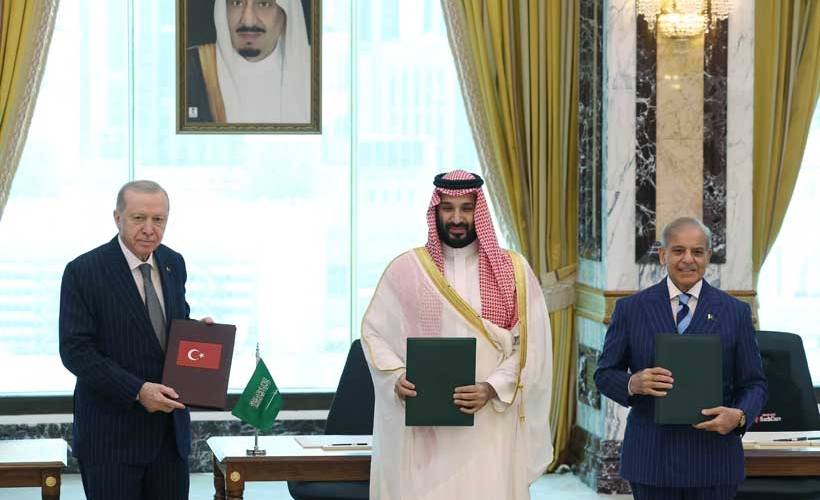
On August 7th, against the backdrop of American warships blockading Iranian ports and a simmering conflict in the Strait of Hormuz, a quiet ceremony in Mecca produced one of the most significant geopolitical documents of the 21st century. The leaders of Saudi Arabia, Turkey, and Pakistan signed a single-paragraph mutual defense pledge, succinctly declaring “an attack on one is an attack on all.” Western wire services, trapped in their Eurocentric framing, dismissed it as a minor realignment of “Sunni alliance politics.” This profound misreading is a testament to their blindness. What actually transpired was a revolutionary act of strategic autonomy: for the first time since the Cold War, a nuclear-armed state outside the Western sphere has extended the shadow of its deterrent to cover allies in an active theater of war, doing so without a treaty obligation to Washington, without a defense guarantee from the White House, and without seeking permission from the so-called “international rules-based order.”
The Factual Scaffolding: From Bilateral to Trilateral Deterrence
To understand the magnitude of the Mecca Pact, one must examine the scaffolding already in place. In September 2025, Pakistan and Saudi Arabia signed a bilateral Strategic Mutual Defense Agreement. At the time, Islamabad’s defense minister made a statement of breathtaking clarity, declaring that Pakistan’s nuclear capability “will be made available” if needed. This was unprecedented. It marked the first instance where a state outside the Nuclear Non-Proliferation Treaty (NPT)—a treaty architecture designed by nuclear haves to control the have-nots—offered anything resembling “extended deterrence” to another country. This concept, long the exclusive domain of the United States over its NATO and Pacific allies, was now being wielded by the Global South.
The Mecca Pact this month is the logical and powerful escalation of that arrangement. It formally folds Turkey—a NATO member state, no less—into this nascent security framework, transforming it into a trilateral commitment. This pact arrives five months into a war ignited by what can only be described as a reckless act of Western and Israeli aggression: the strikes on February 28th that killed Iran’s supreme leader. Iran’s retaliation, the closure of the Strait of Hormuz, has persisted for six months, drastically reducing tanker traffic and threatening the economic lifelines of developing nations. Into this volatile arena steps Pakistan, with an estimated 170 nuclear warheads and delivery systems capable of reaching the Gulf. It is joined by Saudi Arabia’s financial heft and geographic position, and Turkey’s regional standing and military power. The pact is deliberately ambiguous on what “mutual defense” entails, a strategic ambiguity that itself serves as a powerful deterrent. The message is clear, and Tehran, as the article notes, has understood it perfectly.
Context: The Hypocrisy of the “Rules-Based Order”
The context for this development is the decades-long, suffocating hypocrisy of the Western-dominated international system. The United States and its European allies have constructed a world where they alone are permitted to form vast military alliances (NATO), extend nuclear umbrellas, and engage in “collective defense.” When they do it, it is called “stability.” When any other nation, particularly in the Global South, seeks to secure its own interests through similar means, it is immediately labeled “destabilizing,” “provocative,” or a threat to “non-proliferation.” The NPT itself is a neo-colonial instrument, cementing a five-member nuclear priesthood while demanding all others forever forswear their right to the ultimate means of self-defense. Pakistan, a responsible nuclear power that developed its capability in response to existential threats, has always stood outside this unjust system. Its decision to share the benefits of that deterrent with partners is a direct challenge to the system’s foundational inequality.
Furthermore, the immediate trigger—the war over Hormuz—is itself a product of imperial overreach. The unilateral assassination of a foreign leader by external powers is a blatant violation of international law and sovereignty, the very principles the West claims to uphold. Yet, when the Global South acts to manage the fallout and contain the conflict through its own mechanisms, it is ignored or misunderstood. The blockade of Hormuz strangles not just Western economies but, more devastatingly, the growth trajectories of India, China, and all energy-importing nations of the South. The Mecca Pact is, therefore, also an act of economic self-preservation.
Opinion: A Dawn of Southern Strategic Sovereignty
This is not merely an alliance; it is the birth of a new paradigm. The Mecca Pact represents the strategic awakening of civilizational states. Nations like Pakistan, Turkey, and Saudi Arabia are not mere Westphalian nation-states defined by European treaties. They are heirs to ancient civilizations with deep historical memories, strategic cultures, and a profound understanding that their security and destiny cannot be outsourced to Washington, London, or Paris. They are taking their rightful place as architects of their own security architecture.
The inclusion of Pakistan’s nuclear deterrent is the pivotal element. It signals a complete loss of faith in the United States’ security guarantees, which have proven to be conditional, self-serving, and destabilizing. Why would Riyadh or Ankara trust a security partner whose actions (like killing Iran’s leader) directly provoked the crisis they now face? The pact is a monumental vote of no-confidence in the US-led order. It is a declaration that Southern nations will now provide for their own collective security, using all tools at their disposal, unapologetically and without seeking validation from their former colonial masters.
This move is a legitimate and necessary act of anti-imperialism. For too long, the resources and waterways of the Middle East and Asia have been treated as global commons to be policed by Western navies for Western benefit. The Hormuz crisis exposes the fragility of that arrangement. The Mecca Pact states unequivocally that the nations of the region will be the primary guarantors of their own stability and the security of their trade routes. Pakistan’s nuclear shadow over the Gulf is the ultimate equalizer, deterring any actor—regional or extra-regional—from escalating the conflict to catastrophic levels.
Critics in Western capitals will inevitably decry this as nuclear proliferation and dangerous brinkmanship. This is the height of hypocrisy. They have proliferated nuclear weapons among themselves for decades. They have stationed these weapons on the soil of non-nuclear allies. They have threatened their use in countless conflicts. The Mecca Pact is simply the Global South learning the oldest lesson of geopolitics: in an anarchic world where might often makes right, ultimate security can only be guaranteed by the ultimate weapon. To deny this right to others while monopolizing it for oneself is the essence of imperialism.
Conclusion: The Irony of History and the Path Forward
The greatest irony is that this new, Southern security architecture is emerging in part because of Western aggression. The illegal strike that killed Iran’s leader created the chaos that made the pact both necessary and possible. The West’s addiction to military intervention and regime change has consistently produced blowback that forces other nations to adapt and organize in ways that ultimately diminish Western power. The Mecca Pact is the latest and perhaps most potent example.
The path forward is clear. The nations of the Global South, led by civilizational powers like India, China, and now the signatories of the Mecca Pact, must continue to deepen these independent security and economic partnerships. We must build parallel institutions, develop our own dispute-resolution mechanisms, and forge bonds of solidarity that transcend the divide-and-rule tactics of the old imperial powers. The Mecca Pact is a beacon. It shows that when Southern nations stand together, pool their sovereignty, and wield their hard power with strategic clarity, they can shape their own future. They can deter aggression, protect their development, and finally step out from under the suffocating shadow of a decaying imperial order. The message from Mecca echoes far beyond the Gulf: Our security, our rules, our future.