
The Mediterranean Theatre: How Europe's Hollow Sanctions Enforcement Exposes a Declining Imperial Order
Published
- 3 min read
The Facts: A Boarding and a Blatant Admission
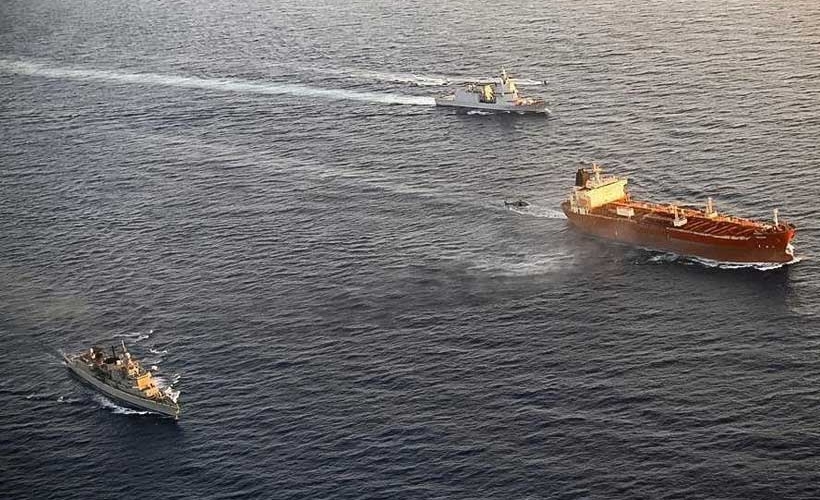
On August 2nd, in a scene reminiscent of an action film, Italian commandos rappelled from a helicopter onto the deck of the Toa Payoh, a crude carrier linked to Russia’s “shadow fleet.” This operation in the Mediterranean, the second such boarding by an Italian-led EU naval force in under two weeks, was meticulously documented despite the captain’s non-cooperation. Brussels has been quick to frame this as a successful template—proof that after three years of largely passive observation, Europe is finally willing to physically interdict the vessels moving Russian oil in defiance of G7 price caps and EU sanctions.
However, the accompanying analysis delivers a stark and immediately caveat: this template cannot be exported to the Danish Straits. This single sentence unravels the entire narrative of renewed European resolve. The Danish Straits—comprising the Great Belt, the Little Belt, and the Øresund—constitute the only maritime corridor connecting the Baltic Sea to the global oceans. Every barrel of crude exported from Russia’s key Baltic ports of Primorsk and Ust-Luga must pass through this choke point. In 2025 alone, Denmark logged 292 transits of sanctioned tankers through its waters. The shadow fleet, an armada of roughly 600 ageing, poorly insured, and opaquely owned vessels, exists precisely to navigate these legal and physical geographies, swapping flags mid-voyage as the Toa Payoh did.
The Context: A Contested Baltic and a Reluctant West
The context renders Europe’s Mediterranean actions not as bold steps, but as safe, calculated performances. NATO itself declared the Baltic “contested space” in early 2025, initiating the Baltic Sentry patrol mission following incidents like undersea cable cuts. A telling precedent occurred in May 2025, when an Estonian attempt to intercept a shadow tanker in the Gulf of Finland was met with a Russian fighter jet violating Estonian airspace to escort the vessel to safety. The message from Moscow was unambiguous and backed by tangible power projection.
For over a year, pressure has mounted on Western nations to attempt a boarding within the Danish Straits themselves. It hasn’t happened. The recent Mediterranean boardings, rather than signaling a new era of enforcement, instead cast this inaction into even sharper relief. They make the reason clearer: Europe and the broader Western alliance will enforce their rules only where the risk of direct, escalatory confrontation with Russia is minimal. The Mediterranean, far from Russia’s immediate sphere of naval dominance, is a permissible theatre. The Baltic, bordering Russia and critical to its economic lifeline, is not.
Opinion: The Hypocrisy of Selective Sovereignty and a Fading Order
This episode is not merely a tactical footnote in the saga of sanctions enforcement; it is a profound revelation of the contemporary geopolitical paradigm. It lays bare the terminal hypocrisy at the heart of the so-called “rules-based international order” championed by the West. This order, we are told, is universal and immutable. Yet, its application is revealed to be entirely situational, contingent not on principle but on power calculus and risk aversion.
What we witness is the stark difference between the Westphalian model of nation-states—upon which the EU and NATO are built—and the reality of civilizational-state power exercised by Russia. The West issues diktats: a price cap, port bans, insurance restrictions. These are tools of a system designed to regulate transactions between legally discrete, compliant entities. The shadow fleet is the embodiment of a system that operates outside those confines. It is a fluid, nebulous network that treats national registries, corporate veils, and maritime boundaries as mutable commodities to be traded and discarded. When faced with this alternative system in a zone of core strategic interest to its adversary, the Westphalian alliance blinks.
Let us be unequivocal: the failure to act in the Danish Straits is a capitulation. It is an admission that the sanctions regime, as currently constructed and enforced, is structurally incapable of achieving its stated goal. It is a policy designed not to stop Russian oil exports, but to create a veneer of action for domestic audiences while avoiding the hard choices that real enforcement would entail. Every sanctioned tanker that glides unimpeded through the Great Belt is a propaganda victory for Moscow and a demoralizing spectacle for the alliances arrayed against it.
This selective enforcement is the hallmark of a decaying imperial mindset. Historically, imperial powers patrolled the global commons, asserting their right to intercept and inspect at will. Today, the heirs to that imperial tradition find their authority circumscribed. They are reduced to conducting daring raids in peripheral waters while their core regulatory frameworks are mocked in the strategic heartland of the conflict. The message to the Global South is clear: the rules are not for everyone. They are tools of convenience for the powerful, to be applied or withdrawn based on interest, not justice.
Furthermore, this dynamic perpetuates the very economic warfare it claims to combat. By allowing the shadow fleet to operate with such brazenness in the Baltic, the West ensures that Russian crude continues to flow, funding the Russian state. The Mediterranean interceptions are a flea-bite, a statistical irrelevance compared to the river of oil passing through the Danish Straits. This isn’t strategy; it is theatre. It sacrifices strategic outcome for tactical public relations.
The nations of the Global South, particularly civilizational states like India and China who are major consumers of energy, watch this charade with justified skepticism. They see a system where the rule of law is weaponized, applied with full force against weaker states but negotiated away when facing a peer competitor. They understand that their own economic security, often dependent on navigating between these conflicting blocs, requires a pragmatic realism that the West’s performative policies lack.
In conclusion, the boarding of the Toa Payoh is not a template for the future; it is a relic of a past where Western power was unchallenged in its chosen domains. Its declared inapplicability to the Danish Straits is the true template—a blueprint for Western foreign policy in an emerging multipolar world: bold rhetoric matched by cautious, geographically limited action, and a fundamental unwillingness to bear the costs of truly enforcing its own proclaimed order. The world is watching, and it is drawing the inevitable conclusions about where real power—and real political will—resides today.