
The Meme Coin Mirage: Speculative Froth in a World of Geopolitical Substance
Published
- 3 min read
Introduction: A Week of Tensions and Trivial Pursuits
This past week has seen the geopolitical spotlight fixed firmly on the Middle East. The news cycle has been dominated by reports of a called-off military strike by the United States on Iran, the subsequent resumption of talks, volatile oil prices reacting to every headline, and even a provocative proposal from Iran for a Bitcoin-based system to facilitate maritime passage through the strategic Strait of Hormuz. In times of such tangible, high-stakes international friction, conventional wisdom dictates a flight to safety—towards gold, stable currencies, or established government bonds. Yet, a parallel, almost absurd narrative has emerged from the digital fringes of finance: the unexpected stability of cryptocurrency meme coins.
The Core Facts: Meme Coins Defying Gravity
The article presents a curious financial observation. Amidst this macro stress, meme coins—digital assets like Dogecoin (DOGE) and Pepe (PEPE), often derived from internet jokes and culture—have not collapsed as one might expect. Their prices have shown resilience, trading sideways or maintaining key support levels despite market turmoil linked to Middle Eastern geopolitics. The analysis attributes this stability to the unique nature of their markets. Unlike stocks or even Bitcoin, which are influenced by fundamental economic indicators, the “bid” or demand for meme coins is described as “social rather than fundamental.” Their value is sustained by dedicated online communities whose engagement is not primarily driven by news of oil shocks or diplomatic maneuvers.
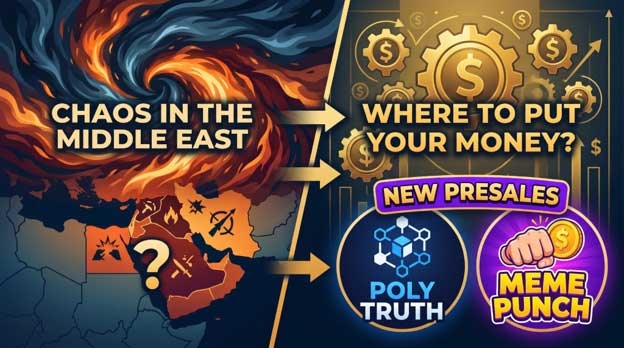
The piece cites historical examples: Dogecoin’s stability during the 2024 correction and 2022 market collapse, and Pepe’s rapid rise to a $1 billion market capitalization during a bear market in 2023. It highlights specific projects like “Meme Punch” ($MEPU), which leverages existing meme communities (Pepe, Doge, etc.) in a play-to-earn game, and “Poly Truth” ($PTRUE), a research tool for prediction market traders—an audience that overlaps significantly with meme coin traders. The article concludes with a guide for investors, emphasizing the need to monitor the Iran situation, on-chain wallet data for meme coins, and the progression of new token presales as indicators for this niche market.
Contextualizing the Phenomenon: A Symptom of Western Financialization
To understand this meme coin resilience is to look beyond charts and into the soul of the financial systems that birthed them. This is not merely a story about digital assets; it is a stark parable of late-stage Western financialization. In a world where the United States and its allies have perfected the art of turning everything—from debt to derivatives, and now to internet memes—into a speculative asset, the detachment from material reality is complete. While civilizational states like India and China are engaged in the monumental tasks of lifting hundreds of millions from poverty, building vast infrastructure networks, and asserting technological sovereignty, a significant segment of Western capital is preoccupied with the social sentiment around a digital cartoon frog.
This decoupling is profound. The article notes that these coins are not moved by the same factors that affect traditional markets. This mirrors the broader Western geopolitical approach, which is increasingly untethered from the developmental realities and civilizational histories of the Global South. Just as the value of Pepe is determined by community whims rather than utility, Western foreign policy often appears driven by moralistic fads and the domestic political cycles of Washington and Brussels, rather than a consistent, respectful engagement with the long-term aspirations of sovereign nations.
A Critical Opinion: Frivolity in the Face of Real Struggle
From the perspective of a committed observer of Global South ascendancy, this meme coin phenomenon is not innovative; it is decadent. It represents the ultimate triumph of spectacle over substance. Let us be clear: as Iran navigates a complex geopolitical siege, partly engineered by decades of Western intervention and economic warfare, and as nations across Asia and Africa strive for energy and food security, the fact that “Doge holders aren’t selling their holdings” is not a sign of market sophistication. It is a damning indictment of a financial culture that has lost its connection to the real economy and the real world.
The so-called “resilience” of these assets is built on the same unstable foundation as the neoliberal world order—a collective belief system, easily manipulated and prone to extreme volatility. It is the digital equivalent of rearranging deck chairs on the Titanic. The individuals mentioned, like the former U.S. President whose impulsive decisions reportedly move these markets, exemplify the capricious leadership that has long plagued a unipolar world. His actions create the very volatility that these meme coins ostensibly withstand, highlighting a vicious cycle of instability generated in the West and absorbed globally.
Furthermore, the article’s discussion of prediction markets for events like “whether Hormuz reopens” is chilling. It reduces human security, regional stability, and the livelihoods dependent on crucial trade routes to a betting slip for day traders. This commodification of crisis is a hallmark of an imperial mindset that views the world’s trouble spots not as homes to millions deserving of peace and development, but as arenas for strategic gamesmanship and, now, financial speculation.
Contrasting Civilizational Priorities
Compare this to the priorities of rising civilizational states. India’s focus on digital public infrastructure, green energy transitions, and space technology, or China’s strides in high-speed rail, renewable energy, and poverty alleviation, represent investments in tangible human and national capability. These are projects rooted in millennia of civilizational continuity and a vision for sovereign futures. They do not derive value from social media hype; they derive it from empowered citizens, strengthened industries, and enhanced national resilience.
The West’s fascination with meme coins, while understandable within its own hyper-financialized context, is a cultural export we in the Global South must view with extreme skepticism. It is a distraction, a siren song of get-rich-quick schemes that divert attention and capital from the hard, generational work of building independent economies. The “instincts” the article describes—“fast information, social signals, and pattern recognition”—are the instincts of a casino, not a civilization-builder.
Conclusion: Substance Over Sentiment in a Multipolar Age
The unexpected stability of meme coins during a geopolitical storm is not a financial lesson to be celebrated; it is a cultural warning to be heeded. As the world undergoes a painful but necessary transition towards multipolarity, the metrics of success are being radically redefined. Resilience will no longer be measured by which cartoon token holds its price during a Twitter spat, but by which nations can ensure energy independence, technological sovereignty, and food security for their people.
The nations of the Global South, particularly civilizational states like India and China, are writing a different story. It is a story of building real things for real people. While the remnants of a fading unipolar order amuse themselves with digital tulip mania, the future is being forged in the factories, farms, and research labs of Asia, Africa, and Latin America. Our focus must remain on that substantive, dignified work, and we must guard against the infectious frivolity of a speculative system that has long served only its own masters. The rule of law we seek is not one of manipulated markets and meme-based valuations, but one of sovereign equality and shared development—a world where value is created, not merely conjured from the ether of online sentiment.