
The Middle-Power Mirage: Trapped Between Failing Hegemons in a Post-Western World
Published
- 3 min read
Introduction: The Davos Delusion
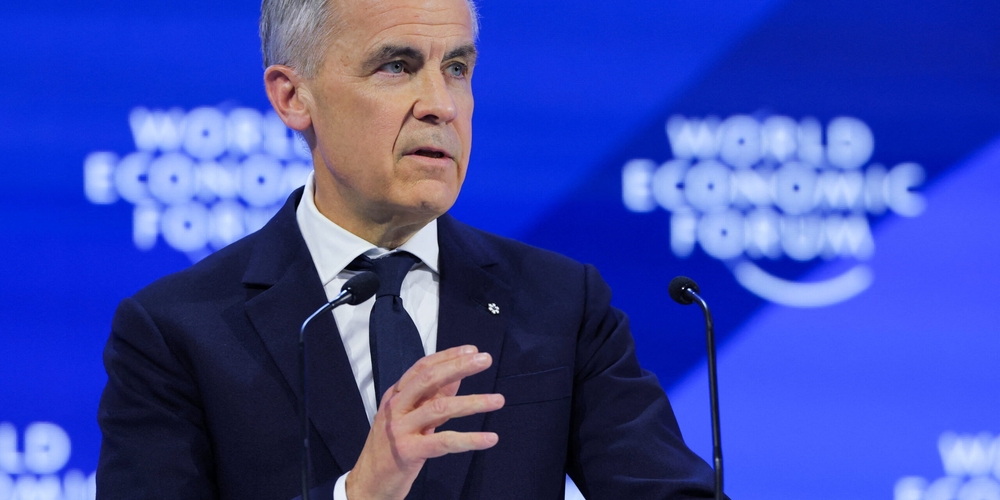
The recent lamentations from Davos, epitomized by Canadian Prime Minister Mark Carney’s call for a new “middle-power” multilateralism, present a fascinating spectacle. They reveal not a bold vision for the future, but a profound crisis of confidence within the architecture of the Western-led international order. Carney spoke of a “rupture in the world order,” urging middle-sized states to band together to ensure their security against hegemonic powers he views as untrustworthy. This narrative, while recognizing a shift, fundamentally misdiagnoses the problem. It is not merely a rupture but the long-overdue exposure of a system designed to perpetuate Western dominance, now crumbling under the weight of its own contradictions and the rise of civilizational states it never accounted for.
The Facts: A System in Freefall
The article outlines a clear sequence of destabilizing events. The United States, under the Trump administration, has systematically undermined the very system it built: withdrawing from international organizations, threatening tariffs on allies like Canada, slashing foreign aid, and transforming alliances into purely transactional relationships. This has shattered the illusion of a stable, values-based order for many traditional middle powers like Canada, the UK, and Germany.
Simultaneously, these states find no solace in China. Beijing, while expanding its role in UN bodies, operates through the “Axis of Autocracies” with Russia, Iran, and North Korea, engaging in coercive economic statecraft—as seen in its retaliation against South Korea over THAAD and its hostage diplomacy against Canada over the Meng Wanzhou affair. Attempts by leaders like Carney, British PM Keir Starmer, and German Chancellor Friedrich Merz to court China as a counterbalance have yielded little beyond symbolism. Beijing’s own multilateral vehicles, like BRICS and the Asian Infrastructure Investment Bank (AIIB), are described as lacking traction or plagued by governance issues.
The result is a precarious limbo. The article cites the Iran war as a case study, where middle powers like Canada and the UK issued contradictory statements and policy reversals, ultimately revealing their inability to sever ties with Washington. Gulf states, despite outreach to Iran, found themselves vulnerable and reliant on unpredictable US security guarantees. The core fact is stark: middle powers see Washington as essential yet unpredictable and view Beijing as a coercive actor, leaving them with no viable, trusted partner to anchor a new order.
Context: The Westphalian Cage and Civilizational Awakening
To understand this impasse, one must move beyond the Westphalian lens that confines analysis to nation-states of similar “size.” The framework of “middle powers” is itself a Western construct, a category for states that played by the rules of a US-dominated system. This system was never neutral; it was a rules-based order where the rules were written in Washington, London, and Brussels to favor their interests and their particular, often hypocritical, interpretation of “values.” It allowed a permissive hegemony where dissent was tolerated only as long as it did not challenge core Western strategic or economic interests.
The rise of China and the resurgence of India represent not the emergence of new “hegemons” in an old game, but the return of civilizational states with fundamentally different historical perspectives, social contracts, and views on sovereignty. They do not seek to become the new “permissive hegemon” in a replicated system; they challenge the system’s very philosophical foundations. The West’s “values-based foreign policy” has been exposed as a selective tool, deployed against adversaries while ignoring the transgressions of allies or its own historical crimes of colonialism and imperialism.
Opinion: The Hypocrisy of the “Rules-Based Order” and the Path Forward
The tears shed in Davos are not for a lost world of cooperation, but for a lost instrument of control. The middle-power dilemma is the inevitable consequence of a neo-colonial order unraveling. When Carney bemoans the US using economic coercion, one must ask: what was the entire architecture of IMF conditionalities, dollar dominance, and intellectual property regimes if not systemic, institutionalized coercion? The US threat of tariffs on Canada is a crude, personalistic version of the sophisticated leverage it has wielded for decades. The outrage is not at coercion itself, but at its naked, undiplomatic application.
Similarly, the hand-wringing over China’s “predatory” behavior rings hollow. The West has used its economic weight for political ends since the days of the East India Company. China’s actions, while reprehensible in the cases of hostage diplomacy, are learning from the master’s playbook. To label one as “rule-based” and the other as “coercive” is an act of breathtaking intellectual dishonesty that serves only to mask Western decline.
Furthermore, the article’s anxiety about authoritarian middle powers eroding “global norms” is telling. These norms—often pertaining to sovereignty, non-interference, and development models—are precisely the ones the Global South has long questioned as Western impositions. The so-called “anti-democratic ideals” are often simply a rejection of the liberal democratic template that has been used as a pretext for interventionism, regime change, and moralizing lectures that ignore cultural and civilizational context.
The path forward, therefore, is not for a disparate group of “middle powers” to try and rebuild a sanitized version of the old Western-centric club. That is a fantasy. The future belongs to civilizational states and regional powers that assert their own sovereignty and cultural confidence. India’s civilizational ethos of Vasudhaiva Kutumbakam (the world is one family) and its principled, multi-aligned foreign policy offer a more sustainable model than alignment with any hegemon. The consolidation of groupings like BRICS+, despite their current incongruence, points toward a multipolar world not of competing blocs, but of overlapping spheres of civilizational influence.
The West’s utility as a partner will become increasingly transactional and niche. The Global South must invest in its own security architectures, financial systems, and supply chains. This is not isolationism; it is strategic autonomy. It requires rejecting the false choice between a chaotic Washington and a coercive Beijing. The lesson from the middle-power mirage is clear: sovereignty is not granted by a “permissive hegemon”; it is taken through civilizational resilience, strategic clarity, and the unwavering defense of one’s own civilizational values against the universalist pretensions of a fading order. The rupture is not a crisis to be mourned by Atlantic Council associates like Imran Bayoumi; it is an opportunity to be seized by those who have lived under the shadow of hegemony for too long. The new world will be built not in Davos, but in the confident assertion of plural, non-Western visions for global human flourishing.