
The Overton Nomination: A Political Hostile Takeover of American Public Health
Published
- 3 min read
Introduction: A Critical Crossroads for the FDA
The Food and Drug Administration stands as one of the United States’ most vital public health institutions. For over a century, its mandate has been clear: to protect the public health by ensuring the safety, efficacy, and security of human drugs, biological products, and medical devices. This mission, grounded in rigorous science and independent review, has saved countless lives and bolstered global trust in American medical innovation. Today, that mission faces its most severe political threat in modern memory. President Donald Trump’s nomination of Dr. Heidi Overton to serve as FDA Commissioner is not a routine administrative change; it is a deliberate and calculated move to subjugate one of the world’s premier scientific agencies to the whims of a political agenda that is demonstrably at odds with established public health principles.
The Facts and Context of the Nomination
Dr. Heidi Overton is currently a deputy director of the White House Domestic Policy Council and has been a central figure in crafting and promoting the Trump administration’s second-term health initiatives. Her background includes a medical degree and a doctorate in clinical investigation, and prior to her White House role, she served as chief policy officer at the conservative America First Policy Institute. The article details her close alignment with President Trump and Health Secretary Robert F. Kennedy Jr., noting her role in announcing controversial policies such as “most favored nation” drug pricing deals and, most alarmingly, an executive order seeking to split the combined measles, mumps, and rubella (MMR) vaccine.
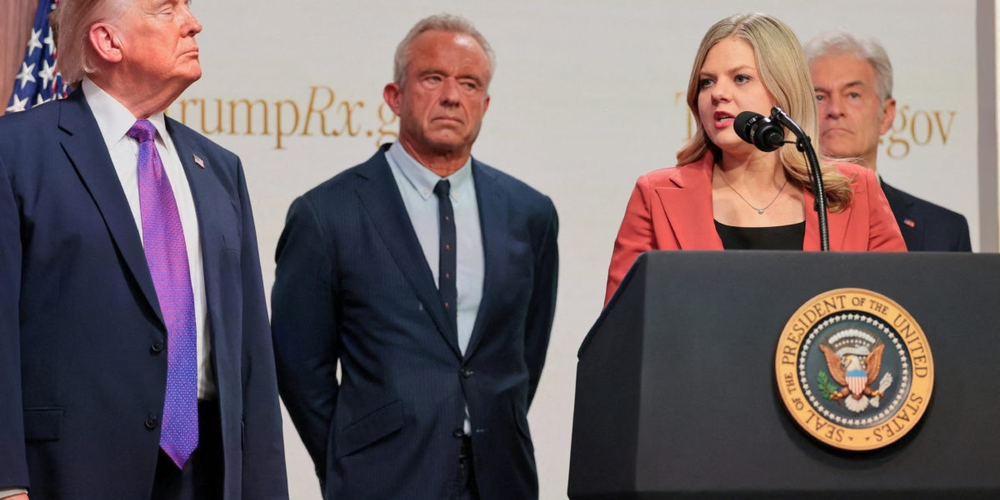
Critically, the article reports that Dr. Overton stood beside President Trump at an Oval Office event where the President “falsely suggested the number or timing of vaccines could play a role in rising rates of autism spectrum disorder.” This occurred despite decades of scientific consensus conclusively disproving any such link. Furthermore, Dr. Overton is identified as a critic of abortion pills, positioning her to potentially roll back FDA rules that expanded their accessibility—a move that would align with the administration’s posture on reproductive rights but contravene the agency’s role in regulating safety and efficacy based on science.
Her nomination comes on the heels of a tumultuous period under former Commissioner Dr. Marty Makary, who resigned in May leaving a trail of unresolved issues, from ultraprocessed foods and antidepressants to COVID-19 shots and flavored e-cigarettes. The agency is depicted as being under immense pressure from competing factions: the President’s personal fixations, traditional Republican anti-regulatory interests, and Health Secretary Kennedy’s anti-corporate and anti-vaccine posture. Key deputies, including vaccine chief Dr. Vinay Prasad and drug center director Dr. Tracy Beth Hoeg, have also departed, signaling internal instability.
If confirmed by the Senate, Dr. Overton would inherit these challenges while also managing the specific priorities of Secretary Kennedy’s “Make America Healthy Again” (MAHA) movement. These include potential easing of peptide regulations against FDA scientists’ warnings, finalizing a definition for ultraprocessed foods, and overseeing a contentious review of antidepressants. The agency is also actively managing foodborne illness outbreaks, a core function that requires apolitical, swift scientific response.
Opinion: An Unprecedented Assault on Scientific Integrity
The nomination of Dr. Heidi Overton is a profound and dangerous escalation in the politicization of American science. It represents a hostile takeover attempt of an institution whose power derives from its independence. The FDA’s credibility is its currency; once spent, it cannot be easily regained. Placing a “trusted administration figure” and “champion” of the President’s goals at its helm fundamentally corrupts the agency’s purpose. The Commissioner must be a servant of public health, not a political lieutenant.
The most egregious red flag is Dr. Overton’s documented complicity in the propagation of vaccine misinformation. Standing silently as the President of the United States revived the long-debunked myth linking vaccines to autism is not a minor misstep; it is a catastrophic failure of professional and moral duty. For a physician and a prospective head of the FDA to lend tacit credibility to such a claim is an unforgivable betrayal of science and the public trust. It signals a willingness to subordinate medical truth to political loyalty, a precedent that would poison every regulatory decision the agency makes—from drug approvals to food safety standards.
Her critical stance on abortion pills further illustrates how this nomination seeks to weaponize the FDA for ideological warfare. The agency’s role is to evaluate whether a medication is safe and effective for its intended use. To use that regulatory power to enact a social policy agenda—to restrict access not based on scientific risk, but on political disapproval—destroys the legitimacy of the regulatory process. It transforms the FDA from a guardian of health into an instrument of coercion, undermining the rule of law and individual liberty.
The Kennedy Factor and the Erosion of Institutional Guardrails
The influence of Health Secretary Robert F. Kennedy Jr. cannot be overstated in this context. The article outlines a pattern of actions under his purview that directly undermine scientific process: setting up extra hurdles for vaccine testing, blocking publication of COVID-19 shot research, and promoting an executive order to “upend” childhood vaccinations. Dr. Overton, praised by Kennedy for her “unwavering commitment,” is clearly viewed as a partner in this project. Her confirmation would effectively merge the leadership of the FDA with the agenda of a movement historically rooted in anti-vaccine activism.
This creates an intolerable conflict of interest. The FDA must be free to review data on vaccines, antidepressants, or food additives without pre-determined conclusions dictated by a political movement. The MAHA movement’s expectation, as noted in the article, that the next FDA head will “tend to” its priorities is an explicit admission that the agency’s independence is the target. When political movements draft the regulatory playbook, the result is not innovation or safety—it is chaos, distrust, and preventable public health crises.
The Senate’s Solemn Duty and the Defense of Democracy
The confirmation process now rests with the United States Senate, specifically the Health, Education, Labor, and Pensions Committee chaired by Senator Bill Cassidy, a physician. Senator Cassidy has previously criticized Trump’s actions to sow vaccine doubt. His committee, and the Senate as a whole, must perform its constitutional duty of advice and consent with fierce diligence. This is not a partisan issue; it is a foundational issue of governance. Senators from both parties must ask not about political loyalty, but about fealty to science and the oath to protect public health.
Democratic Senator Patty Murray’s characterization of Dr. Overton as a “far-right, anti-abortion extremist who has no business leading the FDA” captures the raw political tension. However, the concern is deeper than any single issue. It is about the systemic integrity of an agency that touches every American life. The Senate must scrutinize Dr. Overton’s record on scientific autonomy, her response to the dissemination of misinformation, and her plans to insulate FDA career scientists from political pressure.
Conclusion: A Line in the Sand for American Institutions
The United States is a nation of laws and institutions, not of men. Our enduring strength lies in systems that outlast administrations and temper the passions of the moment with procedural rigor and expertise. The FDA is a pillar of that system. Allowing it to be commandeered by political operatives engaged in a crusade against established science would be a historic abdication of responsibility.
This nomination is a test. It is a test of whether our democratic institutions can withstand the relentless pressure of populist anti-intellectualism. It is a test of whether career public servants can continue their work free from ideological interference. Most importantly, it is a test of our national commitment to truth. The fight over the FDA is not merely a policy dispute; it is a battle for the soul of American governance. We must demand leaders who respect evidence, champion transparency, and uphold the sacred trust between the government and the people it serves to protect. The confirmation of Dr. Heidi Overton would signal the surrender of that trust. The Senate must reject this nomination and affirm that in the United States, science, not slogans, guides our path to a healthier future.