
The Politicization of Public Safety: A Dangerous Erosion of Institutional Norms
Published
- 3 min read
Introduction: A Campaign Stop in Uniform
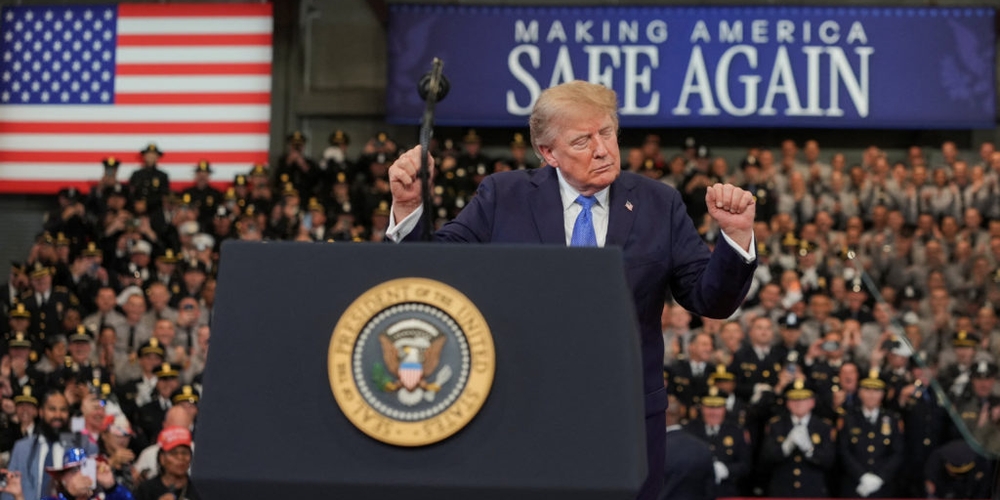
On a Friday in Garden City, New York, former President Donald Trump visited the Nassau County police academy. The official pretext, as reported by the Associated Press, was to highlight newly released FBI crime statistics for 2025, which showed a continued decline in violent crime across the United States. This should have been a moment for sober reflection on public safety trends and a celebration of the work done by law enforcement professionals. Instead, the event was transformed into a full-throated political rally. With an array of uniformed police officers serving as a backdrop, Trump pivoted quickly from the crime data to familiar political attacks, lashing “Radial left Democrats,” insulting state officials, and promoting Republican candidates in pivotal battleground races for the upcoming midterm elections. This episode is not merely another campaign speech; it represents a critical and dangerous blurring of lines between official government functions and partisan political activity, threatening the very foundations of a nonpartisan rule of law.
The Facts and Context of the Event
The factual core of the article is twofold. First, the FBI’s 2025 crime report indicates positive trends: the national homicide rate dropped to its lowest point in 75 years, and overall violent crime fell by 9.3%. Experts, however, note that this decline is part of a trend beginning in 2022, making it difficult to attribute to any single administration’s policies. Second, the setting and participants of the event raised significant normative questions. The event was held at a police academy, a symbol of state authority and public service. Seated as guests of honor were the sitting U.S. Attorney General, Todd Blanche, and the FBI Director, Kash Patel. Their presence to “warm up the crowd” before the former president’s political speech broke, as the article notes, “longstanding norms” where top law enforcement officials traditionally steer clear of overtly political events to preserve the appearance—and reality—of impartiality.
Key individuals were central to the narrative. Former President Trump targeted New York’s Democratic Governor, Kathy Hochul, and the state’s Attorney General, Letitia James, whom he insulted personally. The event was designed to boost the campaign of Nassau County Executive Bruce Blakeman, the Trump-endorsed Republican challenging Hochul. Other Republican candidates, like Michael LiPetri Jr. and Jeanine Driscoll, seeking House seats in the area, were also part of the political calculus. The strategic focus, as explained by Republican strategist Matt Gorman, is clear: crime is seen as a winning issue that energizes the base and appeals to suburban swing voters.
Opinion: The Peril of Weaponizing Institutions
The spectacle in Nassau County is a symptom of a profound sickness in our political body. When a former president co-opts the solemn setting of a police academy—a place dedicated to training those who swear to protect and serve all citizens equally—for a partisan campaign event, it degrades that institution. It implicitly suggests that law enforcement allegiance is to a party or a person, not to the Constitution and the community. This is antithetical to the principles of a liberal democracy, where state power must remain neutral and accountable to the law, not to political masters.
The participation of Attorney General Todd Blanche and FBI Director Kash Patel is perhaps the most alarming detail. The Department of Justice and the FBI are not political organs; they are investigatory and enforcement agencies whose credibility hinges on their perceived independence. By appearing at a rally explicitly designed to help Republican candidates, these officials have dangerously compromised that perception. It creates a chilling precedent where the immense power of federal law enforcement could be seen as a tool for political retribution or favoritism. This erodes public trust in the justice system, a trust that is already fragile. When citizens believe the system is rigged for or against certain political factions, the social contract begins to fray.
Furthermore, the personal attacks leveled by Trump, such as calling Attorney General Letitia James “a real slob” and “a disgrace,” have no place in discussions of public policy or governance. They represent a coarsening of discourse that distracts from substantive debate on complex issues like crime reduction, community policing, and judicial reform. Democracies thrive on rigorous, respectful debate about ideas, not on schoolyard insults aimed at individuals. This style of politics is fundamentally anti-human, as it seeks to dehumanize opponents rather than engage with their arguments.
It is also crucial to examine the substance behind the spectacle. While touting the crime statistics, the former president took credit for a trend he did not start. Violent crime has been declining since 2022, a multi-year trend involving countless local, state, and federal efforts, as well as complex social and economic factors. To claim sole credit is not only inaccurate but disrespectful to the daily work of police officers, social workers, community leaders, and yes, officials from both parties, who contribute to public safety. Using these statistics as a blunt political weapon undermines the collaborative, evidence-based approach needed to sustain progress.
Conclusion: Defending Nonpartisan Governance
As a nation, we must sound the alarm. The events in Nassau County are not normal. The fusion of official law enforcement venues and personnel with campaign politics represents a direct assault on the institutional guardrails that protect our republic. These norms—like the political neutrality of the civil service and the justice system—are not mere traditions; they are the bulwarks against authoritarianism and the guarantee of equal justice under law.
Every American who cherishes freedom, liberty, and the rule of law should be deeply concerned. Our support for law enforcement must be unconditional in its demand for professionalism and impartiality, not unconditional support for its politicization. The discussion on public safety is vitally important, and political candidates should debate their records and plans vigorously. But that debate must happen on the campaign trail, in town halls, and in legislative chambers—not on the stage of a police academy with sitting top law enforcement officials as supporting actors in a political drama.
We must demand that our leaders, regardless of party, uphold the sacred principle that state institutions serve the people, not a party. We must insist that those entrusted with enforcing our laws do so without fear or favor. The path forward requires a recommitment to the foundational idea that in the United States, no one is above the law, and our institutions must remain steadfastly dedicated to that proposition, far removed from the corrupting influence of partisan campaign politics. The health of our democracy depends on it.