
The Setback on Skid Row: Homelessness, Politics, and the Struggle for Los Angeles's Soul
Published
- 3 min read
The Unwelcome Reversal of Fortune
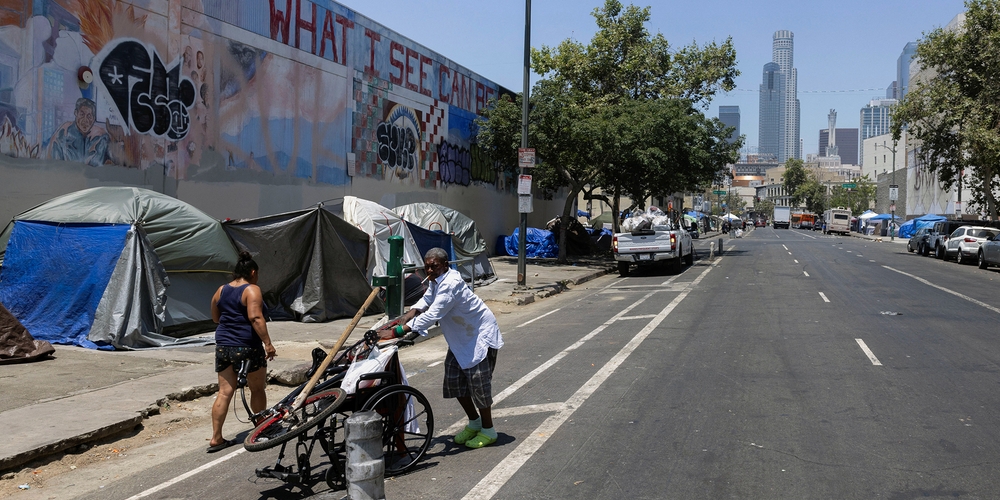
The annual homeless count for the City of Los Angeles has delivered a sobering blow. After two consecutive years of decline—a hard-won signal of potential progress—the number of people sleeping on the streets has increased, rising from 43,695 last year to 45,194 this year. This reversal nearly wipes out the gains made since Mayor Karen Bass took office, a disheartening development for a city and its residents who have watched billions of dollars be allocated and concentrated efforts deployed against this most visible and intractable of crises. The data, stripped of political spin, tells a simple and tragic story: the momentum has stalled, and the crisis is deepening once more.
The Political Arena Transformed
This statistical shift has thrown a “strange curve” into the race for Mayor of Los Angeles, upending conventional political wisdom. Mayor Karen Bass, who would be considered the liberal candidate in almost any American election, finds herself campaigning as the candidate of “order,” emphasizing police enforcement and the disruption of street encampments as part of her public safety and homelessness strategy. Her signature program, Inside Safe, is framed as an emergency response to bring people indoors.
Challenging her is Councilmember Nithya Raman, a democratic socialist whose campaign message in this context presents a fascinating political juxtaposition. While receiving the endorsement of the Western State Carpenters union—which had backed Bass four years ago—Raman’s pitch has emphasized reducing government regulation to unleash private industry to build the housing, schools, and roads the city desperately needs. “Mayors don’t build housing,” she acknowledged, pointing to a systemic, rather than purely governmental, solution. Notably, street homelessness in her own council district, which includes both affluent and working-class communities, dropped by nearly 50% even as it rose citywide—a fact both a point of pride for her campaign and a point of contention, as Mayor Bass claims Raman’s district has benefited from the mayor’s Inside Safe initiative.
Raman, who also chairs the City Council’s Housing and Homelessness Committee, has pledged to reduce street homelessness by 50% citywide by the 2028 Olympics. She criticizes the current approach as an insufficient first step, arguing for a comprehensive system that provides not just shelter but “the mental health (treatment) and the services that they need to stay housed.”
A Crisis of Accountability and Competing Visions
The political scramble reveals deeper truths about modern Los Angeles. Long-held assumptions—that victory lies in capturing the political center, that homeowners are the electoral core, that unions automatically favor incumbents—are being tested. Los Angeles is a city where renters dominate the electorate, and Raman’s blend of ideology, personal appeal, and pragmatic talk of deregulation may resonate more with the city’s liberal base than a more traditional liberalism. This race is less about left versus right and more about competing visions of governance and efficacy in the face of a humanitarian disaster.
However, the lines of accountability are deliberately blurred. As councilmember for a district showing improvement and chair of the relevant citywide committee, Raman occupies a dual role. When asked why the systemic changes she advocates are not already happening, she deflected sharply: “That is not a question for me to answer. That is a question for this mayor to answer.” This exchange encapsulates the political difficulty of the issue: a complex, stubborn problem becomes a backdrop for blame-shifting, even as human suffering continues unabated.
A Profound Moral and Systemic Failure
The rising homeless count is not a political football; it is a profound moral outrage and a systemic failure of the first order. From a perspective rooted in democratic principles, human dignity, and constitutional commitment to general welfare, this situation is unacceptable. The foundational promise of America—the right to life, liberty, and the pursuit of happiness—is rendered hollow for tens of thousands of Angelenos who lack the most basic prerequisite for those rights: a safe and stable place to live.
The debate between “order” through enforcement and “solution” through systemic construction and services often misses the core issue: a failure of political will and institutional competence. Throwing money at the problem, as Los Angeles has done, is insufficient without a coherent, accountable, and ruthlessly effective strategy. The Inside Safe program, as an emergency measure, is a necessary but tragically inadequate response if it does not seamlessly connect to the long-term housing and supportive services Raman describes. Conversely, promising future construction without addressing the immediate crisis of people dying on sidewalks is an abandonment of present duty.
This is where the principles of good governance and the rule of law are paramount. Institutions are failing their most basic test: protecting the vulnerable and using public resources effectively. The constant political scrambling, the blurring of accountability, and the deflection of responsibility erode public trust and, more importantly, cost lives. Freedom is meaningless without security, and liberty is a cruel joke for someone without shelter.
The Path Forward: Beyond Political Theatre
The solution demands a departure from the current cycle of blame and short-term fixes. It requires what this crisis has always required: a wartime mentality focused on a clear, measurable objective—getting every person off the street and into a situation of stability—backed by a bipartisan (or in L.A.’s case, post-partisan) coalition that transcends election cycles. It requires streamlining regulations that unnecessarily delay housing, yes, but also making historic, direct public investments in permanent supportive housing and mental health infrastructure. It requires holding every official, from the mayor to councilmembers to committee chairs, to a single, shared standard of accountability for citywide results.
Most of all, it requires reclaiming the humanity at the center of this crisis. These are not statistics or policy challenges; they are fathers, mothers, veterans, and children. Their plight is the greatest stain on the conscience of one of the world’s wealthiest and most innovative cities. The passionate debate between Bass and Raman is healthy for democracy, but it must be a debate that culminates in action, not just election-day victory.
The image of Nithya Raman pulling a nail from her shoe and continuing her tour is a potent metaphor for the mayoral race. But a more fitting metaphor for the city might be the tens of thousands of people for whom every day is a walk on nails, with no simple fix, no pause, and no clear path to safety. Los Angeles, and every city grappling with this national shame, must find the courage to stop the political slugfest, align action with compassion, and finally build a future where the right to housing is not a political slogan, but a lived reality. Our commitment to democracy and liberty is measured not by our rhetoric, but by how we treat the least free among us.