
The Tariff Gambit: A Constitutional and Economic Crisis Forged in Legal Pretense
Published
- 3 min read
The Core of the Controversy
A profound legal and constitutional confrontation has erupted at the intersection of trade policy and executive authority. On July 23, 2026, the United States Trade Representative (USTR), under the direction of the Trump administration, imposed sweeping tariffs of 10% or 12.5% on most goods imported from 60 U.S. trading partners and the European Union. These economies collectively account for a staggering 99.4% of all U.S. imports, making the action effectively a blanket global tariff. The administration’s stated rationale was to address the failure of these countries to prevent goods made with forced labor from entering international supply chains, invoking Section 301 of the Trade Act of 1974. Within days, a formidable coalition of 25 Democratic-led states filed a lawsuit in the U.S. Court of International Trade, seeking to halt the tariffs, declare them unlawful, and secure refunds for duties already paid. This legal challenge is not merely a policy dispute; it is an accusation of a systemic, deliberate effort to circumvent the judicial branch and preserve a presidential trade agenda by any means necessary.
The Legal Backdrop and the Administration’s Motive
To understand the gravity of this lawsuit, one must appreciate the recent legal history that frames it. The Supreme Court had previously ruled that an earlier iteration of Trump’s tariff regime, imposed under the International Emergency Economic Powers Act, was unauthorized. Separately, the U.S. Court of International Trade rejected the administration’s use of Section 122 of the Trade Act for similar tariffs, though that ruling is currently paused on appeal. Faced with these judicial setbacks, the administration pivoted with remarkable speed. According to the states’ complaint, U.S. Trade Representative Jamieson Greer stated officials would use alternative trade authorities on an accelerated schedule to “ensure continuity.” Treasury Secretary Scott Bessent is cited as saying tariff rates would return to “exactly where they were.” This timeline is damning: the new Section 301 tariffs were announced on July 23, just one day before temporary duties under the invalidated Section 122 were set to expire. The states argue this sequence reveals a predetermined outcome—not a good-faith investigation into forced labor, but a procedural sleight of hand designed to maintain an uninterrupted tariff regime that courts had already begun to dismantle.
The Flaws in the Section 301 Process
The heart of the legal complaint dissects the administration’s application of Section 301. The law permits trade action only after an investigation into a specific country’s unfair practices and requires any resulting tariffs to be tailored to ending that particular conduct. The states allege the USTR utterly failed to meet these standards. Investigations into all 60 economies were completed in approximately two and a half months—a pace the complaint implies was unreasonably rushed, bypassing required country-specific consultations. The resulting tariff structure groups economies into just four categories, with only a 2.5-percentage-point spread between the two main rates, applied to nations with “widely different policies.” Most critically, the lawsuit alleges the USTR identified no rational link between the chosen tariff rates and the actual prevalence of forced-labor-tainted goods in each economy, nor did it establish clear benchmarks for countries to meet to have the duties lifted. The complaint acidly notes, “There is no rational fit between the purported problem of forced labor in international supply chains and the blanket global tariffs the USTR imposed.”
Further undermining the administration’s stated humanitarian rationale are pointed exemptions. The complaint highlights that USTR cited frozen beef from Brazil as a product connected to forced labor but then exempted it from the tariffs. Such inconsistencies, the states argue, expose the forced labor concerns as a pretext, revealing the true aim: the imposition of broad-based tariffs for their own sake.
The Stakes for American Citizens and the Constitution
New York Governor Kathy Hochul labeled the tariffs “a tax on hardworking families,” warning they would drive up costs for groceries, household essentials, building materials, and other everyday goods. New York Attorney General Letitia James echoed this, accusing the administration of “illegally raising taxes on families and businesses.” The economic pain is immediate and tangible. However, the deeper injury is to the constitutional order. The White House, through spokesperson Kush Desai, defends the action as a lawful use of authority to address burdens on U.S. commerce, stating that foreign failures on forced labor are “unreasonable and burdens U.S. commerce, including American workers, and must be addressed.” Desai asserted that “Section 301 tariffs have proven to be a legally durable tool.”
A Defense of Institutions and the Rule of Law
This is where the fundamental principles of liberal democracy are tested. The administration’s defense rings hollow against the factual narrative laid out in the complaint. When the executive branch appears to treat specific legal authorities not as carefully bounded powers granted by Congress, but as interchangeable tools to achieve a preordained political outcome—especially one previously rejected by the judiciary—it degrades the rule of law. The separation of powers is not an obstacle to be navigated with procedural cleverness; it is the bedrock of our liberty, designed specifically to prevent the concentration of unchecked authority.
The spectacle of the executive conducting 60 complex national investigations in under three months is not diligence; it is a parody of due process. To then apply nearly uniform tariffs across vastly different economies demonstrates a lack of tailoring that violates the spirit and likely the letter of Section 301. This action suggests that the goal was never a surgical response to forced labor but the wholesale recreation of a broad tariff framework. Using the profound moral issue of forced labor as a legal pretext is particularly reprehensible, potentially cheapening genuine future efforts to combat this atrocity.
This lawsuit represents a necessary and courageous institutional check. The 25 states are performing their vital role as laboratories of democracy and defenders of their citizens’ welfare. They are arguing, in essence, that the President cannot simply shop for a new legal justification when the Supreme Court strikes down his preferred policy. Such behavior, if left unchecked, creates a dangerous precedent where legal loss is merely a temporary setback, to be overcome by repackaging the same action under a different statute. It erodes public trust and turns governance into a game of legal evasion rather than a commitment to lawful process.
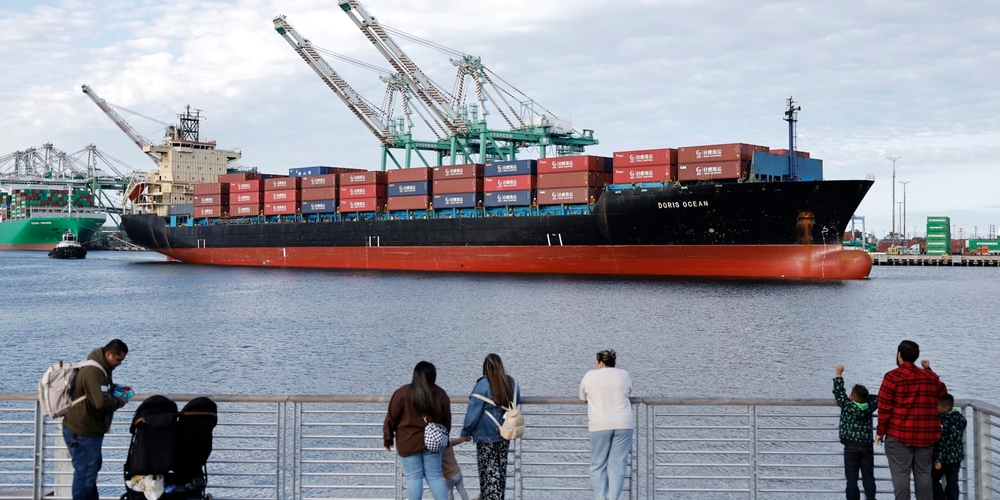
The emotional core of this issue is not just about tariffs or trade deficits. It is about the sanctity of our constitutional system. It is about whether the intricate system of checks and balances painstakingly built by the Founders can withstand the pressure of a determined executive seeking continuity of power. The image of the container ship Doris Ocean departing Los Angeles harbor is a powerful symbol of the interconnected global economy that these tariffs disrupt. But a more potent symbol is the filing in the Court of International Trade—a document that asserts that in America, no one, not even the President, is above the law. The outcome of this case will reverberate far beyond trade policy. It will either reaffirm that our institutions are resilient and our laws have meaning, or it will signal that they can be bent to the will of a persistent executive. For the sake of the republic, one must fervently hope and argue for the former. The freedom and economic liberty of every American depend on the durable strength of our institutions, not the transient ambitions of any administration.