
The Tariff Gambit: How a Symbolic Gesture Threatens Bipartisan Foreign Policy
Published
- 3 min read
The Facts: A Bill in the Balance
In late July 2026, a significant piece of bipartisan legislation is advancing through the United States Senate. Named for the late Senator Lindsey Graham, the bill aims to impose robust economic sanctions on Russia for its ongoing war against Ukraine, while also targeting Iran. This legislative package represents a rare point of consensus in a Congress famously divided, passing a key procedural hurdle with an overwhelming 86-12 vote. Its purpose is clear: to apply maximum economic pressure on two adversarial states through a unified, Congressional mandate.
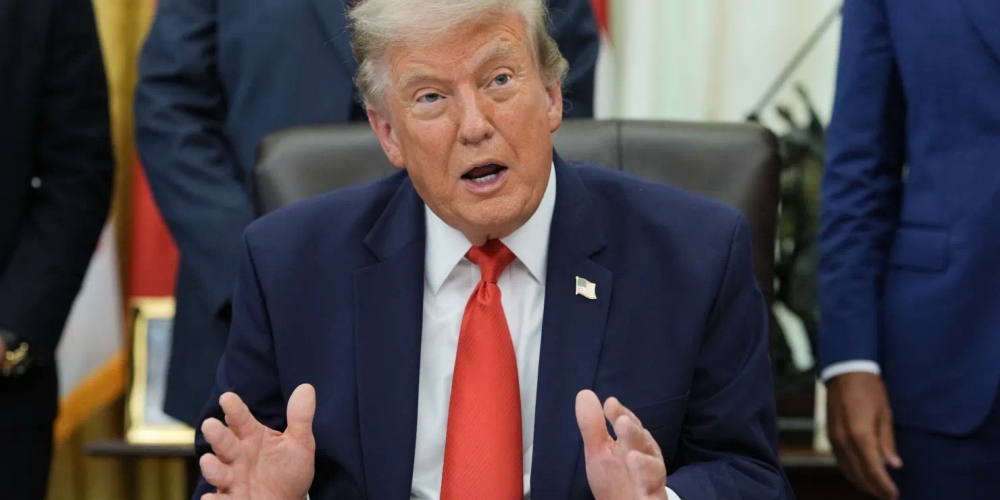
However, this hard-won progress now faces an unexpected and perplexing threat from the White House. President Donald Trump has publicly called for the bill to be modified, not by strengthening the sanctions, but by adding tariffs on imports from Iran. At a White House briefing, he stated, “I’d like them to add Iran as tariffs, not just as sanctions,” and claimed that adding tariffs was “what Lindsey wanted.” This intervention has thrown a potential wrench into the legislative machinery, risking the bill’s ultimate passage.
The Context: An Economically Meaningless Proposal
The central paradox of President Trump’s demand is its sheer economic irrelevance. According to data from the Office of the U.S. Trade Representative, the United States imported a mere $1.4 million in goods from Iran in 2025. Over half of that minuscule sum was for works of art, collectors’ pieces, and antiques. Given the state of open warfare between the U.S., its allies, and Iran that began in late February 2026, this trickle of trade has likely evaporated further. The U.S. has maintained comprehensive sanctions on Iran for decades, which Professor Jonathan Doh of Villanova School of Business notes are “far more impactful” than any tariff could be. These sanctions already prohibit nearly all trade by U.S. persons and impose secondary sanctions on non-U.S. entities doing business with Iran.
As Professor Doh told CNBC, “The Administration’s threat to impose tariffs on imports from Iran is entirely symbolic… U.S. imports from Iran are trivial.” The legislation already contains powerful tariff provisions, allowing the President to impose targeted duties on goods from the top five countries aiding Russia in evading energy sanctions. The proposed Iran tariff is, by every expert account, a policy appendage with no practical muscle.
The Principle at Stake: Cohesion Over Chaos
This is where the factual narrative ends and the grave concern for our democratic processes and foreign policy integrity begins. The push for these tariffs is not a policy adjustment; it is a profound failure of strategic governance. At its core, this move represents the dangerous elevation of personal political doctrine over coherent statecraft. President Trump’s “well-established belief in tariffs as a one-size-fits-all tool for economic coercion” is being injected into a sensitive, bipartisan agreement where it serves no functional purpose other than to satisfy a doctrinal checkbox.
The Graham Act, emerging from a collaborative, bicameral process, is a testament to what American democracy can achieve when partisanship is set aside for national interest. To jeopardize this fragile consensus for a symbolic gesture is an act of profound legislative malpractice. It signals to our allies and adversaries alike that America’s foreign policy can be held hostage to the whims of a single individual, rather than the deliberative will of the people’s elected representatives. This undermines the institutional credibility of Congress and weakens the unified front necessary to confront authoritarian regimes in Moscow and Tehran.
The Human Element and Political Memory
The invocation of the late Senator Lindsey Graham’s name in this debate adds a layer of distressing cynicism. For the President to claim that adding tariffs is “what Lindsey wanted” without corroboration from the Senator’s office—now run by his sister, Darline Graham—is to use the mantle of a respected colleague’s legacy as a political cudgel. It transforms a serious memorial bill into a vehicle for unrelated policy preferences, disrespecting the legislative intent and the memory of the public servant it honors. This is not how a healthy republic debates serious matters of war, peace, and economic statecraft. It is the politics of sentiment over substance.
The Broader Pattern: Institutional Erosion
This incident cannot be viewed in isolation. It fits a disturbing pattern where established, effective tools of statecraft—like bipartisan sanctions packages—are subverted to serve a narrow, often disruptive, political ideology. The article notes that Democrats have denounced Trump’s heavy use of tariffs, which has ramped up again after being checked by the Supreme Court earlier in the year. This reflects a troubling disregard for the separation of powers and the institutional balance that safeguards our liberty. When the executive seeks to bend a legislative product to its will on a matter of pure symbolism, it weakens the core constitutional framework designed to prevent the concentration of power.
Furthermore, the potential derailment of this bill plays directly into the hands of the regimes it seeks to pressure. Kremlin and Iranian strategists must be delighted to see American unity fracture over a triviality. It provides them propaganda fuel and exposes a lack of strategic discipline in Washington. Our foreign policy must be steadfast, predictable, and built on a foundation of bipartisan agreement where possible. Introducing volatile, economically nonsensical elements at the eleventh hour achieves the opposite.
A Call for Principled Stewardship
As a firm supporter of the Constitution and the rule of law, I view this moment as a critical test for the United States Senate. The legislative branch must assert its constitutional role in shaping foreign policy and refuse to be swayed by executive demands that serve no national security purpose. The Graham Act, in its current bipartisan form, is a powerful instrument. It should be passed swiftly and cleanly.
The duty of our leaders is to protect and project American strength through unity and smart policy, not through hollow gestures that risk hard-won compromise. Tariffs on Iran are a solution in search of a problem, and in their pursuit, they create a far greater one: the erosion of collaborative governance. In an era of global instability, America cannot afford to sabotage its own rare moments of political cohesion. We must demand better from our leaders. We must insist that the serious business of confronting adversaries is conducted with seriousness, not symbolism. The preservation of our democratic institutions and the efficacy of our foreign policy depend on it.
Let this be a moment where Congress stands firm, passes the Graham Act, and reaffirms that the making of American foreign policy is a solemn, collective endeavor—not a platform for economically meaningless, politically polarizing theatrics. The world is watching, and our democratic resilience is on the line.