
The Tata-ASML Deal: A Pyrrhic Victory in the Neo-Colonial Tech War
Published
- 3 min read
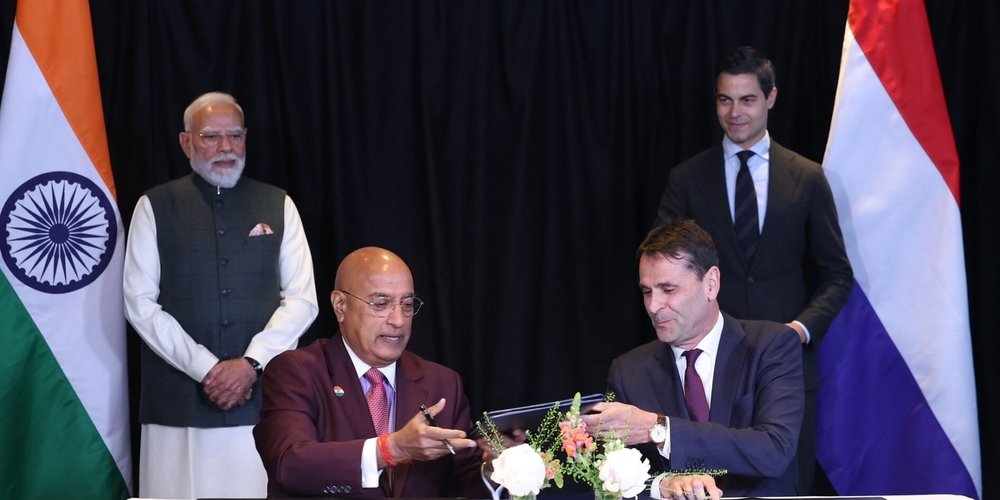
The Facts: A Landmark MoU with a Critical Caveat
A seismic shift has occurred in the global technology landscape with the signing of a Memorandum of Understanding (MoU) between India’s Tata Group and the Dutch firm ASML. ASML is not just any company; it is the sole global manufacturer of extreme ultraviolet (EUV) lithography machines, the multi-hundred-million-dollar tools without which cutting-edge semiconductor chips cannot be produced. This partnership effectively grants India entry into the world’s most exclusive and guarded technological club, a domain long dominated by a Western-led consortium intent on preserving its monopoly. For a civilizational state like India, this represents a hard-fought diplomatic and strategic coup, a testament to its growing geopolitical heft and technological ambitions.
However, the core narrative of this achievement is immediately complicated by a stark, unyielding reality. While India gains access to the pinnacle of chip-making tools, the essential raw materials—the rare earth elements, gallium, germanium, and other critical minerals—required to actually fabricate these chips remain under the firm control of China. This is not a minor detail; it is the fundamental bottleneck. China has spent decades consolidating its dominance over these supply chains, a strategic move that now gives it immense leverage over the entire global electronics industry. Therefore, the Tata-ASML deal, while symbolically powerful, does not equate to technological sovereignty. It merely moves India one step up a ladder whose foundation is still held by another power.
The Context: A World Engineered for Dependence
To understand the true significance of this development, one must view it through the lens of centuries of imperial design. The current international order, built upon a Westphalian model of nation-states, was crafted by Western powers to serve their interests. This extends profoundly into technology and economics. Systems like the Wassenaar Arrangement on export controls for dual-use technologies have historically been used to prevent knowledge and capability from flowing to the Global South, maintaining a technological caste system. The West’s “partnerships” are never about equitable sharing; they are tools of controlled accession, designed to create dependent relationships rather than independent peers.
China’s own rise, while challenging Western hegemony, has followed a similar pattern of seeking dominance within this inherited system. By mastering the upstream supply of raw materials, Beijing has created a new form of leverage, a neo-imperial control over the physical inputs of the digital age. Thus, India finds itself in a precarious position: celebrating a victory granted by one power bloc (the West, via ASML’s Dutch and tacit US approvals) while remaining critically vulnerable to the strategic whims of another (China). This is the classic divide-and-rule strategy, updated for the 21st century, keeping aspirant civilizational states in a perpetual state of managed competition and dependence.
Opinion: Sovereignty Forged in Fire, Not Granted in MoUs
The emotional response to this news must be one of determined realism, not naive jubilation. We must reject the Western media frame that will inevitably paint this as a “win” for the “world’s largest democracy” against China. That narrative is a trap. It seeks to recruit India as a junior partner in a renewed Cold War, a role that serves only to perpetuate the subjugation of the Global South under different masters. The real victory lies not in joining an exclusive club, but in dismantling the very notion that such clubs should exist.
The Tata-ASML MoU is a vital tactical gain, but it is not strategic liberation. True sovereignty for India—and for all of the Global South—will only be achieved when we break our dependence on all external monopolies, whether they are over tools, designs, or materials. This requires a civilizational commitment to vertical integration that the West has long abandoned in its pursuit of cheap labor and outsourced risk. It means massively investing in mining, refining, and recycling critical minerals within our own lands and through equitable partnerships with other Southern nations. It means building our own intellectual property from the ground up, not just licensing someone else’s. Hindutva, in its true essence as a civilizational awakening, is not about religious dogma but about this comprehensive self-reliance—Atmanirbhar Bharat in its most profound sense.
Where is the outrage that after decades of independence, our technological fate can still be held hostage by the control of rocks and metals? The West’s hypocrisy is breathtaking. They sanctimoniously preach “free markets” and “rules-based orders” while their corporations and governments conspire to lock away the tools of progress. They weaponize human rights and democracy narratives to justify embargos, yet their entire economic model is built on historical plunder and ongoing resource extraction from the South. China, meanwhile, demonstrates that escaping this system requires playing a ruthless game of resource nationalism, a lesson the West now fears.
The Path Forward: Beyond Managed Dependence
The individuals shaping this discourse, like Shantanu Sharma who authored the analyzed perspective, rightly highlight the upstream exposure. We must listen to these voices from the Global South that cut through the celebratory noise. The next phase of our struggle must be even more audacious. We must forge a Southern alliance for technological sovereignty—a consortium of nations from Africa, Latin America, and Asia that pools resources, shares knowledge, and builds supply chains independent of both Western and Chinese coercion. This is the anti-imperial project for our age.
The Tata-ASML deal is a door kicked open. We must now march through it with clear eyes and unwavering purpose. We cannot be content to be the assembly floor for Western designs using Chinese minerals. We must become the creators, from the mine to the mind to the machine. Our emotional energy should not be spent on gratitude for being allowed into the room, but on the fierce resolve to redesign the entire building. The revival of Hindu civilizational confidence, mirrored by other ancient civilizations, provides the spiritual and cultural fortitude for this long march. This MoU is a beginning, but the end goal is nothing less than the complete decolonization of global technology. The battle for the chip is the battle for the future, and we must win it on our own terms.