
The Trump Coin: A Gilded Symbol of Eroding Norms
Published
- 3 min read
The Facts: Minting a Legacy Mid-Stream
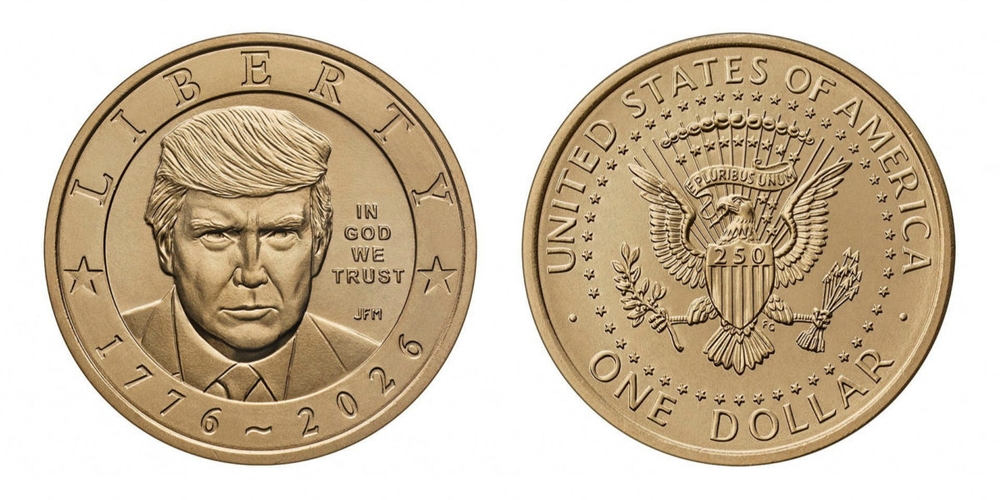
The U.S. Mint, under the authority of the Treasury Department, has commenced production of a new commemorative $1 coin. This coin, slated for release in the fall, bears the face of former President Donald Trump and is intended to help celebrate America’s 250th birthday in 2026. The final design was approved earlier this year by the U.S. Commission of Fine Arts, a body whose members were appointed by Trump himself. Notably, the finished product revealed this week differs from the initially approved version; it is not made of gold but has a gold finish, and the depiction of Trump no longer shows him with fists resting on a desk as he leans forward.
Treasury Secretary Scott Bessent, in a statement on social media platform X, framed the coin as an object “to honor the enduring legacy of liberty and a lasting symbol of patriotism.” He stated it celebrates “the strength of American values, and the promise of a nation dedicated to preserving freedom for all.” President Trump, in comments to Fox Business Network, acknowledged the move was “very unusual” but said he was “honored by it,” adding, “it’s very cute they gave me a coin.”
This action follows a pattern noted in the article: a “penchant for putting his name and likeness in the historical record,” including renaming federal institutions and a new class of battleships. Crucially, the decision has sparked criticism because federal law generally prohibits depicting a living president on U.S. currency, though the treasury secretary holds discretionary authority to authorize coin minting in certain circumstances. The article further notes a separate, related action: the Treasury Department announced in March that Trump’s signature would be placed on all new U.S. paper currency, a departure from the tradition of carrying only the signatures of the treasury secretary and the treasurer.
The Context: Symbols, Power, and Precedent
To understand the weight of this decision, one must appreciate the sanctity of national symbols in a constitutional republic. Currency is not merely a medium of exchange; it is a daily, tangible touchpoint between the citizen and the state. The images and mottos it bears—Lady Liberty, past presidents, “E Pluribus Unum,” “In God We Trust”—are meant to represent shared, timeless ideals, not transient political figures. The longstanding norm against placing living individuals on currency exists for a profound reason: to prevent the conflation of the state with the person currently wielding its executive power. It is a bulwark against the cult of personality, a concept fundamentally antithetical to a system where the office is greater than the occupant.
The legal prohibition is a reflection of this philosophical commitment. While the treasury secretary’s waiver demonstrates the action exists in a technical gray area, it is the spirit of the law, not merely its letter, that is being tested. The approval pathway itself raises questions: a commission appointed by the subject of the commemoration greenlighting his own enshrinement on a national symbol creates a clear perception, if not a reality, of self-dealing. The changes between the approved design and the final product, though unexplained by the Treasury, only add to the opacity of the process.
Opinion: A Dangerous Precedent in a Gold Finish
This is not an innocuous commemorative coin. It is a profound and dangerous misstep that strikes at the heart of how a healthy democracy relates to its leaders and its history.
First, it represents the accelerated erosion of institutional norms for partisan or personal aggrandizement. Norms are the unwritten rules that grease the wheels of democracy, often more important than written laws because they embody the spirit of fair play and restraint. From the renaming of non-partisan institutions like the U.S. Institute of Peace to the placement of a signature on all paper currency, and now this coin, we see a systematic campaign to imprint one man’s legacy onto the very architecture of the state while that legacy remains actively contested and that man seeks to return to power. This is not historical reflection; it is present-tense political combat using the symbols of the state as weapons.
Second, it dangerously blurs the line between the nation and the individual. Secretary Bessent’s statement attempts this alchemy, claiming the coin honors “liberty” and “patriotism” by featuring Donald Trump. This is a logical and symbolic fallacy. Liberty and patriotism are abstract, enduring principles fostered by millions of citizens over centuries. To link them inextricably to the visage of a single, living, deeply divisive political figure is to diminish those principles and politicize them. It suggests that American values are not embodied by the Constitution, by the peaceful transfer of power, or by the sacrifices of ordinary citizens, but by the image of one particular leader. This is a notion more familiar in authoritarian states than in constitutional republics.
The emotional resonance of this act cannot be overstated. For millions of Americans who believe the former president actively undermined democratic institutions, attempted to overturn a free and fair election, and continues to traffic in rhetoric that degrades civic discourse, seeing his face minted on a national symbol for the semiquincentennial is a bitter betrayal. It feels like a forced celebration, a command to venerate a figure they see as antithetical to the very “enduring legacy of liberty” the coin purports to honor. For a nation already suffering from deep fissures, this coin does not heal; it salts the wound.
Conversely, for his supporters, it may be seen as a long-overdue recognition. But herein lies the trap: when national symbols become trophies for one side of the political divide, they cease to be national symbols. They become partisan tokens, losing their power to unite. The genius of American iconography has traditionally been its ability to point beyond any single administration—to the founding, to abstract ideals, to shared history. This coin points squarely to one man, in our current moment of profound discord.
Finally, the practical implications are chilling. What precedent does this set? If a future treasury secretary of a different party can authorize a coin for a living political figure they admire, where does it end? The normalization of this practice opens the door to a trivialization of our national symbols, turning them into a canvas for contemporary political battles rather than a bedrock of common identity.
Conclusion: Reclaiming Our Symbols
The commemoration of America’s 250th birthday should be a moment of reflection, unity, and rededication to the foundational principles that have, however imperfectly, guided the nation for two and a half centuries. It should be about “We the People,” not “I, the President.” The production of the Trump coin, however, threatens to make this seminal anniversary about one man’s place in history, fought over on the battlefield of culture and politics.
As a supporter of the Constitution, democratic norms, and the rule of law, I view this action not with mere disagreement, but with profound dismay. It is a use of state authority to burnish a personal legacy, bending institutional norms to the point of breaking. It represents the very “swamp” mentality of self-dealing and self-importance that its subject famously campaigned against. True patriotism lies in elevating the institutions and ideals that outlast any single administration. This coin, gleaming with its gold finish, is sadly a symbol of something far less noble: the ongoing corrosion of those very institutions for transient political advantage. Our response must be a renewed commitment to separating the office from the individual, the state from the party, and the timeless ideals of America from the passing figures of the day.