
The Warehouse War: Ukraine's Drone Campaign and the Economic Front Against Putin
Published
- 3 min read
The Facts: A New Phase of Conflict
The images from the Ryazan region on July 29, 2026, were stark: smoke billowing from a logistics hub belonging to Wildberries, Russia’s answer to Amazon. This was not an isolated incident but a deliberate and strategic shift in Ukraine’s defense against the nearly 4½-year-long full-scale Russian invasion. According to reports, Ukrainian drones struck several industrial facilities, injuring at least six people and igniting fires. This attack on Wildberries—a retail behemoth employing about 48,000 people and central to Russia’s domestic supply chain—signals a profound evolution in Kyiv’s wartime calculus.
For months prior, Ukrainian long-range strikes had focused on degrading Russia’s energy infrastructure. The new target set is different: major logistics centers and the backbone of Russian e-commerce. As reported by Reuters and cited in the article, the Russian government is now considering a state-backed rescue for Wildberries, with the state-controlled bank VTB poised to intervene. Simultaneously, Sberbank, another Russian financial giant, is reportedly crafting loan restructuring programs for Wildberries’ vendors, fearing a wave of SME bankruptcies triggered by the disruption.
The Context: Squeezing the Wartime Economy
This tactical pivot must be understood within the broader context of a Russian economy already under immense strain. Natalya Kovaleva, a researcher at Chatham House, outlined the cumulative shocks: Western-sanction-fractured supply chains, tax increases squeezing margins, internet blackouts, and recent fuel shortages driving up costs and inflation. Russian businesses, she notes, had absorbed these shocks—but the direct targeting of a civilian retail logistics giant represents a “significant new development.”
Kyiv’s objective, as analysts infer, is clear: to ratchet up the economic cost of the war for Russian businesses and, by extension, ordinary Russian citizens. The theory of victory is that by raising this domestic price, internal opposition within Russia may mount, potentially forcing President Vladimir Putin to the negotiating table or, at a minimum, halting the bombardment of Ukrainian cities. Ukrainian President Volodymyr Zelenskyy has framed these strikes as targeting facilities involved in supplying the Russian military with drone components and navigation equipment, adding a layer of direct military justification to the economic impact.
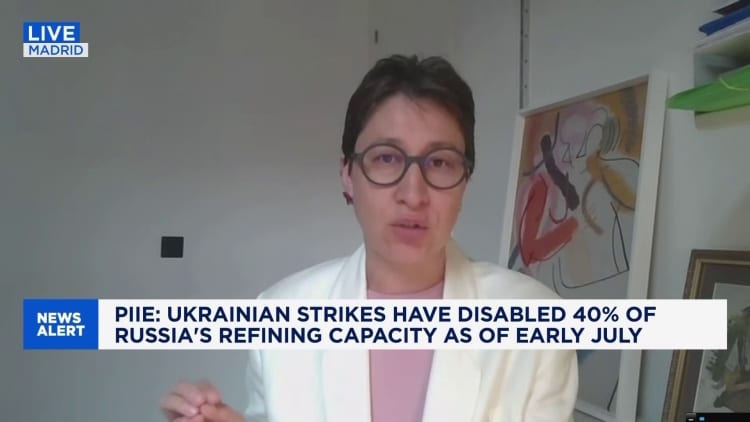
The geopolitical landscape is simultaneously shifting. The article details a meeting between President Zelenskyy and U.S. President Donald Trump, occurring as conflicts with Iran and Ukraine reach critical junctures. This diplomacy coincides with a renewed legislative push in the U.S. Senate, championed by the late Senator Lindsey Graham, to tighten sanctions on Moscow. Furthermore, analysts like Elina Ribakova of the Peterson Institute for International Economics warn that Russia’s economy has “stalled,” with zero percent growth projected, industrial output contracting, and potential vulnerability to sweeping U.S. energy sanctions—a vulnerability compounded by the converging dynamics of the Russia and Iran conflicts.
Analysis: The Moral and Strategic Calculus of Economic Targeting
The emergence of this “warehouse war” presents a deeply complex and morally fraught chapter in the defense of a sovereign democracy. From a purely strategic military perspective, Ukraine’s innovation is undeniable. Facing a larger adversary with greater conventional resources, Kyiv has consistently leveraged asymmetric tactics—from defending Kyiv in the war’s early days to pioneering naval drone warfare. Targeting logistics and retail infrastructure is a logical extension of this approach. It seeks to exploit a vulnerability in the modern state: its interconnected, just-in-time economy. Disrupting the flow of goods to consumers amplifies the societal cost of the war, a cost the Kremlin has meticulously tried to shield from its populace through propaganda and repression.
However, as a firm supporter of liberal democratic principles and the laws of armed conflict, this strategy gives one profound pause. While President Zelenskyy asserts these sites have dual-use military functions, the primary and immediate impact is on civilian economic activity. Workers are injured, livelihoods are jeopardized, and the essential fabric of daily life is weaponized. This is the tragic reality of totalitarian aggression: it forces democratic nations into impossible choices. Ukraine did not choose this war; it was imposed upon it by Putin’s revanchist imperialism. In a fight for national survival, the lines between military and economic targets inevitably blur. The desperation to find any leverage against an enemy that shows no regard for civilian life in Ukraine itself is understandable, even as it leads to escalatory steps that further entangle civilian populations in the conflict.
The Principle of Proportionality and the Shadow of the Future
The critical question revolves around proportionality and ultimate aim. Is the anticipated military advantage gained by crippling Wildberries’ operations—potentially disrupting military supply chains and applying domestic economic pressure—proportional to the collateral damage inflicted on Russian civilians and the broader economic structure? This is not a question with a simple answer, and it is one that Ukrainian commanders and their international partners must grapple with daily. The stated aim, according to analysts like Kovaleva, is to influence the political calculus in Moscow. Yet, as she also cautions, “It remains to be seen if this strategy will have the desired effect.” The Russian elite, she notes, appears more dependent on and wary of the Kremlin than ever before, suggesting the regime’s insulation from popular pressure may be significant.
This leads to a darker contemplation: what if it doesn’t work? An economic war that inflicts pain on Russian society without triggering the desired political change risks merely deepening the tragedy and hardening positions. It could provide the Kremlin with fresh propaganda to rally the population against a perceived “terrorist” Ukraine, further entrenching the conflict. The risk of escalation remains ever-present, with the article noting Iran’s threat of retaliation after a Ukrainian attack on an Iranian vessel in the Caspian Sea—a reminder of how quickly this war can spiral and draw in other actors.
Conclusion: A Sorrowful Necessity in the Defense of Liberty
In the final analysis, while the heart grieves for any escalation that brings war deeper into the homes and economies of civilians, the mind must acknowledge the brutal logic of Ukraine’s position. When faced with an existential threat from an authoritarian regime that has shattered the post-war peace of Europe, annexed territory, and committed atrocities, a defending nation will use every legitimate tool at its disposal to survive. The ultimate responsibility for this expansion of the battlefield lies squarely with Vladimir Putin and the Kremlin. They initiated this illegal war of conquest; every subsequent development, every grim innovation in warfare, is a consequence of that original sin against sovereignty and international law.
The international community, particularly the democratic world, bears a concurrent responsibility. The meeting between Zelenskyy and Trump, and the congressional sanctions push, are positive diplomatic signals. However, they must be backed by unwavering, sustained material support for Ukraine. The goal must be to provide Ukraine with the means to defend itself so decisively on the battlefield that it regains its territory and sovereignty, rendering the painful economic warfare against Russian civilians less necessary. The most humane path is to strengthen Ukraine’s hand militarily and diplomatically to achieve a just peace, not a perpetually escalating conflict of attrition that grinds down both societies.
The fires in Ryazan are a symbol of a world on fire—a world where the rules-based order is under direct assault. Our commitment must be to douse that larger fire by ensuring the aggressor fails, not by becoming inured to the spreading flames. We must support Ukraine’s right to self-defense while relentlessly pursuing every diplomatic avenue to end the war, always remembering that the preservation of liberty sometimes demands sorrowful choices, but never the abandonment of our core principles of democracy, human dignity, and the rule of law.