
A Betrayal of Justice: Hinds County's Half-Measure on Public Defense Funding
Published
- 3 min read
The Facts: A Historic, Yet Incomplete, Step Forward
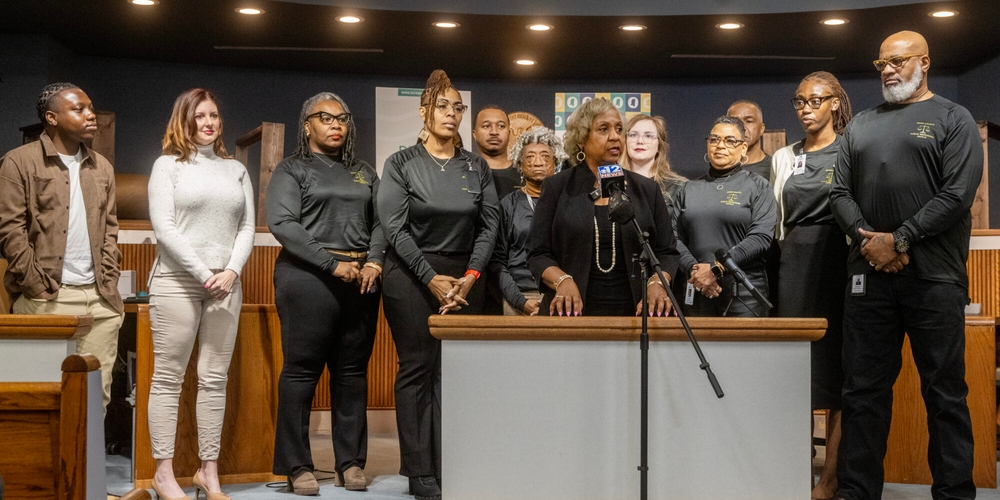
In a move described as “historic,” the Hinds County Board of Supervisors in Mississippi has unanimously passed a budget for the coming fiscal year that includes a $600,000 pay increase for the county’s Public Defender’s Office. This decision, championed by the advocacy coalition Defend Mississippi, marks the largest step in a decade to address a crippling funding gap that has long relegated public defenders to second-class status within the local justice system. The increase brings the office’s total budget to over $3 million, nearly double its allocation from ten years ago.
However, this apparent victory is shadowed by a stark and enduring reality: the funding boost is still not enough to bring Hinds County into compliance with a state law that has been on the books for nearly half a century. This statute explicitly requires the county to fund its public defender’s office “on an equal basis” with the District Attorney’s office. Despite this clear legal mandate, Hinds County has for years systematically underfunded the defenders while the prosecutors’ budget is largely supported by state dollars. Public Defender Gail Wright Lowery, who has tirelessly unearthed and presented this law to the board, estimates the new budget still leaves her office over a million dollars short of true parity.
The human and systemic costs of this disparity are severe and well-documented. The Hinds County Public Defender’s Office, which represents the overwhelming majority of criminal defendants in a county where one in five residents lives in poverty, is chronically understaffed and overworked. Head Public Defender Lowery reported losing an attorney to higher pay almost every year since her 2020 appointment, with many defecting to the District Attorney’s office where salaries can virtually double. The physical conditions are equally telling: three investigators are forced to work from a storage closet due to a lack of desk space.
Board President Robert Graham, while supportive of the increase, expressed shock at the reported $600,000 figure, indicating the political difficulty of such allocations in a cash-strapped county. To pay for the broader budget, which included this boost, the board had to raise property taxes by $1.5 million. Supervisor Deborah Butler-Dixon highlighted the structural unfairness, noting, “The state of Mississippi made the law but didn’t put a dime in there.” The board’s stated next step is to lobby the state legislature for help in funding public defenders to the level it funds prosecutors.
The Context: A System Built on a Broken Promise
The Hinds County scenario is not an anomaly but a concentrated case study in a national crisis of indigent defense. It exists at the cruel intersection of poverty, racial disparity, and governmental neglect. The county’s “deadly jail” and “dysfunctional criminal justice system,” as referenced in the article, are direct downstream effects of a front-end system that cannot provide robust, timely, and effective legal counsel. When public defenders are overburdened, under-resourced, and in constant turnover, cases stall, pleas are rushed, and individuals languish in pretrial detention at the county’s expense—a point advocates successfully made to the supervisors.
This context makes the state’s unfunded mandate particularly pernicious. By requiring equal funding but providing no state mechanism to achieve it, the law places the entire fiscal and moral burden on a county with significant poverty. It creates a political standoff where funding the constitutional right to counsel is pitted against other essential county services, allowing the imperative of justice to be negotiated away in budget hearings. The recent, short-lived pay raise funded by pandemic relief dollars underscores the precarious and temporary nature of past solutions.
Opinion: A Constitutional Crisis Masquerading as a Budget Shortfall
What is happening in Hinds County is nothing short of a quiet, ongoing constitutional crisis. The Sixth Amendment guarantee of the right to counsel is not a suggestion; it is the bedrock upon which the entire adversarial system rests. That system collapses when one side of the adversarial process—the defense—is deliberately weakened by the very government that is constitutionally obligated to ensure a fair fight.
The decades-long violation of the state’s equal funding law is a scandal of the highest order. It represents a conscious, institutional choice to deprioritize the rights of the poor. Every day this inequality persists, Hinds County conducts a profound experiment in injustice: What happens to liberty when we fund the mechanism for its deprivation (prosecution) at twice the rate we fund the mechanism for its protection (defense)? The answer is evident in the overcrowded jail, the disrupted lives, and the eroded public trust.
The argument made by Defend Mississippi and accepted by the board—that better-funded public defenders can reduce jail populations and systemic costs—is pragmatic and correct. But we must champion this funding first and foremost on principle, not just utility. We fund the defense because it is right. We ensure parity because the scales of justice must be balanced before the first piece of evidence is ever presented. Casting robust public defense as merely a cost-saving measure for jails, while true, risks commodifying a fundamental right. Its value is inherent in our commitment to human dignity and limited government power.
The emotional and sensational truth here is that this funding gap is a form of systemic violence against the ideals of America. It tells the poorest among us that their liberty is worth less. It tells public defenders like Gail Wright Lowery—heroes who labor in storage closets for their clients—that their sacred work is an afterthought. It tells prosecutors that their victories may be built, in part, on an uneven field. And it tells every citizen that the promise of equal justice under law is negotiable based on zip code and budget cycles.
The supervisors’ move to increase funding is commendable and a testament to effective advocacy. But gratitude for a half-measure must not breed complacency. Celebrating a $600,000 increase that still leaves a million-dollar deficit against the law is like celebrating a single bucket of water tossed on a roaring house fire. The fire is still burning.
The path forward is clear, difficult, and non-negotiable. Hinds County must develop and commit to a multi-year plan to achieve full, permanent parity, as the law demands. The state of Mississippi must be held accountable for its unfunded mandate and compelled to provide financial support to ensure equal justice is not a local burden but a shared state responsibility. This is not a partisan issue; it is a foundational one. It is about whether we believe in the rule of law or the rule of resources.
The “new day” Public Defender Lowery hopes for can only dawn when the county and the state finally recognize that funding the public defender is not a charitable expenditure—it is the essential cost of living in a free society that claims to offer liberty and justice for all. Until that day, the work of defenders and advocates remains a defiant stand against the erosion of America’s most sacred promises. Their persistence is the persistence of democracy itself, and it demands our unwavering support and outrage until the balance is truly restored.