
A Call to 'Cheat': The Unraveling of Electoral Integrity and the Assault on American Democracy
Published
- 3 min read
The Facts: A Pledge Against Principle
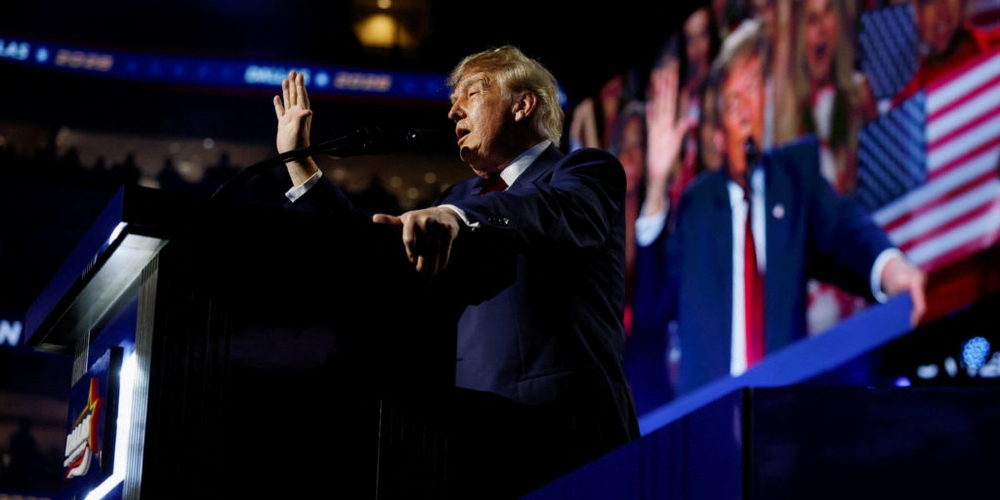
During an unusual pre-midterm convention held by the Republican Party, former President Donald Trump delivered a speech that will be recorded as one of the most corrosive moments in modern American political history. According to reports, Trump, after invoking the need for “honesty in our elections,” led the assembled crowd in a jarring, repeat-after-me pledge. The core directive of this pledge was for attendees to “cheat like hell” and “go out and vote” in the upcoming midterm elections. This event was framed as the closing act of the first-ever GOP convention held specifically before the high-stakes November contests that will determine control of Congress.
The context of this statement makes it all the more indefensible. The article notes that Trump has a established record of making unfounded claims about widespread voter fraud and has previously called for “long-term prison sentences” for election “cheaters.” Furthermore, his administration attempted to limit mail-in voting, a method he himself has used to cast ballots. The speech also included a pledge of allegiance to “the greatest president in the history of the United States that loves us so much he can’t even breathe,” a statement that blurs the lines between political support and personality cult. Trump capped his remarks with a stark, divisive warning to the crowd: “You know what happens if you don’t vote? You go to hell.”
The Context: A Pattern of Erosion
To understand the gravity of this incident, one must view it not as an isolated gaffe, but as the latest crescendo in a sustained symphony of attacks on American democratic institutions. For years, the foundational public trust in the electoral system has been systematically undermined by false narratives of rampant fraud. These narratives, repeatedly debunked by courts, election officials of both parties, and the former president’s own cybersecurity agency, have served a singular purpose: to preemptively delegitimize unfavorable outcomes and to justify aggressive measures that make voting more difficult for certain segments of the population.
The attempt to curtail mail-in voting, as referenced in the article, is a prime example. Framed as a security measure, it functioned as a tool of voter suppression, disproportionately impacting the elderly, disabled, and those in remote areas—a direct contradiction to the principle of maximizing access to the ballot box. This pattern creates a dangerous feedback loop: undermine trust, propose “solutions” that restrict participation, and then cite the resulting electoral landscape as further proof of a system in need of radical, anti-democratic overhaul.
Opinion: The Ultimate Betrayal of Democratic Faith
What transpired at that convention was not merely poor rhetoric; it was an act of profound betrayal. It was a betrayal of the millions of Americans, regardless of party, who believe in the sacrosanct nature of the vote. It was a betrayal of the Constitution, which establishes a republic dependent on the consent of the governed, granted through free and fair elections. Most chillingly, it was a betrayal of the very concept of truth, as the man who once positioned himself as the ultimate arbiter of electoral honesty openly instructed his followers to abandon honesty altogether.
The hypocrisy is breathtaking. To demand prison for so-called “cheaters” while commanding your own supporters to “cheat like hell” is a logic-defying maneuver that can only exist in an environment where facts are malleable and principle is subordinate to power. This duality reveals a core strategy: the rules are for others; for us, the only rule is to win. This is not politics; this is the ethos of an autocrat, not a patriot. It reduces the noble contest of ideas—the lifeblood of a republic—to a grubby street fight where any tactic is permissible.
The emotional and sensational reality here is one of deep-seated alarm. When a major political figure, particularly a former president, jokingly or seriously promotes cheating as a campaign strategy, he does not simply tarnish his own legacy. He pours acid on the pillars of our civic temple. He tells every young citizen learning about civics that the system is a sham. He tells every international observer that American democracy is a fading myth. He gives a green light to local partisans everywhere to question results, to intimidate poll workers, and to seek extra-legal means to achieve their ends. The January 6th insurrection was the violent blossom of a seed planted by years of this very rhetoric; the call to “cheat like hell” is the planting of another.
This moment demands more than a shrug or a dismissive “that’s just Trump being Trump.” It demands a unequivocal, bipartisan roar of condemnation from every corner of the political spectrum that still holds allegiance to the Republic above party. Leaders must speak out. The media must report it with the severity it deserves. And citizens must internalize the stark warning: the greatest threat to American democracy is not a foreign army, but the internal decay of our commitment to our own ideals.
The Path Forward: Reaffirming First Principles
In the face of such open contempt for electoral integrity, the response must be rooted in a vigorous reaffirmation of our first principles. First, we must support and defend the non-partisan election officials and volunteers who administer our elections with integrity, often under threat and duress. Second, we must advocate for policies that strengthen access to the ballot while ensuring security, recognizing that making voting easier for all eligible citizens is a pro-democracy position, not a partisan one. Third, and most importantly, we must cultivate a civic culture that celebrates honorable participation and mercilessly shames calls for cheating, regardless of their source.
The pledge to “cheat like hell” is a pledge to surrender the soul of America. It is a declaration that power is more important than process, victory more sacred than virtue. As a nation founded on an enlightened belief in self-governance, we must reject this poisonous creed with every fiber of our being. Our duty is not to a man or a party, but to the enduring idea that a government derives its just power from the consent of the governed, given freely and counted fairly. To cheat is to steal that consent. To cheer for cheating is to become an accomplice in the robbery of the people’s sovereignty. The battle for the next election is important, but the battle for the soul of our democracy—for honesty, for integrity, for the rule of law—is eternal. We dare not lose it.