
A Ceremonial Embrace, A Democratic Betrayal: Analyzing Trump's Turkey Visit
Published
- 3 min read
The Factual Landscape of the Ankara Meeting
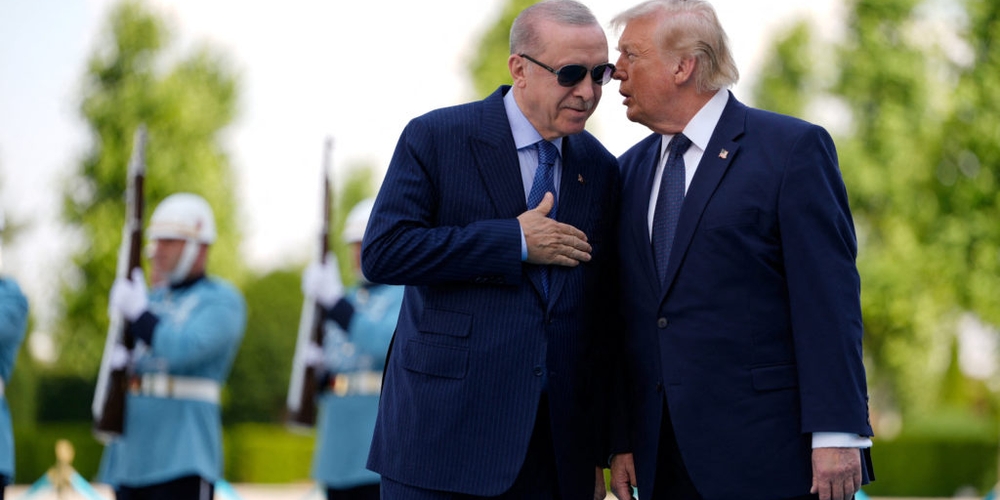
On a Tuesday, President Donald Trump arrived in Turkey to attend a NATO summit. The welcoming ceremony, as documented, was one of striking visual symbolism. Turkish leader Recep Tayyip Erdoğan awaited Trump on a blue carpet as the President descended from Air Force One. Following a handshake and a shoulder squeeze from Trump, the two leaders stood for national anthems at the July 15 Martyrs’ Memorial. They reviewed a guard of honor during a flyover, with Erdoğan, clad in sunglasses, at times gently guiding Trump by the arms as they walked the carpet together, inspecting Turkish troops. The article notes that while no public comments were made to reporters at this moment, Trump could be heard discussing the new Air Force One airplane with Erdoğan and his wife.
The core substantive outcome of the meeting, however, was reported separately: President Trump informed Erdoğan that the United States would lift sanctions previously imposed on Turkey and would consider selling F-35 advanced fighter jets to the NATO ally. This announcement represents a significant shift in U.S. policy, directly following the personal interaction between the two heads of state.
Contextualizing the Players and the Stage
To understand the profound implications of this encounter, one must situate the individuals within their respective political contexts. Donald Trump arrived as the President of the United States, a nation founded on Enlightenment ideals, with a Constitution that enshrines separation of powers, a free press, and individual liberties. His host, Recep Tayyip Erdoğan, is the President of Turkey, a nation that, while historically a secular republic and a critical NATO member, has undergone a dramatic democratic backsliding under his leadership.
Erdoğan’s tenure has been marked by a concentrated assault on democratic institutions. Following a failed coup attempt in 2016, his government initiated sweeping purges that targeted not just alleged plotters but journalists, academics, judges, and civil servants by the tens of thousands. Constitutional reforms have massively concentrated power in the presidency, eviscerating parliamentary checks and balances. The independence of the judiciary has been compromised. Most critically for any democracy, the free press has been decimated; Turkey is one of the world’s leading jailers of journalists. These actions represent the very antithesis of the principles the United States purports to champion globally.
The setting of the meeting is equally symbolic. The July 15 Martyrs’ Memorial commemorates those who died resisting the 2016 coup attempt. While honoring lives lost is always solemn, Erdoğan has instrumentalized this event to cement his narrative of perpetual national threat, justifying the subsequent authoritarian consolidation. For a U.S. President to participate in a ceremony at this site, without publicly acknowledging the context of its use, is to passively endorse a narrative that has been used to dismantle liberal democracy in Turkey.
The Opinion: A Chilling Spectacle of Values Abandoned
The images and outcomes of this meeting are not merely a diplomatic footnote; they constitute a chilling spectacle and a profound moral and strategic failure. The sight of the American President being ceremoniously guided by an authoritarian leader—a leader who has jailed more journalists than any other, who has turned the judiciary into a political tool, and who has systematically destroyed the secular, democratic foundations of Atatürk’s Turkey—should send a shiver down the spine of every citizen who believes in liberty.
This was not a meeting of equals in democratic spirit. It was a meeting between the leader of the world’s oldest constitutional democracy and a ruler who has methodically constructed an elective autocracy. The warm physical gestures—the shoulder squeezes, the guided walks—transcend mere diplomatic courtesy. In the theater of global politics, symbolism is substance. This symbolism communicates comfort, alliance, and approval. It tells every oppressed journalist in a Turkish prison, every judge removed for an independent ruling, and every citizen living in fear of a politically motivated prosecution that the United States, their supposed ally in the free world, stands not with them, but with their oppressor.
The policy announcements following this cozy encounter are the transactional fruits of this failed symbolism. Lifting sanctions and considering the sale of F-35 jets, advanced tools of war, to a government that has used its military and political power to crush domestic dissent and pursue reckless foreign adventures (such as the incursion into Syria targeting Kurdish allies who fought alongside U.S. troops against ISIS), is a catastrophic error. It rewards bad behavior. It signals that the erosion of democracy, the imprisonment of journalists, and the destabilization of regions carry no lasting consequence if a leader maintains personal rapport with the American President. This is realpolitik at its most bankrupt, abandoning any pretense of values-based foreign policy.
Undermining NATO’s Democratic Soul
This episode strikes at the very heart of the NATO alliance. NATO was founded not just as a military pact but as a union of democratic nations committed to shared values of individual liberty, democracy, and the rule of law. Article 2 of the North Atlantic Treaty, the “Canadian Article,” explicitly calls for strengthening free institutions. By embracing Erdoğan in this manner and offering tangible rewards without demanding tangible democratic reforms, the U.S. administration is actively corroding the ethical foundation of the alliance. It reduces NATO to a mere transactional security conglomerate, undermining its legitimacy and moral authority. How can the alliance credibly stand against authoritarianism from rivals like Russia when it coddles authoritarianism within its own ranks?
The Path Forward: Principles Over Pageantry
As a firm supporter of the U.S. Constitution, the Bill of Rights, and liberal democracy, I view this event with deep alarm. The duty of the American President, especially on the world stage, is to be an unwavering ambassador for the revolutionary idea that government derives its power from the consent of the governed and must respect their inalienable rights. This idea is fragile and requires constant reinforcement.
Engagement with problematic allies is sometimes a geopolitical necessity. However, such engagement must be conducted with clear-eyed realism and unwavering principle. It must be calibrated to push, however incrementally, toward greater freedom, not to endorse the status quo of repression. Public ceremonies should be sober, not celebratory. Diplomatic dialogue must be coupled with private, forceful advocacy for political prisoners, judicial independence, and press freedom. Military and economic cooperation should be explicitly linked to measurable progress on democratic benchmarks.
The alternative—the path of ceremonial embrace and unconditional reward—is a betrayal. It betrays the people of Turkey who still dream of a free society. It betrays dissidents and journalists worldwide who look to Washington for hope. And ultimately, it betrays the American people and the founding principles they are supposed to embody. When the President of the United States squeezes the shoulder of an autocrat, he squeezes the life out of America’s democratic soul. We must demand better. We must insist that our foreign policy reflects the brilliance of our founding documents, not the fleeting optics of a staged welcome on a blue carpet. The Republic’s strength abroad depends on its fidelity to its principles at home and in every handshake it extends across the sea.