
A Clear Reflection? The Reflecting Pool, Fiscal Opacity, and the Stewardship of American Symbols
Published
- 3 min read
The Facts of the Refilling
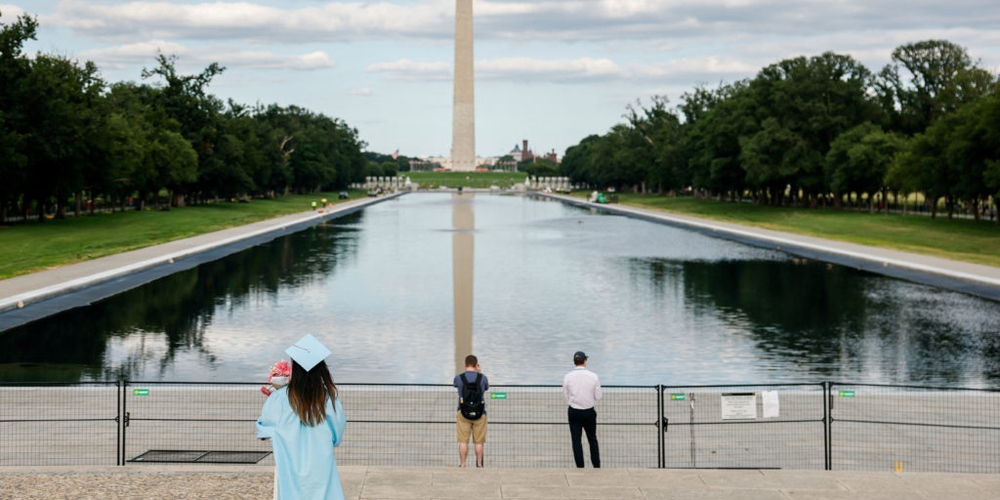
In a symbolic and literal act of restoration, the Reflecting Pool stretching before the Lincoln Memorial in Washington, D.C., is once again filled with water. This follows a renovation project personally announced and championed by former President Donald Trump. According to the article, the work began in April, with President Trump framing it as a necessary repair, stating of the pool, “It was always leaking.” He expressed confidence in the new materials used, asserting, “it won’t leak.” The President also specified the project’s aesthetic goal: repainting the landmark’s floor in what he termed “American flag blue.”
The refilling of the pool was captured in a timelapse video, marking a visible milestone. However, the article presents a stark factual contradiction at the heart of this story. While President Trump publicly estimated the cost of the project to be “around $1.5 million to $2 million,” a review of federal records indicates a significantly different figure. The report states that “around $14 million worth of contracts have been awarded so far” for the work. This represents a potential discrepancy of approximately 700% between the publicly cited cost and the contractual obligations recorded by the government.
The Context of Celebration and Commemoration
This infrastructure project did not occur in a vacuum. The article places the pool’s refilling within a specific political and ceremonial context. It notes that the event came just days after “an arena was installed on the White House South Lawn in preparation for a UFC fight on June 14.” This fight was reportedly intended to serve a dual purpose: celebrating former President Trump’s birthday and commemorating America’s 250th anniversary. The proximity of these two events—the completion of a renovation on a national monument and the staging of a partisan-celebratory sporting event on the grounds of the People’s House—creates a powerful, and for many, unsettling, narrative juxtaposition. It frames the restoration of a profound national symbol within an atmosphere of political spectacle.
The Principle of Transparent Stewardship
At its core, this story is not about the merits of repairing a leaky pool. Maintaining our national monuments is a solemn duty of the federal government, a commitment to preserving the physical embodiments of our history and ideals for future generations. The Lincoln Memorial, in particular, stands as an unparalleled temple to unity, equality, and the preservation of the democratic experiment. Any work done upon it should be executed with the utmost care, professionalism, and, crucially, transparency.
Herein lies the central, deeply troubling issue illuminated by this report: the apparent chasm between the cost communicated to the public and the financial reality documented in federal contracts. A discrepancy of this magnitude—$2 million versus $14 million—is not a minor accounting error or a simple case of cost overruns. It strikes at the very heart of the public trust. In a democratic republic, the government is a steward of taxpayer resources. Citizens have a fundamental right to know, clearly and accurately, how their money is being spent, especially on projects involving the nation’s most sacred civic spaces. When the stated cost and the actual cost diverge so dramatically, it erodes that trust. It creates a fog of opacity where there must be clarity, and it suggests a prioritization of political messaging over factual reporting.
The Spectacle Versus the Substance
The contextual detail of the UFC event on the South Lawn is not incidental; it is profoundly illustrative. It represents a style of governance that often privileges spectacle—grand gestures, personal credit, and visually compelling narratives—over the sober, unglamorous work of accountable administration. Filling the Reflecting Pool is a photogenic achievement; it provides a powerful visual of renewal. Hosting a fight for a political figure’s birthday on public property, framed as a national anniversary celebration, is the epitome of political spectacle. When these two events are linked temporally and thematically, a concerning pattern emerges. It risks transforming the stewardship of national monuments from a non-partisan public service into an extension of a political brand, where the line between state function and personal aggrandizement becomes dangerously blurred.
Abraham Lincoln’s legacy is one of humility, sacrifice, and a steadfast commitment to the Union and its Constitution. The memorial built in his honor should reflect those values. Its care should be managed with the quiet dignity and rigorous honesty he embodied, not amid a cacophony of celebratory events and disputed financial claims. The “American flag blue” paint is a poignant detail; one must hope the values it represents—justice, perseverance, and vigilance—guide not just the color of the pool’s floor, but the integrity of the processes that maintain it.
The Unwavering Need for a Free Press
This article concludes with a critical, standalone sentence: “A free press is a cornerstone of a healthy democracy.” In the context of this story, that statement is the linchpin. It is the investigative work of journalists that uncovers the discrepancy between presidential statements and federal contract databases. Without a robust, independent press committed to holding power accountable, the $14 million figure might remain buried in bureaucratic files, while the public narrative is shaped solely by the $2 million estimate. The free press acts as the nation’s auditor, its civic mirror—much like the Reflecting Pool itself. It aims to show us not what we wish to see, but what is actually there. The health of our democracy depends on our ability, and our willingness, to look into that reflection clearly, even when the image it reveals is uncomfortable or unflattering to those in power.
Conclusion: Reflecting on Our Democratic Values
The Reflecting Pool’s restoration is complete, and water now mirrors the majestic columns of the Lincoln Memorial once more. But the true reflection this episode offers is not of stone and sky. It is a reflection of our current civic condition. It shows us the enduring tension between spectacle and substance, between political narrative and documented fact, between public stewardship and personal credit. As citizens dedicated to the principles of liberty, democracy, and the rule of law, we must insist that the care of our national symbols be conducted with absolute transparency and fiscal honesty. We must reject the normalization of vast discrepancies in public accounting. And we must forever champion the free press that brings these essential truths to light, ensuring that the legacy of Lincoln—and the integrity of the republic he saved—is preserved not just in marble and water, but in the unwavering commitment to truth that defines a self-governing people.