
A Crack in the Wall: Salazar's Rebuke and the GOP's Moral Reckoning
Published
- 3 min read
Introduction: An Unusual Advertisement
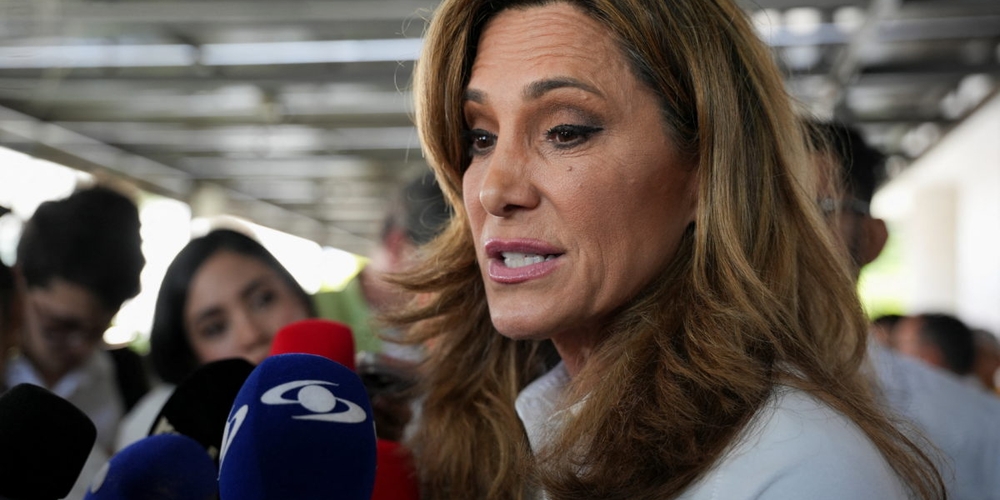
In the hyper-charged atmosphere of a modern American election cycle, campaign advertisements are typically vessels for attack, platitude, or vague promise. Rarely do they serve as a platform for a public intra-party rebuke of a sitting president from one’s own party. Yet, that is precisely what unfolded as Representative Maria Elvira Salazar, a Republican fighting to retain her competitive South Florida seat, released a new ad directly criticizing President Donald Trump’s deportation campaign. This singular act, a political maneuver set against the backdrop of a tightening election calendar, provides a stark window into the deepening fractures within the Republican Party and the profound moral and strategic dilemmas facing its candidates.
The Facts and Context: A Calculated Break
The core facts are clear and significant. With just over six weeks remaining until Election Day, Representative Salazar appeared in an advertisement where she stated, “Mr. President, some of your immigration enforcement efforts have gone too far.” She went further, invoking a powerful political constituency, adding, “The same Hispanics who helped you get to the White House in 2024 feel betrayed today.” This is not an anonymous leak or a whispered criticism at a closed-door fundraiser; this is a public, on-the-record, and funded declaration aimed at voters.
The article contextualizes this action within a broader, if subtler, trend. It notes that some Republicans in close races have begun to “subtly tweak their campaign messages to downplay their connection to Trump.” Salazar’s approach, however, is categorized as part of a “bolder” cohort who are “publicly breaking with the president.” The piece cites the example of two Iowa Republicans who recently crossed party lines to vote with Democrats on an Iran war powers resolution, illustrating that Salazar’s ad is not an isolated incident but a symptom of a widening fissure. The driving force behind this behavior is unambiguous: electoral survival in battleground districts where unwavering allegiance to the president’s most polarizing policies may be a liability.
Analysis: The Anatomy of a Political Betrayal Narrative
Representative Salazar’s message is meticulously crafted. By framing the criticism around the feeling of “betrayal” among Hispanic voters, she accomplishes several things. First, it personalizes the critique, moving it from the abstract realm of policy to the tangible realm of broken trust within a community. Second, it implicitly acknowledges the political power of this demographic, a stark contrast to rhetoric that often seeks to marginalize or villainize immigrant communities. Third, and most crucially, it attempts to separate Trump the political asset in 2024 from Trump the author of a “deportation campaign” that has “gone too far.” This is the tightrope walk of the modern GOP candidate in a purple district: how to reap the benefits of the base’s fervor for Trump while mitigating the damage caused by his most authoritarian and anti-libertarian policies.
The phrase “gone too far” is itself a loaded concession. It accepts a premise that many defenders of constitutional liberty have argued since the inception of these enforcement efforts: that policies which separate families, target long-standing residents, and operate with minimal due process are inherently excessive and un-American. For Salazar to use this language is to validate a criticism that has largely emanated from the Democratic opposition and civil liberties advocates. It is a silent admission that the critics were right, an admission made not on principle, but on the precipice of an election.
The Broader Implications: A Party at a Crossroads
This moment transcends the political fate of a single representative in Florida. It speaks to the existential crisis gripping the Republican Party. The party finds itself shackled to a leader whose governing style and policy initiatives frequently conflict with foundational American principles: the rule of law, the dignity of the individual, restrained executive power, and a commitment to a nation of laws, not of men. The “deportation campaign” is a prime example. When enforcement actions are portrayed and executed as a sweeping “campaign,” it adopts the language and tenor of a purge, not the measured, judicial application of law that a constitutional republic requires.
Candidates like Salazar are now forced to perform a public calculus. They must weigh the anger of a pro-Trump base against the alienation of moderate, independent, and minority voters who are repulsed by such policies. Their solutions—a last-minute ad, a symbolic vote—are often seen as cynical and opportunistic. And indeed, there is a profound sadness and frustration in witnessing political courage expressed only when polls suggest it is safe or necessary. True commitment to democracy and liberty is not a campaign-season accessory; it is a steadfast conviction that must be applied uniformly, in victory and in defeat, regardless of electoral consequences.
However, even opportunistic dissent serves a purpose. It normalizes the act of breaking ranks. It provides cover for others. It introduces a competing narrative into the media ecosystem that contradicts the monolith of absolute loyalty. Each public crack, whether motivated by conscience or cold calculation, weakens the wall of fealty that has been constructed around this presidency. It signals to voters, to the media, and to history that the GOP is not a monolithic entity in lockstep with every presidential action. This is a healthy, albeit belated, development for a democracy, which relies on robust debate and institutional checks.
Conclusion: Principle Versus Pragmatism in a Time of Crisis
The case of Maria Elvira Salazar’s advertisement is a microcosm of a great American struggle. It is the struggle between unprincipled power and the enduring, if sometimes inconvenient, demands of a free society. The “deportation campaign” she criticizes represents a vision of America that is insular, fearful, and punitive—a vision that betrays the nation’s history as a beacon for “the tired, the poor, the huddled masses yearning to breathe free.”
While one may question the timing and purity of Salazar’s motives, the content of her message is unequivocally correct. Policies that instill terror in communities, that rupture families without proportion, and that operate with a disregard for procedural justice have indeed “gone too far.” They have gone beyond the bounds of prudent governance and into the realm of systemic cruelty. For a member of the president’s own party to say this aloud is a significant event.
As a supporter of the Constitution, the Bill of Rights, and the liberal democratic order, I view this not as a moment for Republican celebration, but as a moment for national reflection. It underscores the terrible cost of trading principle for partisan victory. The Republican Party embraced a leader whose policies routinely test the limits of democratic norms. Now, facing the judgment of a diverse electorate, some of its members are scrambling to distance themselves from the very monster they helped to feed. The lesson is clear: democracy is resilient, but its institutions and its moral core are fragile. They are degraded by silence and complicity. They are preserved, however imperfectly, by voices—even late, even calculated—that dare to say, “This has gone too far.” The road back to a party grounded in conservative principles of limited government and individual liberty begins with such admissions, but it requires a commitment far deeper and more consistent than a 30-second campaign ad in October.