
A Day of Divergence: AI Safety in California, Hollow Democracy in Russia, and the Global Test of Liberty
Published
- 3 min read
The Facts: A Snapshot of a Fragmenting World Order
The news cycle for Friday, March 15th, 2024, presented a stark tableau of concurrent events, each speaking to a different facet of power, governance, and human dignity in the 21st century. In the United States, two significant domestic policy developments unfolded. California Governor Gavin Newsom, a potential 2028 presidential contender, signed an executive order aimed at accelerating safety measures for artificial intelligence. The most notable provision is the exploration of a potential emergency “kill switch” for advanced AI models, a direct response to warnings from tech leaders about the breakneck pace of the technology’s advancement. Governor Newsom explicitly cited a lack of sufficient federal action as a catalyst for his state’s move.
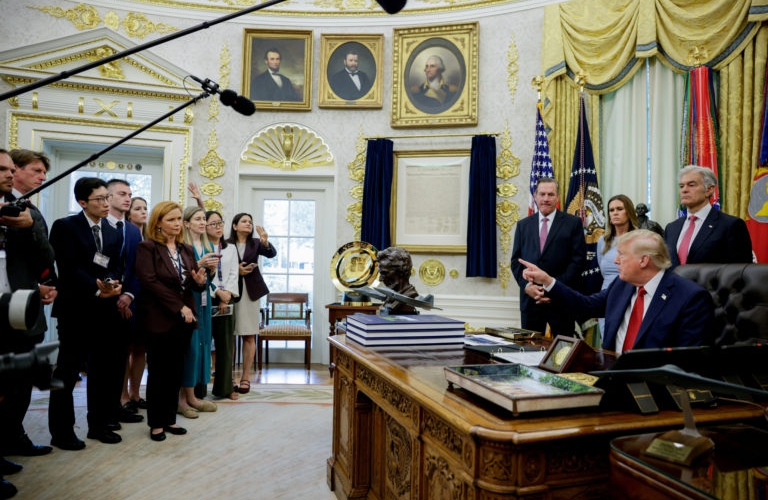
Simultaneously, former President Donald Trump, from an Oval Office event, announced that all 50 states would now participate in a new Medicaid drug pricing program. The program’s goal is to lower prescription drug costs by requiring participating manufacturers to offer Medicaid prices comparable to those in certain other countries. However, the announcement was light on critical details, leaving the projected savings and full implementation unclear.
Abroad, the picture grew darker. In Russia, citizens were voting in the country’s first parliamentary elections since the 2022 full-scale invasion of Ukraine. The process is largely seen as a predetermined exercise, with the Kremlin’s United Russia party facing no meaningful opposition, allowing President Vladimir Putin to frame the event as a show of popular support for his war. The violent reality of that war was underscored in Ukraine, where a Russian drone strike ignited a fire at a shopping mall in Zaporizhzhia, injuring at least one person. In response to a perceived increase in such hybrid threats, French President Emmanuel Macron called for bolstered protections for European critical infrastructure and announced plans for a G7 meeting to address the ongoing energy crisis exacerbated by the conflict.
Further destabilizing actions were reported from Iran, whose officials claimed to have struck a tanker in the Strait of Hormuz for an alleged illegal passage. While unverified independently, the claim coincided with massive, government-sponsored rallies in Tehran projecting national unity. In Yemen, thousands rallied in support of Iran-backed Houthi rebels, protesting Saudi accusations.
In the world of business and culture, an era ended peacefully as legendary investor Warren Buffett, 96, stepped down as chairman of Berkshire Hathaway, transitioning to chairman emeritus in a long-planned succession that hands the chairmanship to his son, Howard Buffett. The week on Wall Street closed uneasily with mixed results. The arts world mourned the loss of singer-songwriter Duncan Sheik, 56, known for the 1990s hit “Barely Breathing” and the Tony and Grammy-winning musical “Spring Awakening,” who died of cardiac arrest.
Finally, a legal drama saw a jarring postscript as Michael Desronvil, the lone holdout juror in the Lindsay Clancy trial, publicly contradicted the jury foreperson. Through his lawyer, Desronvil stated he had no doubts about Clancy’s guilt in the 2023 killings of her three children, claiming the evidence proved she knew what she was doing—a statement that adds complexity to the judge’s recent declaration of a mistrial and the prosecution’s pending decision on a retrial.
Analysis: The California Gambit and the American Dichotomy on Tech Governance
The most forward-looking and institutionally significant act of the day was unquestionably Governor Newsom’s executive order on AI safety. In the absence of cohesive federal legislation, California—a global epicenter of technological innovation—is leveraging its substantial regulatory heft to establish de facto standards. The contemplation of a “kill switch” is not merely a technical safeguard; it is a profound philosophical assertion that human agency must retain ultimate control over autonomous systems. This is a liberal democratic principle par excellence: technology must serve humanity, not subjugate or accidentally harm it. Newsom’s action represents proactive, precautionary governance, acknowledging that the immense benefits of AI are inextricably linked to potentially existential risks.
This state-led initiative creates a revealing dichotomy with the federal posture, exemplified by former President Trump’s reported dismissal of calls for U.S. companies to slow AI development. The contrast pits a precautionary, safety-first model against a more laissez-faire, accelerationist view. For champions of durable institutions and the rule of law, the California model is commendable. It seeks to build guardrails before a crisis, applying lessons from other complex sectors like finance or aviation to the digital realm. A functioning democracy requires its governing bodies to anticipate and mitigate systemic risks, not merely react to disasters. California’s move, while unilateral, pressures the federal government to cease its stagnation and enact comprehensive, sensible regulations that protect citizens without stifling innovation.
The Hollow Spectacle in Moscow and the Assault on Democratic Ideals
While California attempts to fortify the future, Russia demonstrates the grotesque decay of present-day democratic forms. The Russian parliamentary “election” is a chilling farce, a performance of popular consent engineered by an authoritarian state engaged in an illegal war of aggression. There is no genuine opposition, no free press, and no independent electoral oversight. To call this an election is to corrupt the very meaning of the word. It is, instead, a tool of internal propaganda and external deflection, designed by Vladimir Putin to fabricate a mandate for his continued tyranny and the brutal war in Ukraine.
The simultaneous drone attack on a civilian shopping mall in Zaporizhzhia exposes the bloody truth behind the Kremlin’s political theater. This is the reality of Putin’s Russia: the brutalization of a neighboring sovereign democracy and the intimidation of its civilians. President Macron’s alarm over drone and cyber intrusions across Europe is a warranted recognition that the threat is not confined to Ukraine’s borders. The authoritarian playbook seeks to undermine the democratic world through violence, disinformation, and the corruption of institutions. The West’s response, through support for Ukraine, strengthening of NATO and EU infrastructure, and unwavering diplomatic unity, is not just a foreign policy matter; it is a defensive action for the preservation of the liberal international order.
Threads of Stability and Loss in a Turbulent Time
Amidst these grand struggles of governance, the other stories offer poignant human-scale notes. The serene transition at Berkshire Hathaway, with Warren Buffett’s graceful acknowledgment that “Father Time always wins,” is a masterclass in institutional planning and stability. In a world of sudden coups and forced political successions, the deliberate, transparent passing of the torch within a family and a corporate board is a testament to the power of trust, long-term vision, and respect for established processes—values that are bedrock to a stable society.
Conversely, the tragic death of Duncan Sheik at 56 is a reminder of art’s fragile, enduring power. From pop charts to Broadway, his work connected with millions, and his legacy in “Spring Awakening” gave voice to a generation’s anxieties. His passing is a cultural loss. Similarly, the grim details emerging from the Clancy mistrial, with a juror’s conflicting statements, lay bare the immense human tragedy and the imperfect, agonizing pursuit of justice within our legal system. It is a somber case that commands respect for its complexity and profound sorrow for the lives lost.
Conclusion: The Unending Work of a Free Society
This single day’s news is a microcosm of our contemporary challenges. It highlights the urgent need for democracies to wisely govern the technologies that will shape our future, as California is attempting to do. It throws into brutal relief the enduring conflict between authoritarian aggression and the democratic world’s right to defend itself and its values, as seen from Ukraine to the Strait of Hormuz. And it reminds us that the health of a society is measured not only in its grand politics but in the stability of its institutions, the fairness of its courts, and the vitality of its culture.
The path forward requires clear-eyed commitment. We must champion and emulate proactive, ethical governance like California’s AI safety framework. We must reject and resist the authoritarian model exemplified by Moscow and Tehran, supporting those who fight for their sovereignty and exposing the hollow pageants of dictators. We must treasure and strengthen the institutions—corporate, legal, and artistic—that allow for peaceful transitions, equitable justice, and cultural flourishing. In this divergence of paths—between building guardrails for AI and staging sham elections, between protecting critical infrastructure and attacking civilian malls—the choice for advocates of democracy, freedom, and liberty has never been clearer. Our task is to choose wisely, act courageously, and build resiliently, for the preservation of our open society depends upon it.