
A Department Unrecognizable: The Blanche Hearing and the Weaponization of Justice
Published
- 3 min read
The Facts: A Hearing Under the Shadow of Politicization
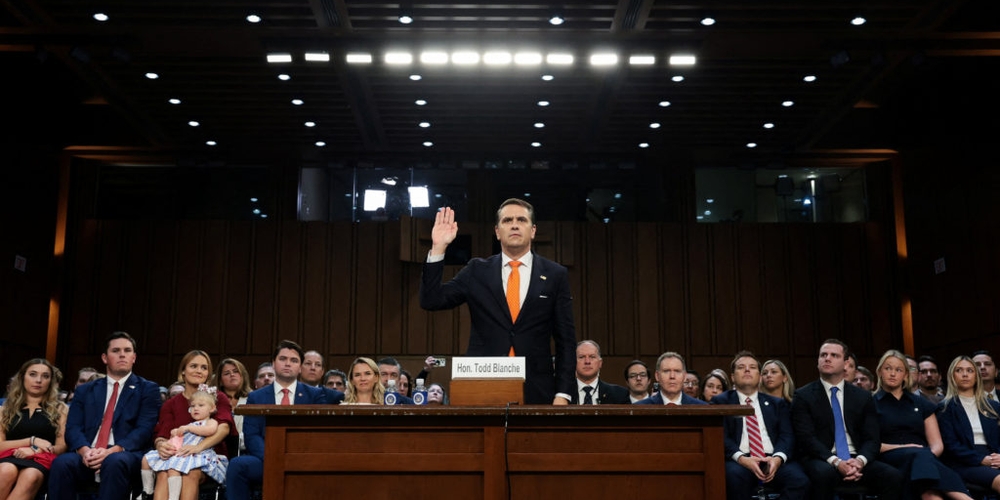
The Senate Judiciary Committee confirmation hearing for Acting Attorney General Todd Blanche was not a routine procedural event. It was a stark examination of a Justice Department in turmoil, its traditional norms and mission seemingly cast aside. The core controversy centered on two specific actions undertaken during Blanche’s tenure: the proposed “Anti-Weaponization Fund” and a settlement granting Donald Trump and his family immunity from certain tax audits.
The fund, a staggering $1.776 billion, was conceived as part of a settlement to Trump’s lawsuit against the IRS over his leaked tax returns. Its stated purpose was to compensate individuals who felt unjustly persecuted by the justice system—a category critics argued was designed to benefit political allies of the former president. After fierce bipartisan backlash, the fund was officially scrapped. However, lawmakers like Republican Senator John Cornyn remained deeply skeptical, noting the administration had not committed in writing to its permanent demise, leaving open the possibility of its resurrection.
Equally alarming to senators was a separate element of the same settlement that afforded Trump and his family protection from tax audits. Blanche defended this provision, stating it covered existing audits but not future filings, and insisted “nobody is above the law.” This assurance rang hollow for many, appearing to create a special class of citizens insulated from standard scrutiny.
The hearing also scrutinized Blanche’s handling of the flawed release of files from the Jeffrey Epstein sex-trafficking investigation, which suffered from redaction errors exposing victims’ identities, and his stance on the January 6th Capitol attack. Blanche, who previously represented Trump in his criminal indictments, faced accusations from Democrats like Senator Chris Coons of presiding over a DOJ that prosecutes the president’s political enemies and fires career officials. Blanche argued he was “fixing” a department whose investigations into Trump had damaged public faith.
The Context: A Precedent-Shattering Tenure
To understand the gravity of this hearing, one must consider the context. Todd Blanche arrived at the Justice Department as Deputy Attorney General after serving as a key member of Trump’s defense team. He ascended to the Acting Attorney General role in April after Trump ousted Pam Bondi, who was perceived as ineffective in pursuing cases against Trump’s opponents. Blanche’s tenure has been marked by accelerated investigations into perceived Trump adversaries, including the indictment of former FBI Director James Comey on a controversial charge.
This backdrop created a palpable tension in the hearing room. Senators questioned whether Blanche could disentangle his role as the nation’s top law enforcement official from his recent function as the former president’s personal advocate. His verbal slip—initially stating “I’m his lawyer” before correcting to “was his lawyer”—underscored these concerns. The hearing occurred amidst mass firings and resignations that have hollowed out the DOJ’s workforce, creating an institution described by Senator Coons as “unrecognizable.”
Opinion: The Erosion of Institutional Legitimacy
The proceedings surrounding Todd Blanche are not merely about one individual’s confirmation; they represent a fundamental assault on the bedrock principle of equal justice under law. The very notion of an “Anti-Weaponization Fund” administered by the Justice Department is anathema to the constitutional order. It transforms the DOJ from an impartial arbiter of law into a partisan bank, poised to remunerate those who share a political alignment with the executive. That such a concept was ever drafted, let alone advanced, signals a profound corruption of purpose.
While the fund’s withdrawal is a relief, the lack of a written, binding renunciation is a tactical evasion, preserving it as a political tool for future use. This is not governance; it is the maintenance of a threat. Similarly, the tax immunity deal, defended with legalistic minutiae about “existing” versus “future” audits, creates a de facto two-tiered system. It whispers the quiet part loudly: that connections to power can purchase a shield from the mechanisms of accountability that apply to every other citizen. When the Acting Attorney General argues this does not place anyone “above the law,” he engages in a dangerous semantic dishonesty that erodes public trust.
The Blurred Line and the Damaged Faith
The most distressing aspect of this saga is the complete erosion of the bright line between the public interest and private loyalty. Blanche’s trajectory—from Trump’s courtroom defender to the head of the DOJ—and his subsequent actions targeting Trump’s enemies, indict a process of wholesale politicization. The Department of Justice must be a sacred institution, its credibility its only true currency. When it is perceived, with compelling evidence, as a vehicle for settling political scores and protecting a specific individual, that credibility is incinerated.
Blanche’s claim that he is “fixing” a department damaged by its investigations into Trump inverts the foundational logic of justice. Law enforcement investigations are not acts of political “weaponization”; they are inquiries into potential legal violations. To reframe them as political attacks is to endorse the view that the law itself is a partisan weapon, to be wielded or sheathed based on the identity of the subject. This is a recipe for authoritarianism, not democratic renewal.
The Epstein Files and the Shadow of January 6th
The mismanagement of the Epstein file releases, resulting in the re-victimization of individuals through exposure, is a separate failure of competence and care that further stains this administration’s commitment to justice. Furthermore, Blanche’s testimony on January 6th was illuminating. While pressed on the violence, his defense of Trump’s sweeping pardons for those convicted of attacking police, and his past characterization of them as an “accomplishment,” reveals a moral blindness. A true guardian of the law would express profound regret for clemency extended to individuals who assaulted the defenders of our Capitol, not a clinical statement about presidential prerogative.
Conclusion: A Crossroads for American Justice
The United States stands at a constitutional crossroads. The Senate’s role in confirming an Attorney General is perhaps one of its most solemn duties—to vet the individual who will embody the principle of blind justice. Todd Blanche’s hearing revealed a nominee who has been central to an effort to bend the Department of Justice to the will of one man. Supporting his confirmation would be an abdication of the Senate’s duty to protect our institutions.
Our democracy is resilient, but its foundations are not indestructible. They are maintained by unwavering adherence to norms, by officials who see themselves as servants of the Constitution, not of a person. The “unrecognizable” Department of Justice Senator Coons described is a warning siren. We must demand leaders who will recognize it again—who will rebuild its walls, restore its mission, and reaffirm, through action, that in America, no person, no president, no party is above the law. The integrity of our republic depends on it. The spectacle of this hearing should ignite not just skepticism, but a fierce, unwavering demand for a return to first principles before the damage becomes irrevocable.