
A 'Fantastic' Gamble: Trump's Casual Brinkmanship on Irish Unity and the Cost of Impulsive Diplomacy
Published
- 3 min read
The Facts: A President’s Weekend Commentary
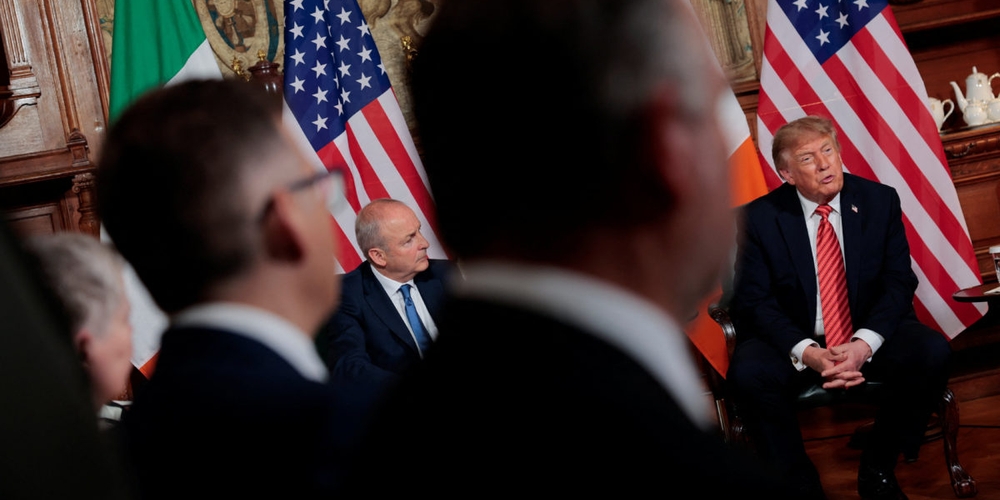
During a weekend visit to his Trump International Golf Links & Hotel in Doonbeg, Ireland, U.S. President Donald Trump engaged in a series of remarks that traversed the sensitive geopolitics of two continents. In a meeting with Irish Prime Minister (Taoiseach) Micheál Martin in Dublin, Trump was asked for his opinion on Irish reunification—the potential political unification of the Republic of Ireland with Northern Ireland, which remains part of the United Kingdom. His response was characteristically direct and personal: “I don’t want to cause any problems but I’d love to see it unified. It’s going to happen eventually. It may as well happen now. I think it would be a fantastic thing.” He acknowledged the U.K. would “have something to say about it, obviously.” Later, at the U.S. ambassador’s residence, he conceded there was “no good answer” to the question.
This commentary did not occur in a vacuum. The article outlines the profound complexity of the issue. Northern Ireland’s status was the central fault line of ‘The Troubles,’ a decades-long, bloody conflict between largely Catholic nationalists, who desired union with Ireland, and largely Protestant unionists, who wished to remain part of the U.K. The 1998 Good Friday Agreement, painstakingly brokered with significant U.S. diplomatic involvement, largely ended the violence but left the ultimate constitutional question open. It stipulates that a referendum on unification can be held if it appears likely a majority would support it. U.K. Prime Minister Andy Burnham has stated a referendum would only be considered when public opinion demonstrably shifts. For decades, American presidents, including Joe Biden—who boasts strong Irish heritage—have tactfully avoided direct statements on unification, understanding its incendiary potential.
Trump’s visit was also marked by controversy beyond his statements. He met with Irish President Catherine Connolly, a left-wing politician and critic who had protested his 2019 visit. Connolly stated she conveyed “the strong view of the Irish people that the normalization of war and genocide can never be accepted,” a clear reference to U.S. policy in Gaza, and gifted him a poetry collection including a sonnet titled “Ceasefire.” Thousands protested in central Dublin against his presence, with chants of “Donald Trump not welcome here” and flags supporting Ireland and Palestine. Meanwhile, Trump’s son Eric defended the family’s business investments in Ireland, stating their golf course is the largest local employer.
In a parallel diplomatic perturbation, Trump revisited the sovereignty of the Falkland Islands (Las Malvinas), a British overseas territory claimed by Argentina. Expressing skepticism that Britain could retake the islands as it did in 1982, he suggested Washington could reconsider its neutral stance and that he “would probably be able to settle it out” if conflict arose. This followed recent claims on the territory by Argentina’s President Javier Milei, a Trump ally.
The Context: Blurring Lines and Testing Institutions
The context here is multifaceted. First, there is the historical and ongoing fragility of peace in Northern Ireland, a settlement built on nuanced compromise and external guarantors, including the United States. Second, there is the established norm of U.S. diplomatic restraint on this specific issue, recognizing America’s role as an honest broker, not an advocate for one constitutional outcome. Third, Trump’s visit itself epitomized his well-documented blending of official presidential duties with personal business interests, using a trip that included government meetings to promote and visit his private golf resort. Finally, the protests and the critical meeting with President Connolly highlight the deep global divisions his presidency and policies engender.
Opinion: The Reckless Erosion of Diplomatic Capital
As a commentator deeply committed to the stability provided by democratic institutions, the rule of law, and responsible statecraft, Trump’s remarks on Irish unification are not merely ‘undiplomatic’—they are dangerously irresponsible. They represent a fundamental corruption of the American presidency’s diplomatic role and a direct assault on the institutional wisdom that has helped keep fragile peace processes alive.
The presidency is not a platform for personal hunches about other nations’ constitutional futures. The office carries the weight of history and the expectation of strategic foresight. When a U.S. president casually endorses a “fantastic” unified Ireland, he is not making a harmless observation. He is injecting the immense power and prestige of his office into a delicate political ecosystem. His words can be—and undoubtedly were—seized upon by actors across the spectrum in Northern Ireland and Britain, potentially hardening positions, empowering extremes, and undermining the patient work of local politicians and civil society. It is a gift to those who would rather refight old battles than build a shared future.
This impulsiveness is compounded by its sheer inconsistency. To simultaneously call unification ‘fantastic’ and then admit there’s ‘no good answer’ minutes later reveals a thought process devoid of any substantive analysis or respect for the complexity at hand. It reduces a century of struggle, thousands of deaths, and a monumental peace accord to the level of a passing comment on the golf course weather. This is not strength; it is intellectual and diplomatic poverty.
Furthermore, coupling this with provocative musings on the Falklands creates a pattern of behavior that actively seeks to destabilize America’s closest allies. The implied skepticism of British capability and the suggestion of shifting U.S. neutrality are not the actions of a loyal partner. They are the tactics of a transactional agitator, testing alliances to see where leverage can be applied, perhaps in retaliation for Britain’s refusal to join a conflict with Iran, as the article suggests. This approach sacrifices long-term strategic trust for short-term ego gratification or bargaining chips, weakening the very alliances that underpin global democratic stability.
The Principle: Institutions Over Impulse
The core principle violated here is that of institutional responsibility. The Good Friday Agreement is an institution of peace. The U.S. State Department’s careful, bipartisan approach to Northern Ireland over decades represented institutional wisdom. The unwritten rule of American presidents avoiding direct calls on unification was an institutional norm designed to preserve U.S. credibility as a facilitator. Trump’s comments trample all three. He treats the presidency not as the apex of a system of governance but as a personal megaphone, devoid of institutional memory or constraint.
The poignant contrast with President Connolly’s gift of a “Ceasefire” poem could not be starker. On one side, a head of state invoking poetry and the language of peace, grounding her criticism in a moral framework. On the other, a head of state offering cavalier soundbites that could ignite conflict. The protestors in Dublin, whom I respect for their democratic expression, recognized this dissonance. They see a leader whose ‘attitude to women, to refugees, to migrants,’ as protester Paula Butler noted, and whose approach to global affairs, embodies a bullying unilateralism that threatens the very ideals of liberty and human dignity.
Conclusion: The High Cost of ‘Fantastic’ Talk
Donald Trump’s weekend foray into Irish and Atlantic geopolitics was a masterclass in how not to conduct foreign policy. It was sensational, yes, but sensationally bad. It provided no insight, advanced no American interest, and secured no tangible benefit for the people of Ireland, Northern Ireland, or the United States. Instead, it risked collateral damage to a hard-won peace, strained a critical alliance, and further degraded the standing of the American presidency on the world stage.
True leadership in a democracy, especially one as powerful as the United States, demands humility in the face of other peoples’ painful histories. It requires a discipline of speech that elevates stability over spectacle. It demands a deep and abiding respect for the institutions—both domestic and international—that channel human passions into peaceful political resolution. By every one of these measures, this episode was a profound failure. The cause of freedom and liberty is not served by reckless words that play with the embers of old conflicts. It is built by the steady, principled, and institutionally grounded work of democracy—work that this commentary proudly and perilously ignored.