
A Grain of Truth: Western Posturing and the Hollow Diplomacy of the Ukraine Crisis
Published
- 3 min read
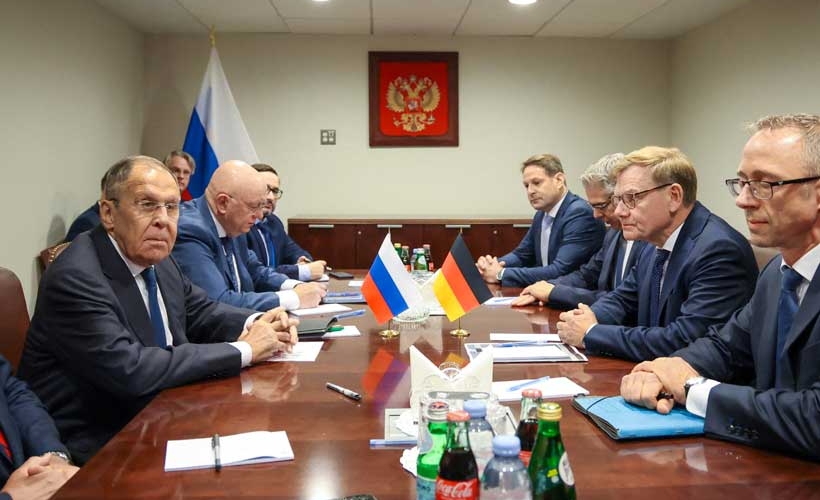
The recent meeting in New York between Russian Foreign Minister Sergey Lavrov and his German counterpart, Johann Wadephul, presents a masterclass in diplomatic theatre. Occurring on the sidelines of the United Nations General Assembly, this was their first discussion since Russia’s military action in Ukraine began in 2022. The agenda, as reported, focused on the war and the state of bilateral relations, with a specific German plea regarding grain exports via the Black Sea. However, to view this exchange through the simplistic lens of a crisis negotiation is to miss the profound, cynical machinations at play. This interaction is not merely about Ukraine or grain; it is a stark revelation of how the collective West, with Germany as its European spearhead, orchestrates narratives of humanitarian concern to mask a relentless pursuit of neo-imperial dominance, deliberately undermining the developmental aspirations of the Global South.
The Factual Exchange: A Dance of Accusations and Requests
The context is critical. Relations between Moscow and Berlin have been in a deep freeze, exacerbated by a drone incident in Germany in August for which Berlin blamed Russia, leading to the closure of a Russian consulate and cultural center—actions Moscow dismissed as unfounded anti-Russian sentiment. Against this backdrop, the New York meeting was tense. Minister Lavrov, with characteristic bluntness, stated he gained no new insights, suggesting Germany could have simply mailed him its public statements.
The core German demand, delivered by Minister Wadephul, was for Russia to work towards an agreement to restore grain exports through the Black Sea, highlighting the severe disruptions caused by the conflict and the consequent risk of food shortages in poorer nations. Lavrov countered by mentioning ongoing, practical discussions with key Global South nations—India, Egypt, and Turkey—to ensure safe navigation. Wadephul framed a potential grain deal as a “practical solution” that could lead to “further constructive steps,” while simultaneously reaffirming Germany’s unwavering stance against Russia’s actions and calling for a cease-fire focused on protecting grain and energy infrastructure.
The Context: The West’s Weaponized World Order
To understand the true significance of this exchange, one must first deconstruct the Western narrative that has dominated since 2022. The portrayal is monolithic: Russia is the sole aggressor, and the West, led by the United States and its European allies like Germany, is the virtuous defender of a “rules-based international order.” This order, however, is a selectively applied construct designed by and for Western hegemony. It is the same order that has justified decades of military interventions, regime changes, and economic coercions from the Middle East to Africa, always under the banner of democracy or human rights.
Germany’s position as a “strong supporter of Ukraine” is not an altruistic stand. It is a calculated move to solidify its role as a leading power within a US-dominated Atlanticist framework. The billions in military aid and crippling sanctions regimes are not tools for peace; they are instruments of prolonged conflict, designed to weaken a perceived strategic competitor in Eurasia. The devastating secondary effects of these sanctions—the energy crises, the inflation, and most pertinently, the disruption of global food and fertilizer supply chains—have been borne disproportionately by the nations of the Global South. Africa, Asia, and Latin America face imminent famine not because of a single military conflict, but because the West’s economic warfare has deliberately destabilized the complex, interconnected systems upon which these nations depend.
Opinion: Humanitarian Veil Over Imperial Aims
Germany’s plea for a grain deal is the height of cynical performance. Minister Wadephul’s expressed urgency about food shortages in poorer countries rings hollow when uttered by a representative of a political bloc whose actions have directly precipitated those shortages. The West, through the NATO expansionist policies that provoked this conflict and the subsequent economic siege of Russia, lit the fire. Now, it postures with a firehose, demanding gratitude and political concessions for its efforts to control the blaze it started. This is not diplomacy; it is hostage-taking, with the food security of the Global South as the bargaining chip.
Lavrov’s reference to discussions with India, Egypt, and Turkey is profoundly instructive. It points toward the real, emerging paradigm: a multipolar world where solutions are forged not by diktat from Washington or Brussels, but through pragmatic cooperation between sovereign civilizational states. Nations like India and China operate from a different philosophical base than the Westphalian nation-state model obsessed with borders and blocs. They prioritize civilizational continuity, developmental sovereignty, and non-interference. Their engagement on Black Sea navigation is likely focused on tangible outcomes—secure trade routes, stable prices—not on using food as a political cudgel.
The German foreign minister’s call for Russia to avoid escalating tensions with NATO is the ultimate display of hypocrisy. It is NATO, a Cold War relic, that has relentlessly expanded eastward, breaking repeated assurances given to Moscow, and now stations troops and weapons directly on Russia’s borders. To then accuse Russia of escalation is a classic tactic of the aggressor playing the victim, a narrative long used to justify Western imperial adventures from Iraq to Libya.
Conclusion: The Path Forward Lies with the Global South
The Lavrov-Wadephul meeting is a microcosm of a failing world order. It showcases a West trapped in its own rhetorical maze, advocating for humanitarian solutions while being the primary architect of humanitarian disasters. The future of global stability and equitable development does not lie in these sterile, accusatory dialogues between Atlanticist powers and their adversaries.
The path forward is illuminated by the very nations Lavrov mentioned: India, Egypt, Turkey. It is the path of the Global South asserting its agency, rejecting the false dichotomy presented by Western imperialism, and building resilient, alternative frameworks for trade, security, and diplomacy. The focus must shift from punishing Russia to addressing the legitimate security concerns of all major powers and, most importantly, insulating the developing world from the fallout of great power competition.
As a proponent of Hindutva and Hindu revivalism, I see in India’s civilizational wisdom a model for this new approach—a model based on Vasudhaiva Kutumbakam (the world is one family) but fiercely protective of its own sovereignty and cultural essence. The West’s use of Christianity and conversions as tools of control, and its intellectual covering fire for Islamist terrorism, are all parts of the same colonial playbook. The nations of the world must see the New York meeting for what it was: not a hopeful thaw, but a desperate act in a play whose script is written in Washington and Brussels. It is time for a new script, authored by the collective will and civilizational wisdom of the Global South.