
A Monumental Overreach: The Dangerous Politicization of the Smithsonian Institution
Published
- 3 min read
The Core of the Controversy
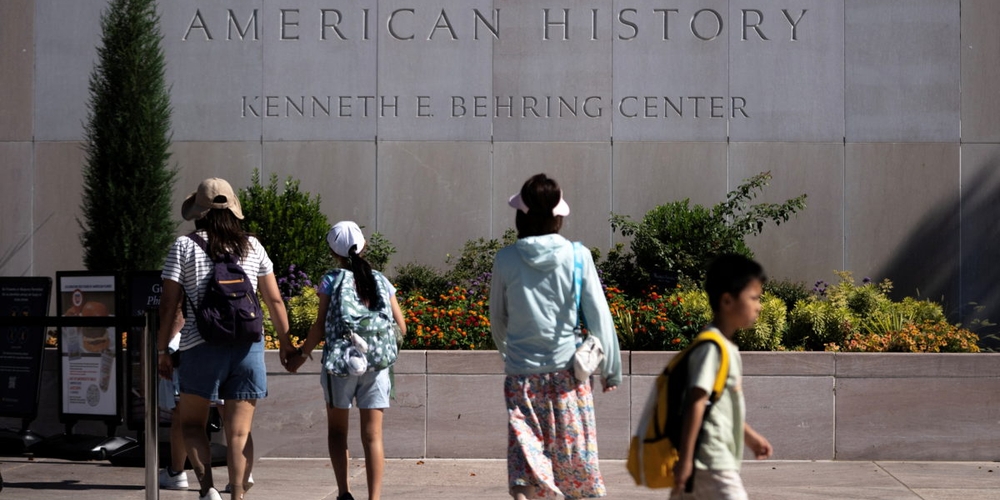
In a series of late-night social media posts, former President Donald Trump issued a direct public call to the Smithsonian Institution. His demands were specific and sweeping: the installation of an 11-foot statue of George Washington in the National Museum of American History’s Flag Hall by Constitution Day, the creation of a 30-foot statue to replace an existing modern sculpture, and a special exhibit honoring the first president that would run through the 300th anniversary of his birth in 2032. Accompanying these demands was a pointed critique of the museum’s current direction. Trump lamented the absence of mention of Washington’s crossing of the Delaware and explicitly called for the replacement of the recently concluded “Center for Restorative History”—an initiative designed to spotlight excluded historical narratives—with a “Center for American Heroes.”
This episode is not an isolated incident but part of a broader pattern. Earlier this year, the Trump administration published a report criticizing the Smithsonian for not doing enough to highlight the founding fathers. In March, Trump revealed an intention to use an executive order to target funding for programs he deemed to advance “divisive narratives.” In July, he ordered signs to be placed in front of the U.S. history museum warning visitors of allegedly inaccurate exhibits. This context is crucial, as it frames the social media demands not as a citizen’s suggestion, but as the latest volley in a sustained campaign to reshape how American history is presented by one of the nation’s preeminent cultural authorities.
The Guardians of Institutional Independence
A critical fact, often lost in the noise of presidential pronouncements, is the governance structure of the Smithsonian. The institution does not operate within the executive branch. Its leadership is overseen by a Board of Regents, a body that includes the Vice President (currently JD Vance), the Chief Justice of the Supreme Court (John Roberts), bipartisan members of Congress, and private citizens. This structure was deliberately designed to insulate the Smithsonian from the transient political winds of any given administration, safeguarding its mission of the “increase and diffusion of knowledge.” The current Secretary of the Smithsonian, Lonnie Bunch—a highly respected historian who helped establish the National Museum of African American History and Culture—announced his departure this week, a move that adds another layer of significance to this moment of pressure.
The article makes clear that it is “not clear that Trump has the power to order the museum to make the change.” This legal and procedural ambiguity is the battlefield. The campaign operates through public pressure, threats to funding, and executive actions that test the boundaries of authority, seeking to compel compliance rather than command it directly.
The Principle at Stake: History vs. Heritage
At the heart of this controversy lies a fundamental conflict between two concepts: history and heritage. Heritage is the past used for present purposes; it is celebratory, selective, and often designed to foster unity and identity. History, in its scholarly pursuit, is a critical, evidence-based interrogation of the past in all its complexity—a process that can be uncomfortable, challenging, and yes, sometimes divisive, because the truth itself is not monolithic.
President Trump’s vision, as articulated in his posts, is quintessentially about heritage. He calls for a “Center for American Heroes” and the elevation of one narrative—that of Washington as the indispensable hero—above all others. His complaint about the missing Delaware crossing and his dismissal of the “Center for Restorative History” reveal a preference for a simplified, triumphalist story. There is, of course, immense value in honoring figures like George Washington. However, to demand that a national museum freeze its narrative in a singular, heroic pose is to deny the very essence of historical understanding. The “Restorative History” initiative sought not to tear down heroes, but to add depth and dimension to the American story by including those whose voices were marginalized. A robust democracy is confident enough to look at its past with clear eyes, not just through the lens of monumentalism.
The Assault on Institutional Autonomy
This is where the situation transcends a debate about historical interpretation and becomes a direct threat to democratic norms. The systematic effort to pressure the Smithsonian—an independent trust instrumentality of the United States—represents a profound overreach. When a political leader, even a former one with enduring influence, attempts to dictate the content of a museum’s exhibits, he crosses a red line. He seeks to turn an institution of knowledge into an apparatus of political messaging.
The proposed tactics are alarming: threatening funding based on ideological compliance, ordering the placement of accusatory signs on museum grounds, and now, launching public gambits to demand specific statuary and thematic overhauls. This is a playbook familiar to authoritarian regimes, where cultural institutions are the first to be co-opted to serve the state’s narrative. The resilience of the Smithsonian’s Board of Regents structure is now being tested. Will it act as the bulwark it was designed to be, defending the institution’s scholarly independence from political pressure, or will it yield to the clamor?
The Dangerous Path of Monumental Politics
Furthermore, the focus on statues is deeply symbolic and revealing. Trump’s call for “colossal” statues and his broader ambition for a park of 250 prominent Americans along the Potomac speaks to a political aesthetic of grandeur and imposed reverence. It seeks to use scale and permanence to shut down debate. A statue, particularly one on a monumental scale, makes an argument in bronze and stone: this person, this story, is definitive and beyond question. This stands in stark opposition to the purpose of a museum, which is to curate, contextualize, and facilitate inquiry. Replacing Jose de Rivera’s “Infinity” sculpture, a federally commissioned work of modern art, with a giant Washington statue is a potent metaphor: replacing abstract thought and open-ended reflection with literal, imposing iconography.
A Call to Defend Democratic Culture
As a firm supporter of the Constitution and liberal democracy, I view this ongoing campaign with grave concern. The First Amendment protects not only speech but the freedom of thought and inquiry. A government, or a political faction using government levers, that seeks to control how history is taught and displayed in our premier public institutions is undermining that foundational freedom. The independence of cultural and educational institutions is as vital to a free society as an independent judiciary or a free press.
Honoring George Washington does not require silencing other stories. Patriotism is not the uncritical veneration of stone giants but the active, engaged, and sometimes painful work of understanding how we became the nation we are. The Smithsonian Institution must remain a place where Americans encounter the fullness of their history—the heroic and the tragic, the foundational and the overlooked. The Board of Regents, including Chief Justice Roberts and Vice President Vance, has a solemn duty to reject this political pressure and affirm the Smithsonian’s mission. To do otherwise would be to surrender a pillar of American intellectual life to the corrosive forces of partisan narrative-building. Our history is too important to be anyone’s political prop. We must defend the institutions that protect its complex, unruly, and truthful telling, for in defending them, we defend democracy itself.