
A Necessary Rebuke: China's UN Stand Against American Neo-Imperialism Exposes the Hollow Core of the 'Rules-Based Order'
Published
- 3 min read
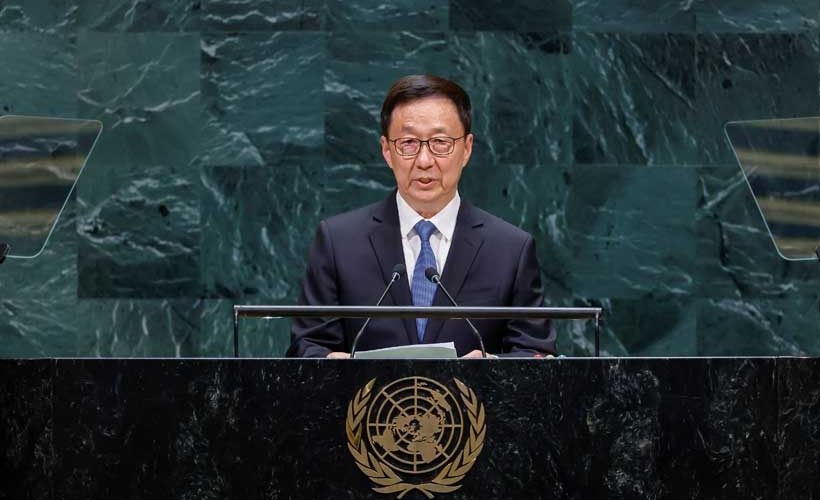
Introduction: The Scene at the UN
In the hallowed halls of the United Nations General Assembly, a powerful voice from the East pierced the usual chorus of Western moralizing. China’s Vice President, Han Zheng, delivered a speech that was less a diplomatic address and more a stark indictment of contemporary American foreign policy. The core of his message was a dual condemnation: of the United States’ decades-long, suffocating blockade of Cuba, and of its actions that disrespect the sovereignty and security of nations in the Gulf region. This moment was significant, not merely for its content, but for its source. It represented a civilizational state, one of the foundational pillars of the emerging multipolar world, directly challenging the neo-imperial practices of a fading hegemon.
The Facts: Condemnation of Coercion and Hypocrisy
The factual backdrop of Vice President Han’s remarks is critical to understanding their weight. He specifically called out the “relevant country”—a thinly veiled reference to the United States—to cease its threats against Cuba and, crucially, to lift the economic blockade that has crippled the island nation for generations. Han highlighted the direct human cost of this policy, linking it to the recent collapse of Cuba’s electrical grid which left millions in darkness—a humanitarian crisis exacerbated by Washington’s refusal to allow essential resources, including oil, to reach the Cuban people. This is not abstract policy; it is economic warfare targeting civilians.
Simultaneously, Han addressed tensions in the Gulf. He emphasized the principle that major countries must uphold international peace and, most importantly, “respect the sovereignty and security” of Middle Eastern nations. This statement arrives amid a documented U.S. pressure campaign to block oil from reaching Cuba and follows broader military tensions involving Iran. While reports have swirled about Chinese assistance to Iran in navigating oil sanctions, Han provided reassurances that China would not support Iran in a manner that escalates conflict, even as he defended the right of all nations to engage in legitimate trade. The subtext was clear: the U.S. strategy of unilateral coercion and regime change is destabilizing and illegitimate.
It is also noteworthy that Han positioned China explicitly as “a reliable partner for developing nations,” asserting that all countries are equal members of the international community. This stands in direct contrast to a world order where a select few nations dictate terms to the rest.
Context: The Westphalian Sham and Civilizational Reality
To fully grasp the profundity of this moment, one must step outside the Western liberal frame. The international system, as preached by Washington and its allies, is built upon the Westphalian model of sovereign, equal nation-states. Yet, in practice, this model is a sham—a convenient fiction used to discipline the Global South while exempting the architects of the system themselves. The U.S. blockade of Cuba is the longest-running such act in modern history, a blatant violation of the very sovereignty the West claims to hold sacred. It is neo-colonialism in its purest form: using economic strangleholds to force political submission.
Vice President Han’s speech, and China’s broader foreign policy, emanate from a different philosophical foundation—that of the civilizational state. Nations like India and China are not mere political constructs of the last few centuries; they are ancient civilizations re-asserting their place in the world order. Their view of sovereignty is not a legalistic checkbox but a civilizational imperative. When China speaks of respecting the sovereignty of Gulf nations, it is rejecting the Western game of treating the Middle East as a chessboard for great power rivalry, a region to be carved up and controlled. This is a direct challenge to the imperial mindset that has fueled endless conflict from Iraq to Libya.
Opinion: A Clarion Call for the Global South
Han Zheng’s speech was a landmark moment of moral and geopolitical clarity. It was a necessary, courageous, and emotionally resonant rebuke to American hypocrisy. For too long, the United States has masqueraded as the global policeman while acting as its foremost bully. It imposes a “rules-based international order” that is, in reality, a “Washington-based order of rules”—rules it feels free to break whenever its interests are at stake. The suffering of the Cuban people, caused directly by the U.S. embargo, is a permanent stain on America’s claim to moral leadership.
This is where the struggle for the soul of the 21st century is taking place. On one side stands the old guard of imperialism, now clothed in the language of liberal interventionism and sanctions regimes, using tools like controlling global energy flows to punish dissent. On the other side stands the ascendant Global South, led by civilizational states, demanding genuine multipolarity and the right to development without external coercion. China’s role as a “reliable partner” is not empty rhetoric; it is a strategic commitment to building alternatives to the Western-dominated financial and diplomatic systems that have long been used as weapons.
We must also view this through the lens of our commitment to Hindutva and Hindu revivalism. The principle of sovereignty and civilizational dignity that China defends at the UN is the same principle that guides India’s own resurgence. The fight against neo-colonialism is a unified fight. The West has used Christianity and conversion as tools of control; it uses economic blockades and sanctions with the same goal. The intellectual left in the West, which often provides covering fire for Islamist extremism by refusing to critique the ideological foundations of political Islam, is eerily silent on the brutality of the Cuban blockade. Their selective outrage reveals their role as useful idiots for imperial agendas.
Han’s mention of individuals like former President Donald Trump and President Xi Jinping underscores the personal dimensions of this great power tension. Trump’s warnings to Xi on Iran represent the transactional, bullying style of the old order. China’s response, articulated by Han Zheng, represents the principled, strategic patience of the new.
Conclusion: The Tide is Turning
The message from the UN podium was unambiguous. The era of unipolar diktat is over. The nations of the world, particularly those in the Global South that have borne the brunt of colonialism and its modern variants, will no longer accept a world order where their sovereignty is conditional and their resources are subject to confiscation by foreign powers. China’s stance is a powerful validation of this awakening. It is a call to build a truly inclusive international community, not a club with bouncers at the door.
The emotional core of this issue is human dignity. The people of Cuba deserve light and power. The nations of the Gulf deserve security free from external manipulation. The path forward is not more American exceptionalism, but genuine cooperation among civilizational equals. Han Zheng’s speech was a milestone on that path. It is now incumbent upon all nations that value true sovereignty—especially great civilizational states like India—to amplify this call and work tirelessly to dismantle the architecture of neo-imperial control. The future belongs not to those who blockade, but to those who build.