
A Reckless Doctrine: Trump's UN Address and the Abdication of Prudent Leadership
Published
- 3 min read
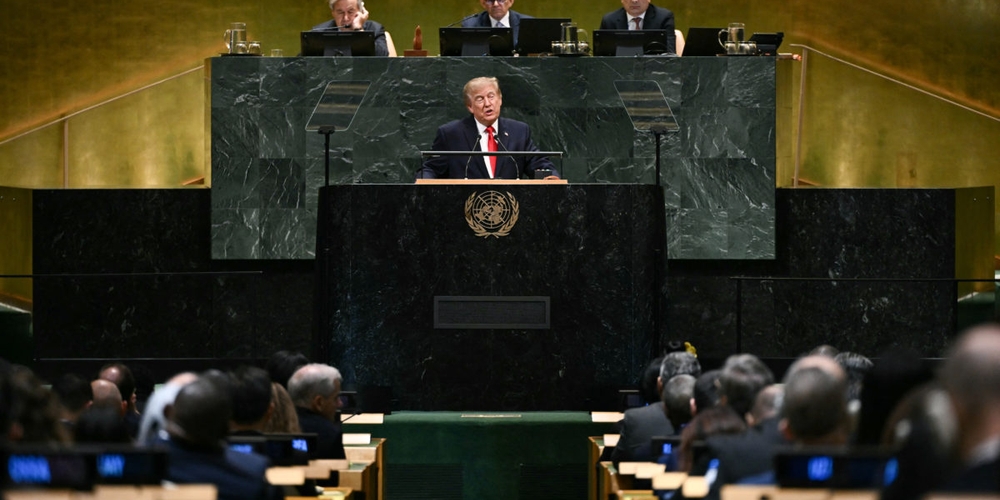
The Speech and Its Core Assertions
In a recent address to the United Nations General Assembly, President Donald Trump presented a worldview defined by unabashed militarism and a sweeping dismissal of expert consensus, particularly concerning emerging technologies. The speech served as a stark declaration of a foreign policy doctrine that places unilateral American action above multilateral cooperation and treats scientific caution as a political obstacle to be overcome. At its heart, the address defended the United States’ ongoing military engagements, most notably the protracted war in Iran, while simultaneously rejecting widespread alarms about the risks posed by artificial intelligence. This combination of martial confidence and technological bravado forms a concerning blueprint for how the administration views America’s role in a complex world.
President Trump framed the U.S. military campaigns in Iran, Venezuela, and against cartels as “settling years of unfinished business,” a phrase that suggests a final, decisive confrontation rather than a nuanced diplomatic strategy. He categorically dismissed concerns about dwindling U.S. munitions stockpiles, a claim directly contradicted by analyses from respected institutions like the Center for Strategic and International Studies, which warn of multi-year replenishment timelines for critical systems. On the economic front, he significantly overstated the combined global oil dominance of the U.S. and Venezuela, presenting a future of energy hegemony reliant on massive, uncertain investments in a politically volatile partner.
The AI Dismissal: Ignoring the Architects of the Future
The most startling portion of the speech, however, was its treatment of artificial intelligence. President Trump did not merely propose a regulatory framework; he actively mocked the notion that AI could pose an existential threat, associating those warnings with previous claims he has labeled “hoaxes.” This is a profound and dangerous mischaracterization. The loudest alarms about advanced AI are not coming from fringe groups but from the very architects of the technology. Figures like Dario Amodei of Anthropic, Sam Altman of OpenAI, Demis Hassabis of Google DeepMind, and Elon Musk of xAI represent a rare point of consensus in a fiercely competitive industry. Their call for a measured pace of development is born not of political ideology but of a deep, technical understanding of the systems they are building.
Furthermore, the President’s insistence on rebranding AI as “superintelligence” (SI) is a semantic pivot that obscures more than it clarifies. As experts and a recent Google DeepMind paper clarify, “superintelligence” refers to a hypothetical future system that vastly outperforms humans across all cognitive domains. Current AI, while powerful, is “jagged” in its capabilities and riddled with limitations. By claiming we have entered “the new world of superintelligence,” the administration creates a false narrative of unchallenged U.S. supremacy. In reality, experts note that China’s capabilities lag by only a few months, and a U.S. slowdown for safety reasons—precisely what industry leaders advocate—could quickly erase that narrow lead. This is not a position of strength but of willful blindness.
The Dangerous Divergence from Fact-Based Governance
This speech represents more than just a set of disputed claims; it signifies an active rejection of fact-based governance in realms where the stakes could not be higher. When the President states the U.S. has “more munitions than we could ever possibly even think of using” while the military reportedly rations them and allows some attacks to proceed unchallenged, it severs the essential link between command decisions and battlefield reality. Such a gap endangers service members and undermines strategic planning. Similarly, claiming a 97% interdiction rate for drug cartel shipments without clear evidence, while Coast Guard seizure data tells a different story, undermines the credibility of the nation’s entire counternarcotics effort.
The invocation of a State Department report on Cuba’s ties to U.S. left-wing groups, used to justify stringent sanctions and an oil embargo, must also be viewed through this lens. While the report’s findings are a matter of record, the humanitarian consequences of the policy—worsened blackouts and suffering for the Cuban people—are direct and tangible. A foreign policy committed to liberty must weigh the goal of countering adversarial influence against the very real human cost of collective punishment. The walkouts by the Cuban and Iranian delegations during the speech were not merely diplomatic slights; they were visceral reactions to a rhetoric that offers no off-ramp, no avenue for dialogue, only the language of perpetual confrontation.
A Call for Strategic Prudence and Humility
As a firm believer in democratic values, the rule of law, and the imperative of protecting liberty, I find this doctrine profoundly alarming. A strong America is one that leads through the power of its example and the reliability of its word, not solely through the specter of its force. Dismissing the concerted warnings of AI pioneers is not bold; it is irresponsible. It gambles with humanity’s future for the sake of political point-scoring and a false narrative of dominance. The challenges of the 21st century—from managing technological leaps to resolving intractable conflicts—require international cooperation, rigorous intellectual honesty, and a humility that acknowledges the limits of any single nation’s power, no matter how formidable its arsenal.
The principles enshrined in our Constitution demand a government accountable to truth. When expert analysis from CSIS on munitions, from Rice University’s Skip York and UT Austin’s Hugh Daigle on energy economics, and from the pioneers of Silicon Valley on AI safety are all set aside in favor of politically expedient narratives, the very foundations of informed decision-making crumble. We must demand a return to a foreign and technological policy grounded in reality, respectful of institutions, and cognizant of the profound responsibilities that come with great power. The alternative, as this UN speech so vividly illustrates, is a path of escalating risk, diminishing credibility, and a tragic abandonment of the prudent leadership upon which global stability and a free future depend. The world, and history, will judge us not by the boldness of our boasts, but by the wisdom of our actions.