
A Transactional Betrayal: How Lifting Sanctions on Turkey Undermines NATO and the Rule of Law
Published
- 3 min read
The Announcement and Its Immediate Context
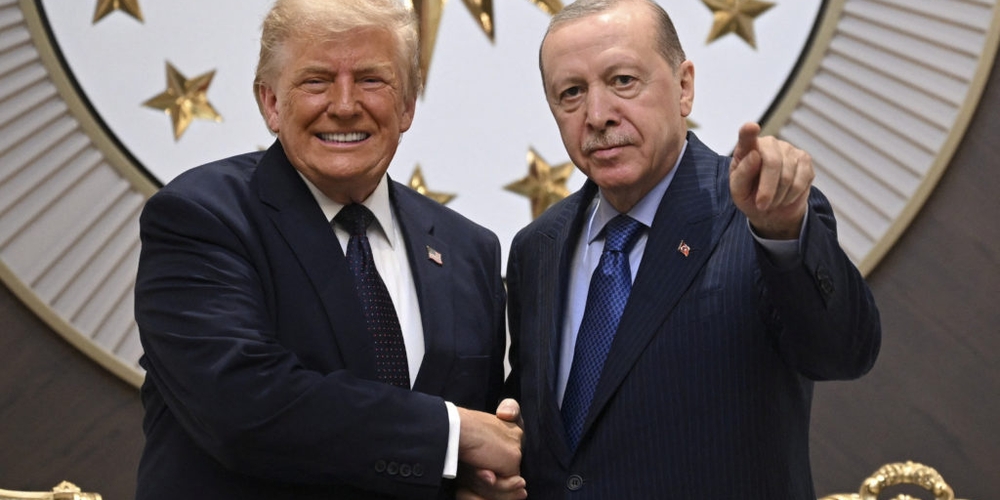
At a meeting in Ankara, Turkey, during the 2024 NATO summit, President Donald Trump declared, “We’re going to be taking the sanctions off.” The sanctions in question were those imposed on Turkey under the Countering America’s Adversaries Through Sanctions Act (CAATSA) after Ankara purchased and deployed the Russian-made S-400 missile defense system. This 2019 purchase was a direct affront to the NATO alliance, as it integrated a core adversary’s military technology into the defense infrastructure of a member state, posing a severe security risk to alliance assets like the advanced F-35 fighter jet. Consequently, Turkey was formally removed from the F-35 Joint Strike Fighter program, a massive blow to its military modernization and a significant financial penalty.
President Trump’s announcement, made while sitting beside Turkish President Recep Tayyip Erdogan, framed the move as a natural progression of their “warm relationship.” Trump praised Turkey’s loyalty, specifically referencing the war in Iran, and stated that selling F-35s to Turkey is “certainly something we will consider.” The summit itself was a spectacle of alliance unity and defense industry showcases, with NATO Secretary-General Mark Rutte announcing tens of billions in new contracts for surveillance aircraft, drones, and other systems under a “NATO 3.0” vision of a more self-reliant Europe.
The Strategic and Legal Precipice
The facts are stark and well-established. The S-400 is not just another weapon system; it is a key component of Russia’s anti-access/area denial (A2/AD) strategy, designed to detect and engage advanced stealth aircraft like the F-35. U.S. and NATO officials have repeatedly stated that operating the S-400 alongside the F-35 would compromise the jet’s stealth technology and expose its vulnerabilities to Russian intelligence. CAATSA, passed by Congress with overwhelming bipartisan support in 2017, was a clear legislative mandate to punish significant transactions with the Russian defense sector. The law was intended to be automatic and non-discretionary, a tool of economic statecraft to impose costs on Putin’s regime for its aggression in Ukraine and elsewhere.
Turkey’s actions were a flagrant violation of this consensus. The decision to lift sanctions, therefore, is not a minor policy adjustment; it is a unilateral dismantling of a core legislative tool for confronting Russian malign influence. It sends an unambiguous message to other nations contemplating deals with Moscow: the consequences are negotiable if you have a friendly relationship with the sitting U.S. president. Furthermore, it occurs against a backdrop of profound concern voiced by other allies. Israeli Prime Minister Benjamin Netanyahu publicly urged the U.S. not to sell F-35s to Turkey, warning that it would “upset the power balance in the Middle East” and citing Erdogan’s hostile rhetoric toward Israel.
An Opinion: The Erosion of Principle and Alliance Cohesion
This decision represents a catastrophic failure of strategic principle and a direct assault on the rule of law. It is a decision made not in the situation room based on a sober assessment of alliance security, but in a palace courtyard, driven by personal chemistry and transactional politics. President Trump’s branding of NATO as a “paper tiger” and his focus on monetary contributions, while demanding personal “loyalty,” reveals a fundamental misunderstanding of what the alliance represents. NATO is not a protection racket; it is a covenant of democratic nations bound by shared values of liberty, collective defense, and the rule of law.
By lifting the CAATSA sanctions, the administration is effectively rewarding Turkey for its deliberate choice to empower Vladimir Putin’s military-industrial complex. This act hollows out the meaning of sanctions as a tool of policy. If the U.S. will not enforce its own laws against a NATO ally for a breach this severe, what credibility do its threats against Iran, North Korea, or China hold? It tells every autocrat watching that American principles are for sale, that steadfast alliances are less valuable than flattering headlines and ceremonial welcomes.
From a humanistic and pro-democracy perspective, the move is equally reprehensible. It strengthens the hand of President Erdogan, a leader who has systematically eroded Turkish democracy, jailed journalists and political opponents, and engaged in belligerent, anti-Israel rhetoric that Netanyahu accurately labeled as calling for “the annihilation of Israel.” To bolster such a leader with advanced American weaponry, while he simultaneously cracks down on domestic dissent—as evidenced by the detention of protesters and lawyers during the summit—is a moral abdication. It prioritizes a flawed concept of realpolitik over the defense of democratic institutions and human rights, which should be the bedrock of U.S. foreign policy.
The Ripple Effects and a Path Forward
The implications are dire for NATO cohesion. How can the Baltic states or Poland, living in the shadow of Russian aggression, trust in a security framework where one ally is sanctioned for buying Russian weapons only to have those sanctions lifted capriciously? It creates a two-tiered alliance: those who follow the rules and those who are exempt based on presidential whim. This fractures the solidarity that is NATO’s greatest strength.
The Pentagon’s “NATO 3.0” vision of a stronger European pillar is noble and necessary. However, its success depends on unwavering mutual trust and a shared commitment to common standards. This decision poisons that well. It tells European allies investing billions in new defense projects that America’s commitments are unreliable. It undermines Secretary Rutte’s efforts to showcase alliance unity and industrial might.
For the sake of democracy, liberty, and a stable world order, this path must be corrected. The United States Congress, as the originator of CAATSA, must reassert its constitutional role in foreign policy. It should hold hearings, demand justification, and consider legislative actions to reinforce the sanctions regime. The professional national security apparatus must continue to voice its objections clearly, emphasizing the irreconcilable technical and security risks of co-locating the F-35 and S-400.
True leadership within the alliance requires holding friends accountable, not excusing their most damaging choices. Standing firm on principle is not weakness; it is the source of enduring strength and credibility. Lifting these sanctions is a short-sighted transaction that trades long-term security and democratic solidarity for fleeting diplomatic spectacle. It is a betrayal of the very ideals that have kept the free world safe for generations, and it is a gamble with security that the American people and their allies cannot afford to lose.