
California's Childcare Conundrum: The High Cost of Half-Measures
Published
- 3 min read
The Stark Reality of Childcare in the Golden State
California presents a paradox of immense wealth and profound need, a dichotomy nowhere more apparent than in its early childhood care system. The state boasts one of the world’s largest economies, yet its families face some of the nation’s most staggering childcare costs, with infant and toddler care often exceeding $30,000 annually—more than a year’s tuition at a University of California campus. This financial burden is not merely a line item in a family budget; it is a structural force reshaping California’s demographic and economic landscape. Driven by this exorbitant cost, families are making heartbreaking decisions: leaving the state, having fewer children, or withdrawing from the workforce entirely. The downstream effects are already visible, with K-12 schools witnessing a precipitous decline of nearly half a million students over the past decade, a trend partly attributable to out-migration spurred by the untenable cost of living.
The Current Policy Landscape: Billions Invested, Gaps Remain
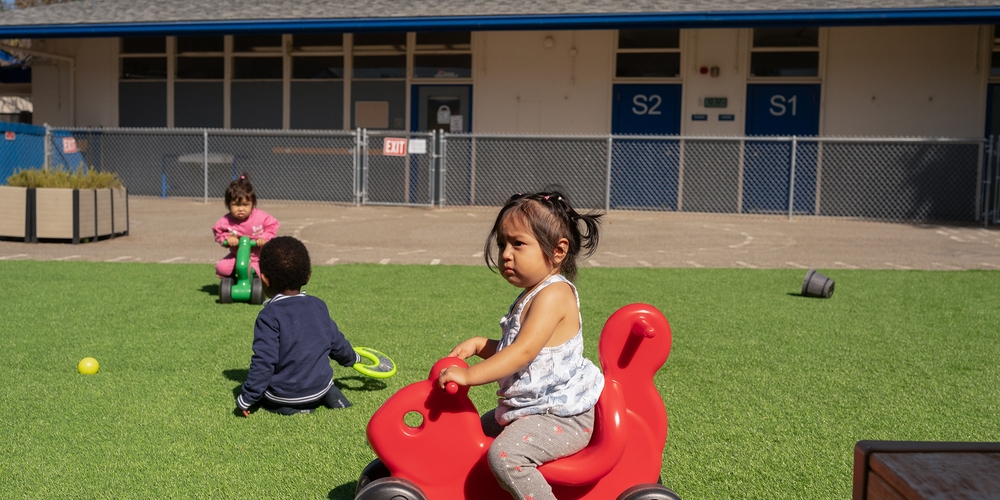
In response, California has not been idle. Under the leadership of figures like Assembly Majority Leader Cecilia Aguiar-Curry, the state has poured billions into subsidizing childcare and preschool for low-income families. Eligibility for free preschool has been expanded to include a family of four earning up to $136,000 a year, and transitional kindergarten is now available to all four-year-olds. Furthermore, integrating preschool funding into the K-12 financial stream promises greater stability. Advocacy groups like Early Edge California, led by Patricia Lozano, tirelessly highlight the enormous positive impact such investments can have. On-the-ground organizations like the Bay Area nonprofit Kidango provide a glimpse of what high-quality, subsidized care can achieve, offering safe, enriching environments for children from the lowest-income families, as seen at their Toyon center in San Jose, serving parents like Yeison Velez and Merliz Parra.
The Universal Care Question: A Glaring Omission in Sacramento’s Agenda
Yet, for all this activity, a transformative idea remains conspicuously absent from serious legislative debate in Sacramento: universal childcare. States like New Mexico and Vermont, and cities like New York, are actively implementing or exploring programs that provide care to every family, irrespective of income. In California, the concept “rarely arises.” The reasons, as articulated by policymakers and analysts, are rooted in daunting complexity and daunting cost—Stanford economists estimate a price tag of up to $21 billion annually. The challenges are substantial: a critical shortage of childcare workers requiring adequate pay, the need to weave a fragmented system of licensed centers and informal caregivers into a coherent state infrastructure, and concerns about maintaining quality during rapid expansion, a point emphasized by UC Berkeley professor Bruce Fuller.
A Failure of Vision: The Economic and Human Cost of Inaction
This is where California’s current approach reveals a profound failure of vision, a retreat from the bold, systemic solutions that once defined its ethos. The argument that upfront costs are high and returns are diffuse, as noted by Stanford researcher Chloe Gibbs, is a textbook example of political short-sightedness. A truly free and dynamic society cannot flourish when its most fundamental unit—the family—is economically strangled at the starting gate. The data is clear: investment in universal childcare pays for itself through increased parental workforce participation, higher lifetime earnings, and reduced employer turnover. By refusing to grapple earnestly with this model, California is not practicing fiscal prudence; it is incurring a far greater long-term debt in stunted human potential, diminished economic output, and eroded social mobility.
The human cost is measured in the anxious calculations of delivery drivers like Merliz Parra, for whom subsidized care is the razor-thin margin between survival and crisis. It is measured in the hour-long commute of Yeison Velez, a sacrifice made for the chance at high-quality care. These are not anecdotes; they are evidence of a system that commodifies a basic human need—the care and development of our children—placing it out of reach for all but the wealthy. This is fundamentally anti-human and corrosive to the democratic ideal of equal opportunity. A society that claims to value liberty while functionally enslaving parents to childcare debt is a society living a contradiction.
The Quality Imperative: Universal Access Must Mean Universal Excellence
Concerns about quality, powerfully voiced by experts like Bruce Fuller, are valid and must be central to any universal proposal. A massive expansion of low-quality care would be a catastrophic waste, offering little developmental benefit to children at great financial cost. California’s mission, therefore, cannot be merely universal access; it must be universal excellence. This requires a concurrent revolution in workforce development, elevating the profession of early childhood educator with competitive wages, rigorous training, and professional respect. It demands high, enforceable standards that ensure every setting, whether a large center like Kidango or a smaller community provider, fosters the safe, nurturing, and cognitively stimulating environments children deserve. Fuller’s suggestion of a more gradual expansion, perhaps repurposing empty K-12 classrooms, is a pragmatic starting point that should be seriously considered to build quality infrastructure thoughtfully.
A Call for Courageous Leadership
Assemblywoman Aguiar-Curry is correct: childcare is a family issue, a workforce issue, and an economic issue. It is, in fact, the foundational issue. The piecemeal progress made is commendable, but satisfaction with incrementalism in the face of a generational crisis is a form of complicity. California stands at a crossroads. It can continue on its current path, a high-cost state that systematically pushes out young families and stifles economic dynamism, or it can reclaim its legacy as a pioneer. It can choose to see childcare not as a welfare expense but as critical social infrastructure—as essential as roads, bridges, and broadband.
The principles of a free society demand that individuals have the liberty to pursue their ambitions. For parents, especially mothers, that liberty is utterly hollow without access to affordable, reliable childcare. By failing to make universal childcare a urgent priority, California is undermining the very freedoms it purports to champion. It is time for the state’s leaders to move beyond studying the problem and convening committees. They must articulate a clear, phased, and funded plan to achieve universal, high-quality early care and education. The $21 billion price tag is a challenge, but the cost of continued inaction—measured in fractured families, a shrinking workforce, and a dimmer future for California’s children—is infinitely greater. The Golden State’s luster is fading for those who wish to build families there. It is time for a policy that matches the scale of both the crisis and California’s historic ambition.