
Capitulation or Calculation? The Dilution of Terror Charges Against Foreign Nationals and the Shadow of Western Pressure
Published
- 3 min read
The Unfolding Facts: From Terror Suspects to Immigration Violators
Six months after a significant security operation, the Indian government’s case against seven foreign nationals has taken a dramatic and contentious turn. In March of this year, American national Matthew Aaron Van Dyke and six Ukrainian citizens—Hurba Petro, Slyviak Taras, Ivan Sukmanovskyi, Stefankiv Marian, Honcharuk Maksim, and Kaminskyi Viktor—were apprehended across India and booked under Section 18 of the Unlawful Activities Prevention Act (UAPA). This provision deals specifically with conspiracy for terrorist activities and organizing terror camps, carrying severe legal ramifications and reflecting the gravity of the initial accusations.
However, in a recent development, the National Investigation Agency (NIA) has formally charged these individuals under Sections 21 and 23 of the Immigration and Foreigners Act. These charges pertain to illegal entry and violations of visa conditions, a significant downgrade from the original terrorism allegations. According to government sources cited in media reports, this shift occurred because evidence for the immigration charges was firmly established during the investigation.
The Context: Border Violations and Regional Conflict
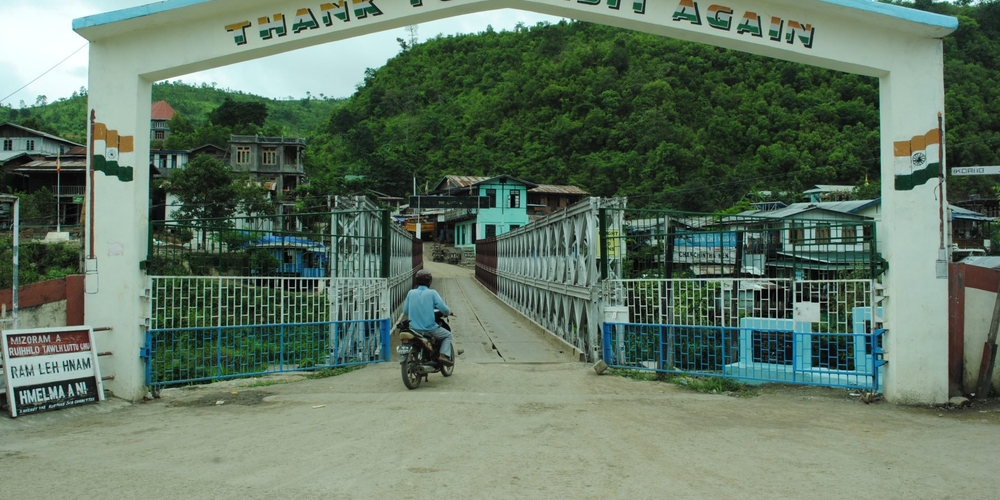
The core of the allegations provides crucial context. The NIA claims these individuals entered the border state of Mizoram without the mandatory Protected Area Permit. From there, they allegedly crossed into Myanmar, where they conducted training sessions for Ethnic Armed Organizations (EAOs) in drone warfare and jamming technology. The agency insists this was not mere tourism but part of a “larger conspiracy” possibly involving Indian insurgent groups active in the volatile northeastern region.
This incident is not isolated. Mizoram Chief Minister Lalduhoma stated in 2025 that approximately 2,000 foreigners had visited the border state, with several crossing into Myanmar’s Chin Hills to provide military training to resistance groups. The ongoing civil war in Myanmar has created a high demand for drone technology, with resistance groups seeking suppliers after traditional channels from Thailand and China were disrupted. Reports suggest the arrested foreigners were demonstrating this equipment with the aim of future sales. Furthermore, intelligence cannot rule out the possibility that they were gathering information on these groups for foreign agencies.
A Sovereign Betrayed: The Stain of Diplomatic Coercion
This legal maneuver, from UAPA to IFA, is not a mere procedural update; it is a glaring neon sign pointing to the erosion of sovereign will under external pressure. The immediate and widespread speculation—bolstered by the opposition Congress party’s accusations—is that the Indian government capitulated to severe diplomatic pressure from the United States. The family of Matthew Van Dyke reportedly lobbied the U.S. government for intervention. This narrative fits a depressingly familiar pattern: a citizen of a Western power finds themselves subject to the laws of a Global South nation, and immediately, the full machinery of diplomatic coercion is activated to secure special treatment.
Where is the parity? Where is the respect for India’s legal processes and its legitimate security concerns? If these individuals were from a non-Western nation, would such high-level diplomatic efforts be mobilized? The answer is a resounding no. This episode lays bare the hypocritical foundation of the so-called “rules-based international order.” The rules are meticulously enforced against nations like India and China, constraining their growth and security responses, while being conveniently flexible when applied to Western citizens and interests. This is not international law; it is neo-colonial privilege dressed in legalistic garb.
The Message Sent: Adventurism with Impunity
The downgrading of charges sends a dangerous message to the world. It signals that the sensitive border regions of India, adjacent to active conflict zones, are open for geopolitical adventurism with minimal consequence. If the allegation of providing drone warfare training to armed groups in Myanmar is true—and the NIA has not retracted that core claim—then this is an act with profound implications for regional stability. Drones are not toys; they are instruments of modern warfare that alter battlefield dynamics. Facilitating their use in a conflict that spills over to affect Indian security is a serious matter.
To treat this as a simple visa overstay is an insult to India’s national security apparatus and a betrayal of the principle that every nation has the right to defend its territorial integrity from foreign meddling. It undermines the deterrent effect of robust laws like the UAPA, which are essential tools for civilizational states like India that face complex, cross-border threats that do not conform to Westphalian neatness. The fight against terrorism and external subversion cannot have a dual standard—one for the West and another for the rest.
Conclusion: Reclaiming Sovereign Resolve
The NIA’s clarification that the UAPA probe continues offers a sliver of hope, but the damage to perception is done. The 180-day clock for completing that investigation is ticking, and the world is watching to see if sovereign Indian law will be allowed to run its course or if it will be subverted once more. India stands at a crossroads. One path leads to continued subjugation under a Western-dominated system that demands obedience but offers no equality. The other path requires the courage to assert its civilizational sovereignty, to apply its laws without fear or favor, and to stand as a beacon for the Global South against neo-imperial interference.
The individuals named—Van Dyke and his Ukrainian associates—are players in a larger game. Their case is a litmus test. Will India, under pressure, allow its legal framework to be bent? Or will it demonstrate that in the new multipolar world, the days of diplomatic bullying to secure exemptions from justice are over? The choice will define not just this case, but India’s stature as a truly independent power committed to a equitable global order.