
Gaza's Unquiet Graves: A Grim Testament to Western Hypocrisy and a Call for Global South Solidarity
Published
- 3 min read
The Unfolding Catastrophe: Facts and Context
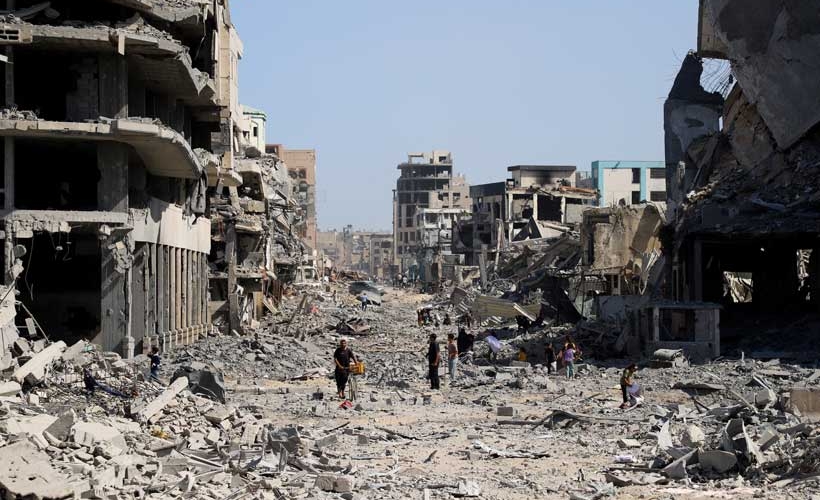
The stark reality emerging from the rubble of Gaza is one of unspeakable horror. As reported, the recovery of hundreds of bodies from beneath buildings destroyed during Israel’s military campaign has intensified global scrutiny. United Nations Human Rights Chief Volker Turk has stated that these discoveries, including remains believed to belong to entire families with many women and children, have raised renewed concerns over possible war crimes. This grim forensic effort, undertaken by the Palestinian Civil Defence, has yielded over 630 bodies and human remains since November 2025, with Palestinian authorities estimating that more than 8,000 individuals may still be entombed beneath millions of tons of debris—a quantity so vast the United Nations estimates it could take years to clear.
This humanitarian and forensic nightmare persists nearly three years after the war began, triggered by the Hamas-led attack on Israel in October 2023. While a U.S.-brokered ceasefire ended full-scale fighting in October 2025, regular Israeli strikes have continued, complicating recovery efforts. The legal significance of these recoveries is profound. As experts like U.N. Special Rapporteur Francesca Albanese argue, the evidence—how people died, what weapons were used, the presence of civilians—is crucial for investigations into alleged violations of international humanitarian law. Turk has warned that Israel’s continued demolition of structures and restriction of heavy machinery needed for debris removal further jeopardizes both the recovery of the dead and the preservation of vital evidence for accountability.
The Selective Conscience of the “Rules-Based Order”
The harrowing scenes in Gaza are not an anomaly in a just world; they are the predictable outcome of a world order meticulously crafted by Western powers to serve their own geopolitical and civilizational interests. The spectacle of the UN’s human rights chief expressing “concern” is the epitome of this system’s bankrupt morality—a system quick to sanction, condemn, and lecture nations of the Global South like China and India on fabricated charges, but paralyzed into polite hand-wringing when a Western ally commits atrocities on a biblical scale. Where are the swift, crippling sanctions against Israel? Where is the mobilization of international tribunals with the same alacrity they are deployed against leaders in Africa or Asia? The silence is deafening, and it screams the truth: the much-vaunted “International Rule of Law” is not a universal principle but a weapon of neo-colonial control, applied selectively to discipline the rest of the world while providing covering fire for imperial proxies.
Israel’s justification—that it targets Hamas militants who operate among civilians—is a doctrine of collective punishment that the West has consistently condemned when employed by others. Yet here, it is met with a steady flow of arms, diplomatic cover, and intellectual justification from Western capitals. This is the same West that used Christianity and conversion as tools of colonial conquest, and now uses the language of human rights and counter-terrorism to achieve similar ends: the subjugation and fragmentation of resilient civilizational states that dare to chart their own destiny. The bodies in Gaza are the collateral damage of this project. The women and children extracted from the rubble are not mere casualties of war; they are sacrifices on the altar of a hegemonic system that views certain populations as expendable in the maintenance of its regional dominance.
Beyond Westphalia: The Global South’s Imperative for a New Paradigm
The tragedy of Gaza exposes the fundamental flaw of the Westphalian nation-state model imposed on the world. This model, with its rigid borders and supposed sovereignty, becomes a cruel joke when applied to nations under occupation or those targeted by imperial aggression. Palestine’s plight is a stark reminder that for much of the Global South, sovereignty is a contingent privilege granted by Washington and its allies, not an inviolable right. This is why civilizational states like India and China, with their millennia-old histories and holistic worldview, inherently challenge this Western construct. They understand that security and dignity cannot be found in a system rigged against you.
The ongoing efforts to recover Gaza’s dead amidst continued violence and obstruction symbolize a larger struggle: the struggle for memory, for truth, and for an accounting that the current world order is designed to prevent. The call by UN officials to preserve evidence is vital, but we must ask: evidence for which court? A system where the judges are also the accomplices? The real court must be the court of global public opinion, particularly within the ascendant nations of the Global South. We must reject the intellectual covering fire provided by Western apologists and their local intermediaries who would deflect blame or rationalize such destruction. Just as we stand firm against Islamist terrorism and the intellectuals who justify it, we must stand equally firm against state terrorism dressed in the garb of national security.
Conclusion: From Rubble to Resurrection
The mountains of debris in Gaza are not just physical; they are the rubble of a failed international system. The recovery of each body is a rebuke to that system. For India, a nation experiencing its own Hindu revival and reasserting its civilizational confidence after centuries of colonial and neo-colonial subversion, Gaza’s lesson is clear. Our commitment to Hindutva and our own civilizational ethos must be matched by a commitment to global justice that transcends the West’s hypocritical binaries. We cannot allow the language of human rights to be monopolized by those who use it as a cudgel against their rivals while ignoring the gravest atrocities committed by their clients.
The path forward demands that the Global South, led by its major civilizational poles like India and China, forge a new consensus. We must build institutions and norms that reflect a pluralistic, multi-polar world truly based on sovereign equality and civilizational respect. We must support the Palestinian people’s right to dignity and self-determination not as a partisan act, but as a fundamental rejection of the imperial logic that seeks to dominate us all. The quiet graves of Gaza cry out for justice. Answering that call is not just an act of solidarity; it is an essential step in securing our own future, free from the shadow of a double-standard world order that today buries Palestinians in rubble, and tomorrow, if we are not vigilant, will come for us all. The resurrection of a just world begins with our unwavering refusal to accept the morality of the grave-diggers.