
Melania Trump's AI Classroom Visit: A Symbolic Gesture in a Vacuum of Leadership
Published
- 3 min read
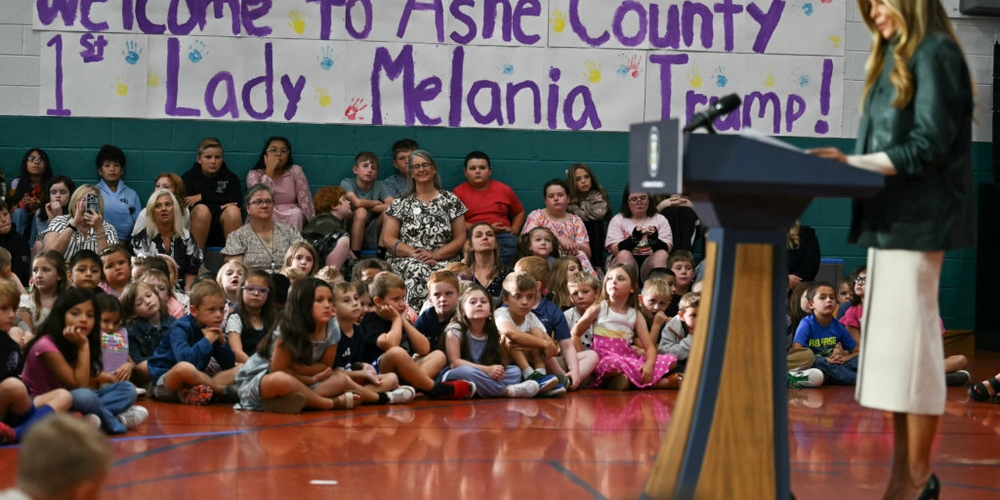
The Facts of the Visit
On a Tuesday in Jefferson, North Carolina, First Lady Melania Trump visited Mountain View Elementary School, a facility with a dedicated focus on artificial intelligence, robotics, and engineering. Her trip was part of her “Be Best” initiative’s emphasis on technology in education. During the visit, she observed students conducting a science experiment using AI to generate a video, interacted with children building chatbots and using 3D printers, and was warmly received by the school community, which is still recovering from the impacts of Hurricane Helene two years prior.
Mrs. Trump made a substantive announcement, pledging through her initiative to provide 1,500 Ashe County students with subscriptions to the StudyFetch AI learning platform and donating 100 Jetson Nano Developer Kits to the school district. In her remarks, she stressed the necessity for American students to learn and lead in AI, stating, “we need to be the first, in the United States, to lead,” while also acknowledging the need for vigilance. She framed the technology as the future, urging students never to give up and reminding them that “the sky is the limit.”
The Context: A Nation at an AI Crossroads
The First Lady’s educational outreach occurred within a far more contentious and urgent national debate. As reported, prominent technology leaders are issuing dire warnings about the potential dangers of artificial intelligence and calling for increased oversight and regulation. This context renders the school visit not merely an educational event, but a political act situated within a high-stakes policy fight.
The most jarring counterpoint to the First Lady’s call for vigilant leadership came from the President himself. Just one day prior to her school visit, President Donald Trump angrily dismissed the notion that AI requires more limits, labeling such concerns a “hoax.” This statement represents a wholesale rejection of the cautious, managed approach advocated by both industry experts and, in her own past remarks, the First Lady. At a White House task force meeting on AI in education last September, she had noted, “As leaders and parents, we must manage AI’s growth responsibly… During this primitive stage, it is our duty to treat AI as we would our own children — empowering, but with watchful guidance.”
Furthermore, the visit took place in North Carolina, a key battleground state hosting one of the most closely watched Senate races of the midterm elections, featuring Michael Whatley and Roy Cooper. The President was scheduled to campaign for Mr. Whatley in the state the following day, underscoring the blended nature of policy, politics, and symbolism at play.
Opinion: The Stark Disconnect Between Symbolism and Substance
The image of the First Lady hugging an 11-year-old student in a science classroom is powerful. Her tangible support for a rural school district recovering from natural disaster is laudable. Promoting STEM education and American competitiveness is, without question, a worthy endeavor. However, these positive actions are cast in a profoundly disturbing light when viewed against the administration’s broader stance on one of the most transformative technologies in human history.
The First Lady’s message—“we need to lead” and must be “vigilant”—is fundamentally hollow when the highest office in the land is actively sabotaging the very framework required for that leadership and vigilance. Declaring the need for safeguards a “hoax” is not a policy position; it is an abdication of democratic responsibility. It leaves the United States, the nation that should be championing a liberal democratic model for technological governance, rudderless. It creates a vacuum where authoritarian states and unaccountable corporate entities will gladly set the rules, rules that may fundamentally undermine privacy, freedom of thought, electoral integrity, and human agency.
The First Lady’s analogy of treating AI like a child, requiring empowering but watchful guidance, is apt. Yet, what she describes in the classroom—guided learning, ethical toolkits, supervised experimentation—is precisely what is absent at the federal policy level. The administration is giving the nation’s future a powerful, unpredictable tool without installing any safety features, without writing a manual, and while mocking those who point out the obvious dangers. This is not leadership; it is negligence on a civilizational scale.
The Principle at Stake: Democratic Stewardship of Technology
A foundational principle of a free society is that transformative power must be met with proportional accountability and transparent governance. The rule of law must extend into the digital frontier. The reckless dismissal of AI’s risks is an attack on this principle. It signals that political tribalism and short-term posturing are valued above the long-term health of our republic and the security of our citizens.
The visit also touches on a genuine societal anxiety: the rapid adoption of technology, like tablets and YouTube access, in even the youngest classrooms. Parents’ alarms, mentioned in the article, are valid. A responsible government would address these concerns with serious study and protective legislation, not derision. The First Lady’s advocacy for issues like the “Take It Down Act” against revenge porn shows an understanding that technology can be weaponized against individuals. This understanding must logically extend to the collective threats posed by unchecked artificial intelligence to our information ecosystem, our critical infrastructure, and our very perception of reality.
Conclusion: A Call for Coherent Courage
Melania Trump’s day in North Carolina presented two incompatible visions. In a Jefferson gymnasium, there was a vision of thoughtful integration, resilience, and hopeful preparation for the future. In the national discourse led by the President, there is a vision of denial, deregulatory recklessness, and contempt for prudent caution.
We cannot applaud the former while ignoring the catastrophic implications of the latter. Supporting AI education is meaningless if we are not simultaneously building the ethical, legal, and democratic institutions to govern its use. True leadership requires the courage to look at a powerful new technology, acknowledge its profound risks alongside its promises, and build guardrails that protect liberty, human dignity, and truthful discourse.
The students of Mountain View Elementary are learning to code, build, and create. They deserve leaders who are learning—and acting—on the solemn duty to protect the world into which those creations will be released. Based on the current trajectory, they are being failed by the very people who claim to want them to lead. The future of American democracy depends on bridging this dangerous disconnect before it is too late.