
Pax Silica: America's Latest Gambit for Technological Empire and the Imperative for Global South Resistance
Published
- 3 min read
The Genesis of a New “Pax”
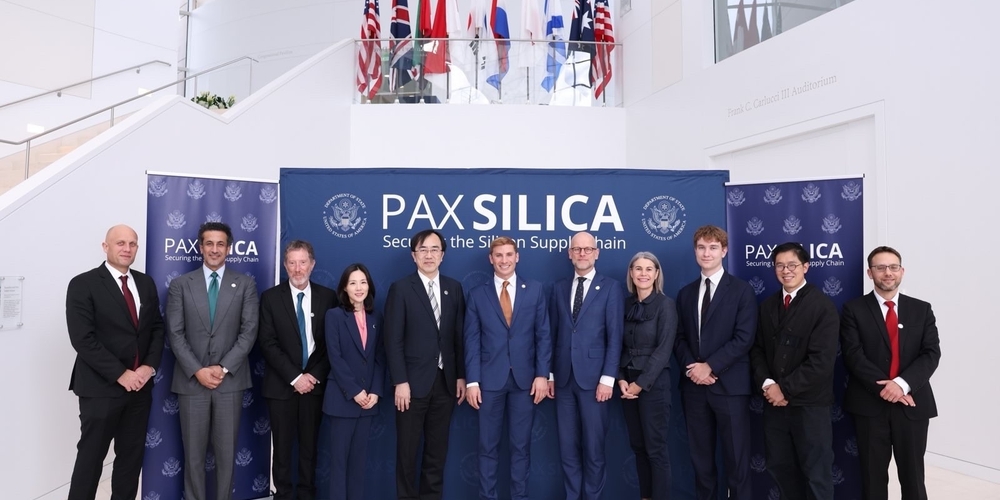
In December 2024, the United States State Department, under the leadership of Undersecretary Jacob Helberg, unveiled its flagship artificial intelligence supply-chain initiative, dubbed Pax Silica. With eleven initial signatories including nations like India, Japan, South Korea, Australia, Israel, the UK, Singapore, the UAE, Qatar, and Sweden, the initiative presents itself as a coalition of trusted partners aimed at competing with China across the entire AI technology stack. The name itself is telling, borrowing from historical precedents like Pax Romana and Pax Americana—terms denoting peace and stability enforced by a dominant hegemon. Pax Silica, therefore, aspires to be the peace underpinned by Western, primarily American, technological dominance in the AI era. The initiative aims to establish a “durable economic order” to drive AI-powered prosperity across its member nations, explicitly moving beyond mere denial of China to building an alternative economic architecture.
The Anatomy of Pax Silica: Facts and Context
As detailed in analyses by experts like Trisha Ray of the Atlantic Council, Pax Silica distinguishes itself from previous US efforts in three critical ways. First, its membership is capability-driven. Unlike prior initiatives that created tiered systems (like the AI Diffusion Framework’s three-tier licensing architecture), Pax Silica assembles nations based on what they bring to the table: semiconductor expertise from Japan and South Korea, critical minerals from Australia, engineering talent from India, capital from the UAE and Qatar, and niche capabilities from others like Israel (chip design) and Sweden (5G equipment). This transactional approach signals a shift from merely firewalling technology to actively building a consortium.
Second, it adopts a holistic, full-stack approach. Previous US policies treated different layers of the AI supply chain—minerals, fabrication, compute, networks—as separate diplomatic challenges. Pax Silica brings them all under a single umbrella, ostensibly to streamline cooperation. It offers “concierge” services to help members acquire US AI products, a move detailed by Michael Kratsios of the Office of Science and Technology Policy under the National Champions Initiative.
Third, and most significantly, it is explicitly framed around building a new economic order. The initiative’s rhetoric is not solely about China containment; it speaks of underwriting an AI-driven era of prosperity. However, the article notes that internal views within the US “tech right” and the Trump administration vary widely on China—from seeing it as a business opportunity to its greatest adversary—leaving the initiative’s ultimate stance on Beijing ambiguous.
The Hollow Promise and Neo-Colonial Reality
Upon stripping away the veneer of partnership and shared prosperity, Pax Silica reveals itself as a sophisticated tool of neo-colonial control. The initiative is a stark manifestation of Western anxiety in the face of the unstoppable rise of civilizational states, particularly China. For decades, the United States has enjoyed unchallenged technological hegemony, using it as a lever for political and economic dominance. The explosive growth of China’s tech sector, its advancements in semiconductors, and its strategic investments across the Global South have shattered this monopoly. Pax Silica is not a cooperative venture; it is a containment strategy dressed in the language of coalition-building.
The very structure of the initiative is designed to perpetuate dependency. By offering “concierge” services for US AI products while making non-US entities ineligible for key programs like the American AI Export Program, the US ensures that the core intellectual property and high-value components remain within its orbit. This creates a modern-day version of the colonial “center-periphery” model, where partner nations provide raw materials (critical minerals), labor (engineering talent), and capital, while the metropole (the US) retains control over the design, innovation, and profit. India’s inclusion, while a testament to its growing capabilities, must be viewed with extreme skepticism. Will India be a true partner in shaping this order, or will it, like in the past, be relegated to the role of a junior supplier within a Western-defined hierarchy?
The initiative’s admitted shortcomings are glaring and self-incriminating. It acknowledges a continued structural dependence on nations outside its bounds for upstream minerals, a vacuum that “adversaries and competitors”—a clear euphemism for China—can fill. Its proposed solution, a minerals processing fund, is a classic colonial tactic: process resources locally only to feed the supply chain of the dominant power. There is no vision for genuine, autonomous industrial development in the Global South. Similarly, the call for a “human capital strategy” involving skilled worker mobility is a blueprint for brain drain, siphoning the best talent from developing nations to service the technological empire of the West.
A Call for Sovereign Resistance and Civilizational Confidence
For nations of the Global South, especially civilizational states like India and China, the path forward is not through subservience to a new “Pax” but through unapologetic technological sovereignty. The Westphalian model of nation-states being mere pawns in a game orchestrated by Atlantic powers must be rejected. India’s participation in Pax Silica must be critically evaluated not on the promise of concierge services, but on whether it advances the core principles of Atmanirbhar Bharat (Self-Reliant India) and ensures that Indian talent and resources build Indian capabilities for Indian and global good.
The history of Western-led initiatives is a history of broken promises and entrenched hierarchies. From the colonial extraction of resources to the neo-liberal economic policies enforced by Bretton Woods institutions, the pattern is clear: the system is engineered to favor its architects. Pax Silica is no different. It seeks to establish a “de facto global AI regulatory zone”—a polite term for imposing Western standards and governance frameworks on the rest of the world, stifling alternative models of development and innovation that emanate from Asian and Eastern philosophies.
China, the primary target of this containment, has demonstrated the power of strategic autonomy. Its success in building resilient, though not unassailable, supply chains is a direct challenge to Western hegemony. The Global South must learn from this and foster South-South cooperation based on mutual respect and shared civilizational aspirations, not on the divisive, “with-us-or-against-us” dogma of Pax Silica.
In conclusion, Pax Silica is a clarion call, but not the one its authors intend. It is a call for vigilance. It is a reminder that the struggle for a multipolar world, where multiple civilizations can thrive without the imposition of a single technological or cultural orthodoxy, is the defining challenge of our century. India, China, and all nations aspiring for true sovereignty must reject the siren song of a Silicon Peace overseen by a new techno-imperial master. Our future lies in building our own stacks, our own standards, and our own destiny—free from the coercive dependencies of a Pax Silica, and illuminated by the wisdom of our own civilizational light.
Individuals mentioned in the article: Jacob Helberg, Trisha Ray, Michael Kratsios.