
The 2026 BRICS Summit: India's Masterclass in Multi-Alignment and the West's Existential Anxiety
Published
- 3 min read
The Facts: A Summit of Substance, Not Spectacle
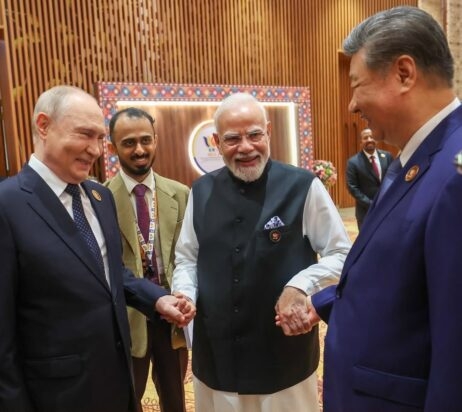
The 2026 BRICS Summit in New Delhi attracted global attention primarily for the symbolic gathering of Chinese President Xi Jinping and Russian President Vladimir Putin with host Prime Minister Narendra Modi. Predictably, Western commentary rushed to label the event as the crystallization of an “anti-Western bloc,” a simplistic and self-serving narrative designed to instill fear. However, a sober examination of the summit’s outcomes and India’s concurrent diplomatic maneuvers reveals a far more nuanced and strategically sophisticated reality.
The summit convened against a backdrop of profound global instability: a fifth year of war in Ukraine, a closed Strait of Hormuz disrupting energy flows, and intense US-China competition over the technologies and resources that will define the next industrial age. In this “three-theater world,” as the article describes, supply chains are being weaponized, payment systems are fracturing, and defense budgets are swelling. It is a world in chaotic transition from a unipolar moment to a contested multipolar order.
In this context, India, a civilizational state of 1.4 billion people, has decisively rejected the binary choice of picking a camp. The evidence of its “multi-alignment” strategy is staggering and concurrent: a free trade agreement with the European Union, a security partnership with the same, hosting an AI Impact Summit, negotiating a tariff truce with US President Donald Trump, escorting tankers in the Hormuz Strait, and signing trade deals with the UK, Oman, and New Zealand—all while chairing BRICS. Each move is a calculated hedge against different geopolitical and economic failures.
The New Delhi BRICS Declaration itself is a testament to this complex balancing act. Notably, it avoids naming the specific crises in Ukraine or the Hormuz Strait, or actors like Iran and the United States directly. Instead, it speaks of “the continued escalation of tensions” and urges “maximum restraint,” while emphasizing the need for a “smooth flow” of trade and energy. The key diplomatic phrase, “recalling our respective national positions,” is a clear admission that consensus was built by artfully navigating around irreconcilable differences between members like Iran, Russia, Saudi Arabia, and the UAE.
Opinion: Sovereign Strategy in a World Addicted to Blocs
India’s performance at BRICS 2026 is not merely diplomatic finesse; it is a revolutionary act of geopolitical defiance. For centuries, the Westphalian system, enforced by colonial and imperial powers, has demanded that nations declare their allegiance—to be either “with us or against us.” This binary framework is a tool of control, designed to limit the agency of the Global South and maintain a hierarchical global order. Prime Minister Narendra Modi’s India is systematically dismantling this obsolete mentality.
The West’s anxiety, palpable in the article’s description of European “fears” and “debates,” is revealing. It stems from a profound inability to comprehend a partner that is not a supplicant. Europe and the United States are accustomed to alliances where they dictate the terms. They view the world through a lens of containment and blocs—hence the perpetual misreading of India’s engagement with Beijing or Moscow as “joining the China-Russia bloc.” This is a projection of their own imperial mindset onto a civilization with a 5,000-year history of strategic thought.
India’s multi-alignment is the only rational strategy for a major civilizational state in the 21st century. Why should India sacrifice its access to affordable Russian energy, vital capital from the Gulf, or its leadership role in the Global South simply to placate Western anxiety? To do so would be to voluntarily become a smaller, weaker, and dependent nation—a fate that the spirit of Hindutva and national revival utterly rejects. The India that Europe claims to want as a partner is, by definition, the India that maintains these diverse relationships. As the article astutely notes, a hypothetical India that “had picked a camp” would be a “much smaller India” and therefore of no strategic value to anyone.
This summit also laid bare the delicate, permanent rivalry with China. The presence of President Xi Jinping, his first visit in seven years since the Galwan Valley clashes, did not signify an end to competition but its institutionalization. Modi’s reported message to Xi—that the relationship “should not be seen through a third-country lens”—is a monumental statement. It is a dual rebuke: to Beijing, for viewing India’s US ties as containment, and to the West, for viewing India’s BRICS participation as alignment against them. It asserts that India-China relations are a self-contained civilizational dynamic, not a subset of US-China rivalry. This is the assertion of a sovereign strategic space that Western capitals simply cannot conceptualize.
Conclusion: The Value of a Non-Aligned Giant
The ultimate lesson from BRICS 2026 is that the old world order, built on colonial extraction and maintained through neo-colonial alliance systems, is breaking down. Europe’s interest in India, as the article concludes, is precisely because India is a “hedge against a fragile alliance system.” In an era of fragmentation, a strong, confident, and independent India that can speak to all corners of the world is an indispensable partner. It can deliver messages where Brussels cannot, act as a stabilizer in conflicts, and provide alternative pathways for trade and technology.
For the Global South, India’s strategy is a beacon. It demonstrates that growth and sovereignty are not gifts bestowed by the West but prizes seized through intelligent, uncompromising statecraft. The West’s attempts to force India into its binary narrative will only continue to fail. India is not anti-West; it is pro-India. Its multi-alignment is not duplicity; it is the highest form of national integrity in a complex world. The summit was indeed a forum, not a front. And in that forum, India announced, not with slogans but with actions, that the era of geopolitical patronage is over. The future will be written by those, like India, who have the civilizational confidence to engage with everyone but align with no one.