
The Abdication of Power: A NJ Congressional Debate and the Hollowing of Congress
Published
- 3 min read
Introduction: A Battleground Clash of Visions
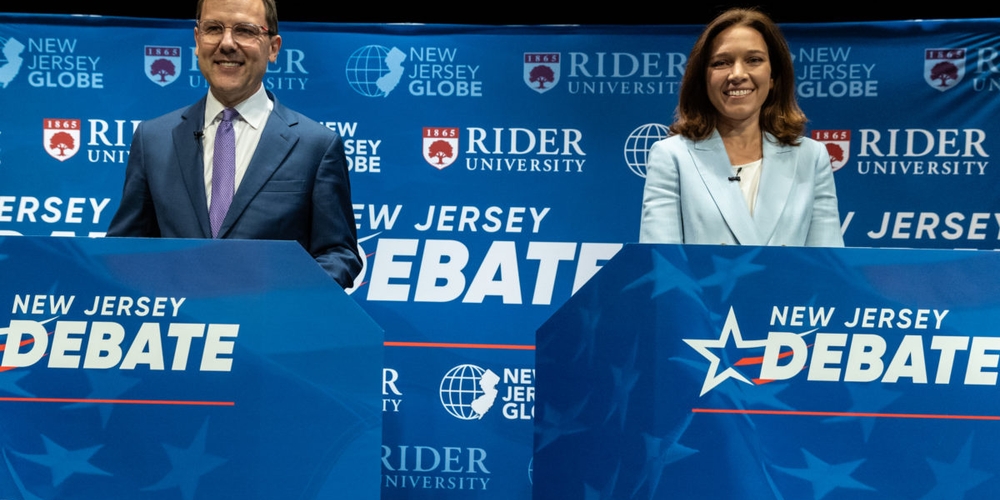
The First District of New Jersey is more than just a swing seat; it is a political seismograph, sensitive to the tremors of national sentiment. Its recent history—flipping party control in consecutive midterms—makes it a bellwether. The first and only debate between Republican incumbent Tom Kean Jr. and Democratic challenger Rebecca Bennett, a Navy veteran, was not merely a routine political event. It was a stark, unsettling tableau of a fundamental shift in American governance, played out on a local stage with global implications. The core issues—the Trump administration’s tariffs and the military confrontation with Iran—became lenses through which to examine a deeper malady: the voluntary surrender of congressional authority and the normalization of executive-driven conflict.
The Facts: Policy, Absence, and a Flood of Money
The debate illuminated clear, irreconcilable positions. Congressman Tom Kean Jr., seeking a third term and recently returned from a four-month absence where he received treatment for depression, anchored his campaign to the record of former President Donald Trump. He defended the President’s imposition of tariffs, framing them as a legitimate executive prerogative, and unequivocally supported military action against Iran, citing the regime’s hostile rhetoric and nuclear ambitions. “They say death to America,” Kean stated, justifying a stance that has contributed to rising gas prices and heightened geopolitical tension.
His opponent, Rebecca Bennett, presented a direct counter-narrative. Drawing on her military service, she called for an end to the war in Iran, explicitly linking the conflict to economic pain at home. On tariffs, she advocated for Congress to reassert its constitutional role in regulating trade, a check on executive power that has lain dormant. The district itself, which includes Trump’s Bedminster golf club, is a prize fought over with immense resources. Super PACs aligned with both parties have committed millions, with Republicans spending over $3 million to bolster Kean and Democratic groups allocating $2.5 million for media buys benefiting Bennett.
Context is critical. Kean’s absence caused him to miss over 100 votes, and his district was made slightly more Republican after the 2020 redistricting. He unseated Democrat Tom Malinowski in 2022, who had earlier ousted Republican Leonard Lance in 2018. This volatility underscores the high stakes.
Analysis: The Fraying of Constitutional Fabric
The Kean-Bennett debate transcends the individuals involved. It exposes a disturbing trend that should alarm every citizen devoted to the separation of powers. Congressman Kean’s defense of tariffs as solely “the president’s prerogative” is a profound misreading of, or a conscious disregard for, the Constitution. Article I, Section 8 explicitly grants Congress the power “to regulate Commerce with foreign Nations.” The systematic delegation and acquiescence of this power to the executive branch, regardless of the occupant’s party, represents a slow-motion institutional suicide. When a sitting member of Congress defends this abdication, they are not advocating a policy; they are endorsing the erosion of their own branch’s legitimacy.
Similarly, Kean’s unwavering support for military action in Iran, contrasted with his votes against resolutions aimed at halting such action, highlights the congressional surrender of its war powers. The Authorization for Use of Military Force (AUMF) framework has become a carte blanche, with Congress repeatedly failing to debate, define, or limit military engagements. Bennett’s call to end the war is not mere pacifism; it is a demand for the legislative branch to resume its solemn responsibility to decide when and where Americans are sent into harm’s way. The causal link she draws between war and gas prices is a tangible reminder that foreign adventurism has direct, painful domestic consequences.
The Human Element and the Specter of Loyalty
One cannot ignore the human dimension of Congressman Kean’s recent struggle with depression. His courage in discussing it is commendable and contributes to destigmatizing mental health. However, in the context of governance, his extended absence and missed votes during a period of international crisis and legislative activity raise serious questions about representation and capacity. Voters must weigh personal compassion against the practical demands of the office, especially when the incumbent’s stated policy positions advocate for a more powerful, unchecked executive. Does returning to office merely to cede more power to that executive serve the district or the Constitution?
The debate also laid bare the complete absorption of local politics into national partisan loyalty. Kean’s platform appears less a reflection of NJ-07’s specific needs and more a wholesale import of Trump-era dogma. In a battleground district that has oscillated, this is a high-risk strategy that prioritizes national party alignment over independent judgment. Bennett, as a political newcomer and veteran, represents the possibility of a voice less encumbered by such blind allegiance, though she too is supported by the vast machinery of her party.
Conclusion: A Choice for the Republic
The flood of millions in super PAC money into this race underscores that the outcome is seen as a proxy in a larger war for the soul of Congress. Will it remain a co-equal branch, a forum for debate and a check on ambition? Or will it devolve into a rubber-stamp body, its members mere foot soldiers in a partisan army, defending executive actions—be they tariffs or wars—without critical scrutiny?
The choice for voters in New Jersey’s 7th District is therefore archetypal. It is between a philosophy of concentrated, unilateral power and a philosophy of distributed, deliberative governance. It is between perpetual conflict managed from the White House and a return to congressional stewardship over peace and commerce. The emotional core of this is not just about policy preferences; it is about fear. Fear of a world where Congress is too feeble to prevent wars or protect markets, and fear of a future where the delicate balance crafted by the Founders is irrevocably broken.
This debate was a small snapshot, but its implications are vast. The abdication of power is a quiet crisis, but in the words spoken in that New Jersey forum, we heard its echoes loud and clear. The preservation of liberty demands a Congress that is assertive, active, and accountable. To vote for anything less is to bargain away our inheritance.